


Chapter XI Modifications Of The Still-Head (continued)
Description
This section is from the book "Distillation Principles And Processes", by Sydney Young. Also available from Amazon: Distillation Principles And Processes.
Chapter XI Modifications Of The Still-Head (continued)
Bubbling Still-heads
In many of the still-heads employed on the large scale, for example the Coffey still (Fig. 68, p. 167) the condensed liquid is made, by means of suitable obstructions, to collect into shallow pools, and the ascending vapour has to force its way through these pools ; very good contact is thus brought about at definite intervals between vapour and liquid. The excess of liquid is carried back from pool to pool and finally to the still by suitable reflux tubes.
The "Linnemann" Still-head. - The first still-head constructed on this principle for use in the laboratory was devised by Linnemann.2 A number of cups of platinum gauze, a, were placed at different heights in the vertical tube (Fig. 48) and the liquid collected in these, but, as no reflux tubes were provided, the liquid gradually accumulated in the still-head until the quantity became unmanageable, when the distillation had to be discontinued until the liquid flowed back to the still. There was thus much waste of time, and increased loss of material by evaporation, and it was impossible to make an accurate record of the temperature.
In the more recent forms of bubbling still-head, reflux tubes are provided, and it is on the size and arrangement of these tubes that the efficiency and usefulness of the still-heads chiefly depends.
The "Glinsky" Still-head. - The Glinsky still-head3 has only one reflux tube, which carries the excess of liquid from the large bulb to the tube below the lowest obstruction, practically back to the still.
1 When a description of the still-head devised by G. L. Thomas and the author was first published in the Chemical News (1895, 71, 177) the term "dephlegmator" was adopted to distinguish this form of still-head from others such as the "Wurtz" and " Hempel," in which no bubbling through pools of condensed liquid takes place. The term was retained in the paper on still-heads published in 1899 in the Trans. Chem. Soc. (75, 679) and in Fractional Distillation (Macmillan, 1903). The word is, however, very loosely used in the literature, and Mr. Kewley has kindly looked up a considerable number of references, from which it would appear that it is most correctly employed to denote the small condenser placed above a fractionating column to return a sufficient amount of condensed liquid to the uppermost section of the column. It is therefore thought best to adopt the term " bubbling column," used by Mariller in La Distillation Fractionnee, in place of "dephlegmator."
2 Linnemann, " On a Substantial Improvement in the Methods of Fractional Distillation," Liebigs Annalen, 1871, 160, 195.
3 Glinsky, "An Improved Apparatus for Fractional Distillation," Liebigs Annalen, 1875, 175, 381.
In its original form (Fig. 49), the dephlegmator otherwise resembled the Linnemann still-head very closely, but, as now constructed, there are bulbs on the vertical tube, and spherical glass beads, instead of platinum cups, rest on the constrictions between the bulbs.
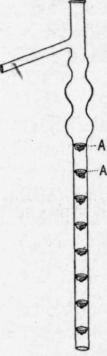
Fig. 48. - The "Linnemann" still-head.

Fig. 49. - The "Glinsky " still-head.

Fig. 50. - The "Le Bel-Henninger" still-head.
The "Le Bel-Henninger "Still-head. - In the Le Bel-Henninger apparatus 1 the obstruction is usually caused by placing platinum cones on the constrictions between bulbs blown on the vertical tube ; each bulb is connected by a reflux tube with the one below it (Fig. 50) so that the liquid is carried back from bulb to bulb and not straight to the still.
In these still-heads, unlike that of Coffey, the reflux tubes are external, and the returning liquid is thus exposed to the cooling action of the air. The still-heads of Brown,2 and of Young and Thomas,3 4 follow the principle of the Coffey still more closely, the reflux tubes being much shorter and being heated by the ascending vapour.
The "Young and Thomas" Still-head. - The Young and Thomas still-head 5 is shown in Fig. 51 a, b, and c. It consists of a long, glass tube of about 17 mm. internal diameter, with the usual narrow side delivery tube. In the wide tube are sharp constrictions, on which rest concave rings of platinum gauze, r, previously softened by being heated to redness, and these support small, glass reflux tubes, t, of the form shown in Fig. 51 b. The upper and wider part of the reflux tube has an internal diameter of 4.5 mm., the narrow U -shaped part, which serves as a trap, an internal diameter of 3 mm.; if, however, the number of constrictions exceeds 10 or 12, the traps for the lower reflux tubes should be slightly wider, say, 3.5 mm. The length of the reflux tubes should be about 45 mm., and the distance between two constrictions about 60 to 65 mm. The enlargement, a, on the reflux tube prevents it from slipping through the ring if the tube is inverted, and the reflux tube and ring together are prevented from falling out of position by the five internal projections (made by heating the glass with a fine blow-pipe flame and pressing it inwards with a carbon pencil), one of which, b, is shown in Fig. 51 b. A horizontal section through the tube at b is shown in Fig. 51 c.
1 Le Bel and Henninger, "On Improved Apparatus for Fractional Distillation," Berl. Berichte, 1874, 7, 1084.
2 Brown, "The Comparative Value of Different Methods of Fractional Distillation," Trans. Chem. Soc, 1880, 37, 49.
3 Young and Thomas, " A Dephlegmator for Fractional Distillation in the Laboratory," Chem. News, 1895, 71, 117.
4 Young, " The Relative Efficiency and Usefulness of Various Forms of Still-head for Fractional Distillation," Trans. Chem. Soc, 1899, 75, 679. 5 Loc. cit.

Fig. 51. - The " Young and Thomas " dephlegmator.
Comparison of Bubbling Still-heads.1 - On comparing the efficiency of the three still-heads - each of three sections - it was found that when a large quantity (400 grams) of the mixture of benzene and toluene was distilled, the Le Bel-Henninger still-head gave slightly better results than the Young and Thomas, and both of these distinctly better results than the Glinsky. On distilling 50 grams of the mixture, the Young and Thomas still-head was found to be the best; with the Le Bel-Henninger tube the residual toluene was not quite pure, and with the Glinsky it contained a quite appreciable amount of benzene, although the temperature reached 110.6° in all three cases.
With 25 grams of the mixture the differences in efficiency were much accentuated, and it was only with the Young and Thomas still-head that the temperature reached 110.6°, though even in this case the toluene was not quite pure. The highest temperature reached with the Glinsky still-head was 107.6°, and with the Le Bel-Henninger, 107.35°, but the residual toluene was far less pure in the former case, for, on distillation from a small bulb, the Glinsky residue came over between 102.2° and 110.4°, and the Le Bel-Henninger from 105.7° to 110.6°, and the Young and Thomas from 110.4° to 110.6°.
With the "rod and disc," the "pear" and the "evaporator" (3 and 5 sections) still-heads, nearly as good results were obtained with 25 as with 50 or more grams of the mixture, and in all these cases the residual toluene was quite pure.
It will thus be seen that, for small quantities of liquid, the Young and Thomas still-head gives better results than the Glinsky or Le Bel-Henninger, but that none of them are so satisfactory as the other forms of still-head.
The relative efficiency of the three bubbling still-heads when 400 and 25 grams, respectively, of the mixture were distilled, and the effect of increasing the number of sections in the case of the Young and Thomas still-head, are shown in Table 53. The results in the last column were obtained by taking the distillation at only half the usual rate. In this case, 42.6 out of the 50 grams of toluene were recovered in a pure state in the single distillation, and 33.7 grams of benzene were obtained with a temperature range of only 0.5°.
1 Young, loc. cit.
Continue to:


My Books

