


Distillation. Part 3
Description
This section is from the book "Distillation Principles And Processes", by Sydney Young. Also available from Amazon: Distillation Principles And Processes.
Distillation. Part 3
Shape Of Still
The shape of the vats is usually cylindrical or nearly so, of slightly less diameter at the top than at the bottom; they are built up of staves held in place by bands of iron after the manner of a barrel. The taper produced by the varying diameter assists in keeping the iron bands in position and preventing leaks.
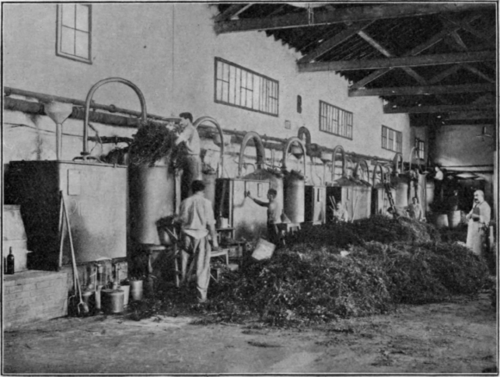
Fig. 198. - Tombarel Freres, Grasse.
In America, for distilling a brushwood such as birch, cedar, or spruce, the wooden still is of an oblong, rectangular shape, this shape permitting the branches to be laid in without cutting them into short lengths.1
The exact shape of a still is usually not of very great importance and it depends largely on the mechanical facilities that may be available. A spherical still is the most economical as regards loss of heat by radiation, but the constructional difficulties are excessive.
French Distillery for Peppermint, etc. - A useful type of still, largely used in South France, is shown in Fig. 198.2 The stills are in use for peppermint, a heap of which can be seen in the foreground. The herb is introduced into the still by way of the manhole at the top, and the exhausted charge is removed through a similar manhole in the side and near the bottom of the still; this latter manhole protrudes through the wall behind the still, so that the exhausted charge is discharged into a yard outside the still room, thus avoiding dirt and disorder. These stills are of general utility and are regularly used for roses, lavender, geranium, peppermint, rosemary, etc.
1 Information kindly supplied by Chas. V. Spar hawk, N.Y.
2 By kind permission of Messrs. Tombarel Freres, Grasse.
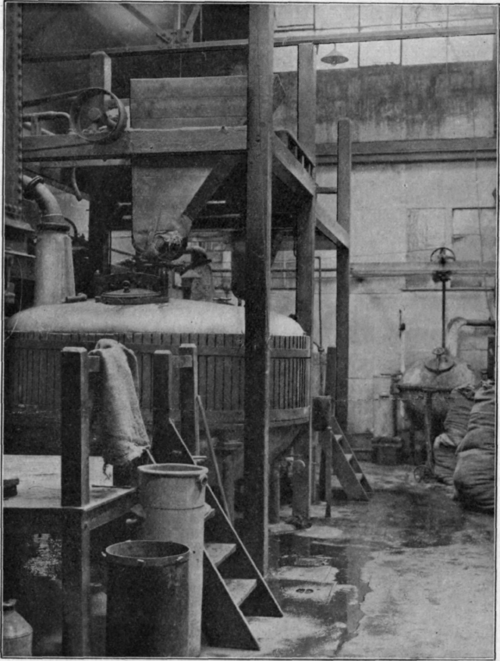
Fig. 199. - Stafford Allen & Sons, Ltd., Long Melford,.
The relative height and diameter of the still will depend on the porosity of the material with which it has to deal; if the charge be of an "open " character its depth may be considerable, but if of a close texture too great a depth should be avoided.
Shallow Still For Powders
For powders or similar material a shallow type of still is the best, being operated with boiling water instead of live steam.
Fig. 199 shows a well designed still of this type used by Messrs.
Stafford Allen & Sons, Ltd. The following points -are worthy of notice :
1. The large diameter of the still compared with its height.
2. The careful lagging of the still so as to avoid loss of heat by radiation.
3. The overhead hopper by means of which the charge is introduced into the still.
Stills For Orris And Almonds
Stills of radically different designs to the above are used in the south of France for distilling orris and almonds, both of which are reduced to a fine powder before distillation.
The methods involved in the production of these two oils are unique and of considerable interest. It will be well to deal with them at this point.
Oil Of Bitter Almonds
In the case of oil of bitter almonds, so called in order to distinguish it from the non-volatile sweet oil of almonds, the almonds have first to be crushed and submitted to an enzymic fermentation for the purpose of generating the volatile oil. The method adopted in the south of France is to crush them by means of large stone edge-runners ; these edge-runners develop no sensible heat and deal quite efficiently with the material. After crushing and before distilling it is necessary to extract the fixed oil, which consists mainly of the glycerine esters of oleic and linoleic acids, and is practically non-volatile.
Hydraulic Press
For this purpose hydraulic presses of the open type are used, the meal being placed in a number of square bags made of camel hair; these bags withstand very well the strain due to the great pressure employed. The yield of fixed oil varies from 38 to 50 per cent. A more modern and improved press is the Anglo-American oil press, a photo of which (Fig. 200) is shown. This press does away with the necessity of using the costly camel-hair bags, and in consequence allows a larger quantity of material to be pressed at one time. The press illustrated has a 16-inch ram and can treat nearly three hundredweight of material at one charge ; the pressure employed is 2 tons per square inch.
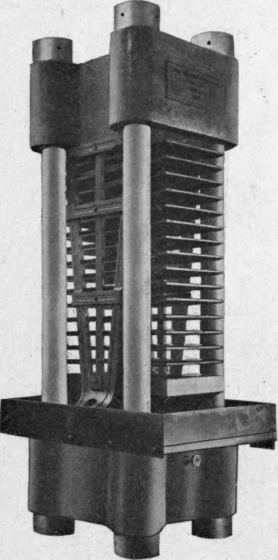
Fig. 200. Rose, Downs & Thompson, Hull.
Fermentation
After "drawing" the fixed oil in this manner, the press cakes - which are odourless - are broken up and placed in a still with cold or lukewarm water and there allowed to ferment for about twenty-four hours at a temperature not exceeding 40° C. During the process benzaldehyde is liberated by the action of the enzyme ferment, emulsin, on the glucoside amygdalin, glucose and hydrocyanic acid also being formed.
Distillation
The stills used for this purpose are conical in shape, the apex of the cone being at the bottom and being provided with a tap.
Live steam is the only heating medium employed, the distillation being of comparatively short duration on account of the relatively high vapour pressure of the benzaldehyde. A diagrammatic sketch of the type of still in use at Grasse is shown in Fig. 201.
In this process one of the products of the fermentation is the highly poisonous prussic acid which comes over mainly at the start of the distillation ; this can be rendered innocuous by employing a closed receiver provided with a pipe to lead away the gas to some place where it can be safely discharged into the atmosphere. The prussic acid may alternatively be absorbed by placing a mixture of slaked lime and ferrous sulphate in the still. For every 100 lb. of almond meal there is required at least 6 oz. of slaked lime and 8 oz. of ferrous sulphate crystals. In order to remove the last traces of prussic acid, the oil from the distillate should be thoroughly agitated with a similar mixture and water.
Continue to:


My Books

