


5. Phosphorus Extraction
Description
This section is from the book "A Practical Treatise On The Fabrication Of Matches, Gun Cotton, Colored Fires And Fulminating Powders", by H. Dussauce. Also available from Amazon: A Practical Treatise on the Fabrication of Matches, Gun Cotton, Colored Fires and Fulminating Powder.
5. Phosphorus Extraction
Phosphorus is extracted from calcined bones, which have been heated to the red heat in contact with the air, so as completely to destroy the organic matter. This combustion can easily be made in a lime-kiln. This kiln is surmounted with a reverse cone, terminated by a pipe, more or less long, so that the gases can be directed into a chimney.
Oven
A particular disposition which permits an avoidance of the disagreeablo odor, and renders the operation more economical in burning all the gases, is indicated in Fig. 1.
Fig. 1.
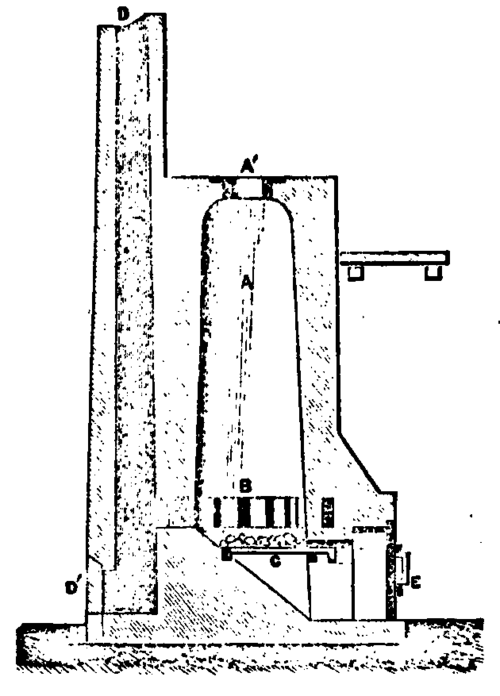
This disposition consists in a cylindrical oven, A. The upper aperture of which, A' is narrow and provided with a cast iron muff; near the lower part, the aperture B is put in communication with the body of the furnace with a circular gallery leading to the chimney D; a grate C, supported by two transverse bars, which are fixed in the beginning of the operation, the door E being open. The grate is loaded with combustibles, which arc lighted under it. When the fire is well-lighted, shut the door 2?, and in the low part of the chimney D, by an aperture D', light a few handfuls of shavings to establish a draught. Shut the aperture D', when the flame passes by the aperture in the circular gallery, and thence into the chimney. Begin to load with bones, the organic matter of which accelerates the combustion which is complete; all the gaseous products passing through an incandescent mass. When the furnace is full, shut almost completely for a few minutes the upper mouth A' then withdraw the bars of the grate C, so that the burned bones fall on to the ground. After this operation, shut again the door E; fill the furnace with new bones, and from time to time extract the burned bones through the door E, which is shut immediately, and new bones are introduced by the aperture A'. The combustion is uninterrupted, and operated without any other combustible than the substance of the bones itself. The incombustible residue of this ope-ration is so formed: -
Sub-phosphate of lime • • • | 80 | to | 82 |
Carbonate of lime • • • • | 15 | to | 17 |
Sand ................................................ | 5 | to | 1 |
100 | 100 |
Pulverization Of The Bones
The burned bones are reduced to a fine powder, and passed through a sieve; the coarse powder is ground over again and again, until the whole is entirely powdered.
Decomposition By Sulphuric Acid
To produce this decomposition, that is, to transform the sub-phosphate of lime (8Ca03Ph05) into sulphate, and bi-phosphatc, and the carbonate of lime (CaOCO2) into sulphate of lime, use a quantity of sulphuric acid, equivalent to the lime contained in the bones, in excess of the quantity which could form a bi-phosphate of lime, that is, for 100 of powdered bones, 66 of concentrated sulphuric acid, or rather the equivalent = 100 in acid not concentrated, and marking 50°.
The operation is effected in a tub lined with lead. Pour, at first, twenty-five gallons of boiling water, then forty pounds of acid at 50°, in which you dilute by degrees, with a wooden spatula, forty pounds of powdered bones.. An effervescence is produced by the disengagement of carbonic acid gas. When the effervescence has stopped, begin four times a similar operation ; then you have in the tub, 160 pounds of bones decomposed by 160 pounds of acid, at 60°. The matter, while warm, must be stirred from time to time to favor the reaction. Leave 21 hours, stirring occasionally; leave it to rest 12 hours, and decant the clear liquid by a wooden tube, which leads it to the filters, and then into the evaporating pans.
Washing
Dilute the first settlement with a quantity of water equal to the first; leave it to settle, and use this liquid to pass it on five or six other deposits. By this way the washing liquors are saturated to 10 or 12° in the fifth or sixth barrel, while the first is exhausted by the successive additions of water. Take out the deposit, and begin another operation.
This methodical washing can be substituted by a methodical filtration, in barrels provided each with a double bottom, and covered with a cloth.
All the solutions being saturated enough, are concentrated to 24°, and are put into a leaden vessel, in which the sulphate of lime, rendered insoluble by the concentration, is deposited.
Decant the liquid, which runs through a flannel filter to eliminate the sulphate of lime. Evaporate till it marks 33°. Leave it to settle, and decant anew.
Concentration - Mixing - Desiccation
The filtration being completed, evaporate to syrupy consistence till the liquid marks 50°. This syrup, mixed with 20 per cent of its weight of finely powdered charcoal, is submitted to a last evaporation till completely dry, in a cast-iron kettle, heated brown red, and stirring all the time.
The excess of sulphuric acid decomposed by the carbon disengages a large quantity of sulphurous acid, and it is for this reason that the operation must be performed under a chimney with a good draught.
When the mixture is as dry as possible, proceed to its decomposition at a red heat, so as to have the carbon react on the phosphoric acid which constitutes the phosphate acid. It takes the oxygen from this acid, and permits the phosphorus, set free, to pass to the distillation.
Decomposition of the Mixture, and Distillation of the Phosphorus. - This operation is effected in earthen retorts, which are filled three-quarters full. The retorts are inspected, so as to be sure that they are sound; they are covered with a coating of argillaceous earth, they are dried slowly and completely, then placed on two ranks into a furnace, with a doable vault, as represented in the Fig. 2.
Fig. 2.
Each rank of five retorts is heated by a hearth situated a little above and below the hole A, The flame which extends under the vault escapes by vcnt-holes, situated above each retort These vent-holes are gradually larger, better to regularize the temperature. The products of the combination engage under a general vault D, which direct there towards the central chimney. A lead basin J, put on cast-iron plates, is used to concentrate a part of the solutions; utilize the lost heat, and prevent the top of the furnace from becoming too warm.
The beak of each of the retorts B is joined to an adapter in copper K, which itself enters into the beak of a receiver of copper E. These two joints are carefully heated with a mixture of hydrated lime mixed with blood, iron filings, and powdered sulphur, or a mixture of dry powdered clay and linseed oil forming a thick paste.
The receiver presents a large aperture through which the arm can easily pass, and which is shut by a covercle h; a little adjutage g is left open for the disengagement of gases, and another lateral adjutage f is used as a "too full." All the retorts being thus disposed, brick up the front part of the oven C, under the vault, then light the fire, that is gradually raised for 12 hours, so as to avoid sudden changes, which would break the retorts. Begin to heat with coal, which, by its regular combustion, and its less calorific power of equal volume, decrease the chances of breaking the retort; terminate it by using dry wood, the 3 lower flame of which surrounds the retorts better. Keep up the temperature till all dis-engagement of gases has stopped. At first, it disengages air mixed with vapor of water, then hydrogen and oxide of carbon produced by the action of the charcoal on the water of the acid phosphate. Later, when the acid begins to decompose, phosphuretted hydrogen is mixed with the oxide of carbon, and this gas produces white vapors, which are sure signs of the beginning of the production of phosphorus. The volume of the liquid now increases in the receiver. Let a part run out by the adjutage f, to avoid too great a pressure. Raise the temperature, so as to sustain the disengagement, and when it has completely stopped, which is the case after three days and two nights, the operation is completed.
If the beak of the receiver is not largo enough, it will fill towards the end of the operation, and it is necessary to clear it every hour with a little bone spatula, being careful to have the hand covered with a glove of chamois skin, and well saturated with water. It is usual to press and immerse in water the the first portions of phosphorus, which swim to the surface, and which may take fire during the operation. When the inside opening of the tube K is clear, the arm and the aperture h must be surrounded by a wet cloth, and the tube g ought to be shut to prevent the entrance of the air, which might cause a combustion of that part of the phosphorus which is on the surface. It often happens that the temperature rises in the receiver, in which case it can be cooled by pouring cold water into it, which is taken out by the adjutage f. It is better to fix under all the receivers a kind of gutter, as indicated in the Fig. 2; then dispose in front of the receivers a tube i, which is adapted, at will, to the cork of a superior reservoir, so that by opening this cork the water is projected in a fine stream by the tube i, on the receivers, and cools them.
Continue to:


My Books

