


Spain. Part 18
Description
This section is from the book "Spain - John L. Stoddard's Lectures", by John L. Stoddard. Also available from Amazon: John L. Stoddard's Lectures 13 Volume Set.
Spain. Part 18
This spire soon faded from our view amid the bustle and excitement of arrival, as we drove rapidly through the streets to our hotel. How thoroughly Spanish were the sights around us! Now we were passing by a crowded market-place, where sunburnt peasants offered fruit for sale in a wild medley of discordant cries, - their wares meantime protected by rude awnings, antique enough to pass for Roman togas rescued from the rag-bag, but rivaling in hues young Joseph's coat of many colors. The awnings were, however, quite essential both for men and fruit.
It was with pleasure that I reached at last the shady court of my hotel. How grateful and refreshing after the hot ride was its cool garden! I felt as if I had entered an oasis, and understood at once the Moslem's love for shade and fountains and the great part they play in stories of the Arabian Nights.

The Giralda.
Seville is the Paris of Andalusia, the gayest city of all Spain, the home of Figaro and Don Juan. Glittering like a jewel on the banks of the Guadalquivir, environed by orange-groves and palms, and glowing under an ardent sun, it is almost an Oriental city. Its inhabitants are the merriest of all Spaniards, and, like the Neapolitans, are careless chil-dren of the sun. Many of them seem to live - who can tell how ? - on an orange or a bit of bread, yet they always have strength enough left to thrum a guitar or dance a fandango. They sleep on the steps of churches, they warm themselves in the sun, and know of heaven only what they see of it through the smoke of their cigarettes.
I shall not soon forget my first siesta in Seville. Seated beneath a canopy of vines, I listened to the murmur of a neighboring fountain, above which rose at times the throbbing tones of a guitar. Just opposite, upon a balcony, I saw a Spanish lady toying with her fan. Somewhere the tremulous tones of silver-throated bells were calling men to prayer.
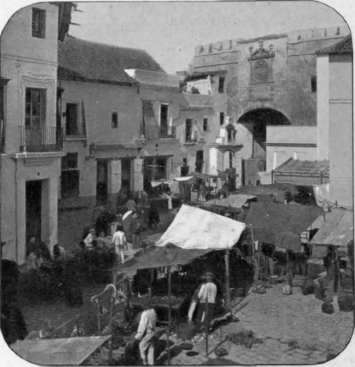
A Spanish Market-Place.
Here was, in truth, a combination of impressions, which left no doubt that I was actually in Spain.
At length, refreshed by an hour of repose, we started out to view Seville in the cool of the afternoon.
A few steps brought us to an open rectangle which bears the appropriate name of the "New Square." New, indeed it is. The Moor of seven centuries ago would smile disdainfully at such an imitation of northern towns, and pointing to his narrow streets, in which the sun can only fully enter for an hour at noon, would ask if his were not a system better suited to the climate. For it is no trifling matter to cross this stretch of fiery sunlight in the summer heat. Some slender palm-treesit is true, raise here and there their feathery screens against the overpowering sun, but these are not sufficient. If, therefore, in the early afternoon this square appears deserted, it is because the long siesta is not yet concluded, during which time, the Spaniards say, no one stirs out in the sun save dogs and Englishmen. But could we enter at that hour one of the private houses of Seville, we should find luxuries enough to warrant this desertion of the public squares. Nothing can be more charming than the appearance of these open courtyards, even from the street. We look in through a trellised gate, and see almost invariably a pretty patio with marble pavement, enclosed by walls enameled with bright tiles.

The Cathedral At Seville.

In Spanish Gardens.
Sometimes an awning is stretched over it; oftener a grapevine forms a thick roof with its broad, green leaves. At all events, no matter how plain the exterior of a Spanish house may be, it always has its open court, adorned with flowers, orange-trees, and possibly a fountain, where, in the evening, may be heard the sound of a piano or guitar, or the melody of a song. But when one turns to behold the exterior of some of the houses, he frequently concludes that life here after all is not so attractive. The windows are covered with heavy iron bars, as if the buildings were safe-deposit vaults instead of private houses. These gratings, while intended to protect the family plate, are also meant to guard the young ladies of the household. But, as the song assures us, "Love will find the way;" and so, no matter how narrow the opening in a Spanish balcony may be, it is never too small for the tiny hand of an Andalusian lady. Hence, on our evening walks, we often saw beneath one of these cruel lattices a lover armed with a guitar, and holding within his hand a small, white object glistening in the moonlight, which he from time to time would press fervently to his lips.
Continue to:


My Books

