


Spain. Part 19
Description
This section is from the book "Spain - John L. Stoddard's Lectures", by John L. Stoddard. Also available from Amazon: John L. Stoddard's Lectures 13 Volume Set.
Spain. Part 19

A Spanish Courtyard.

Grated Windows.
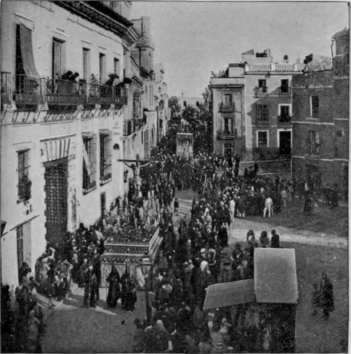
A Religious Procession In Seville.
One day, in strolling through the streets of Seville, we saw approaching us a religious procession, conveying through the city paintings and holy relics of the church.
Times change indeed, and we change with them. Eighteen hundred years ago Venus was worshiped in Seville, and at that time her statue was borne through the streets as that of the Virgin Mary is to-day. In fact, quite early in the Christian era, during a festival of Venus in Seville, two maidens, who had been recently converted to Christianity, refused to render homage to the goddess, and were put to death. These martyred girls became the patron saints of Seville, and, so far as protecting real estate is concerned, very successful ones they seem to have been. For tradition says that, in 1504, during a terrific thunder-storm, the devil tried to blow the Giralda over. To overturn a tower three hundred and fifty feet in height is no easy undertaking, even for the devil; yet it is claimed that Satan would have done it but for those pretty patronesses. They wound their white arms tightly round the tower, and clung to it so firmly that it did not move. Do not regard this as an unimportant story. It is portrayed on canvas or in sculpture in almost every sanctuary of Seville, and even Murillo consecrated to this breezy legend one of his finest paintings. I once heard a heretic remark that, if those saints were really as beautiful as Murillo represented them, he wished he could have changed places with the Giralda during that heavy gale.

Palace Of San Telmo.
On our first evening in Seville, we made our way to its most fashionable promenade, bordered on one side by the handsome palace of San Telmo, the home of the Duke of Montpensier. This avenue is deserted by day, but after sunset is usually thronged with joyous people. It was, I recollect, one of those perfect nights which form the charm of southern Spain. The sun, the tyrant of the day, had disappeared. Its burning heat had been succeeded by delicious coolness; and now, refreshed by their siestas, yet with a trace of the sun's fire tingling in their veins, the gay Sevillians seemed to have taken a new lease of life. The costumes of the men were, as a rule, such as one may find in any part of Europe. Among the ladies, we did not see a single hat or bonnet. Such innovations may be tolerated in Madrid, but the Sevillians draw about their handsome tresses lace mantillas, which, when coquettishly adorned with a red or pink rose, are certainly the prettiest and most becoming head-dresses in the world. Moreover, with an art peculiar to themselves, these fair Sevillians open and close incessantly their restless fans, - each motion, it is said, conveying a meaning to the initiated. Courtship by this means, therefore, has become a science, for, in addition to such gestures, these Spanish belles send forth from their dark eyes glances which can be best described as a startling combination of velvet and fire. As for the peril of flirtation with them, the traveler may well recall the sad experience of one who sings "One evening when the setting sun was gleaming on the Guadalquivir, To gold converting, one by one,
The ripples of that mighty river; Beside me on the bank was seated
A Seville girl with jet-black hair, And eyes that might the world have cheated,
A wild, bright, wicked, diamond pair!
"She stooped and wrote upon the sand (Just as the brilliant sun was going) With such a small, white, shining hand,
I could have sworn 't was silver flowing! Her words were three, and not one more; What think you could the sentence be?

A Senorita.

The Tower Of Gold.
The siren wrote upon the shore: 'Death, not inconstancy.'
"And then her two large liquid eyes
So looked in mine, that (devil take me!) I set the world on fire with sighs,
And was the fool she chose to make me! St. Francis might have been deceived
By such an eye and such a hand, But one week later I believed
As much the woman as the sand!"
Continue to:


My Books

