


Predisposing Causes. Part 2
Description
This section is from the book "The Horse - Its Treatment In Health And Disease", by J. Wortley Axe. Also available from Amazon: The Horse. Its Treatment In Health And Disease.
Predisposing Causes. Part 2
Of the many symptoms attending a fracture crepitus is the one which should be specially sought for. It is the sensation or sound which results from the rubbing of one broken piece against the other. In comminuted fractures, where the bone is divided into several pieces, it is soon made apparent; but in some cases of simple fracture it is difficult to develop, and a good deal of care, guided by experience, may be needed to bring it about, and especially in young and fractious animals.
When it does not become at once apparent, the upper segment of the broken bone should be firmly held by an assistant, and the lower one gently rotated, and moved from side to side and from front to back by another, while the operator is engaged in manipulating the seat of fracture.
By this method the broken ends may be made to rub against each other and yield the rubbing sensation or sound which is the evidence required.
In some situations, as where a rib or the pelvis is broken, it is impossible to carry out this method, for the reason that the parts are so situated that they do not lend themselves to the kind of manipulation prescribed.
In fracture of the ribs the part will show soreness to pressure, and some irregularity may be felt in the line of the rib when accessible. By gently pressing the rib inward, or making the animal cough while the fingers rest firmly upon the part, crepitus may be felt.
Fracture of the front ribs is usually attended with more or less lameness of the front limb on the side of the breakage. Fracture of the pelvis may sometimes be felt by passing the hand up the rectum, or crepitus may be heard by applying the ear over the surface of the quarter while the leg is moved about by an assistant.
The difficulty in question is particularly emphasized in fracture of the neck of the femur, owing to our inability to restrict the movement of the detached head and bring the body of the bone into contact with its broken surface.
In fracture of the thigh or the pelvis or front ribs, where great masses of muscle intervene between the ear and the fracture, crepitus may not be recognized unless movement of the broken parts one upon the other is of considerable extent.
For various reasons this most important and reliable symptom cannot always be made to reveal itself. The broken pieces may be firmly held together so as to preclude any movement one upon the other such as would yield a rubbing sound. This is frequently the case in fracture of the long pastern and some other bones.
In impacted fractures (fig. 328), where one piece of bone is driven into the other, and in incomplete fractures where there is no movement of the imperfectly-divided bone, and in those instances already referred to where the broken pieces are firmly held together by strong ligaments, no crepitus or rubbing is likely to be heard, and considerable difficulty is experienced in bringing it about where a piece of torn muscle or fascia has insinuated itself between the broken ends of the bone, or where one piece has been drawn some distance away from the other by the force of muscular contraction, as where the point of the elbow is raised from the body of the bone by the great extensor of the arm, or a piece of the patella is displaced upwards by the straight muscle of the thigh.
A sound simulating crepitus is sometimes heard where the tissues about the seat of injury become infiltrated with air, or where inflamed tendons rub against their investing sheaths.
This false crepitus, however, does not emit that harsh grating sound which is so characteristic of the rubbing together of the rough surfaces of a broken bone.
Care must be taken not to mistake a dislocation for a fracture. Where the latter takes place in the middle of a long bone there is not much danger of such an error being committed, but when fractures occur near joints, the case is altered. Here it should be borne in mind that where dislocation exists the displaced bones are more or less fixed, and the movements of the joints are very much restricted or altogether prevented; whereas in fracture the broken bone exhibits excessive mobility, allowing the limb to be moved in various directions to an abnormal extent.
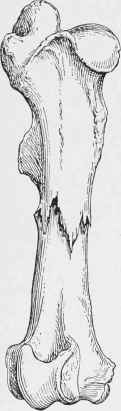
Fig. 328. - Impacted Fracture of Femur.
Treatment
The first consideration which will arise on the occurrence of a fracture in relation to treatment will be the value of the animal, the prospects of a speedy recovery, and to what extent, if at all, his future usefulness will be compromised.
In this connection it will be safe to advise, no less from a sense of humanity than from consideration of economy, that when the animal is of little value he should be slaughtered at once. If, however, it is otherwise decided, the sooner measures of treatment are adopted the better. Owing to the restlessness and unreasoning action of the patient, delay in this respect is fraught with the greatest danger. Many a simple fracture, which, if adjusted at once, would have speedily reunited, has been converted into an incurable compound fracture by the unrestrained use which the animal has been allowed to make of the injured limb after the occurrence of the accident. A horse's highest intelligence fails to realize the advantage of that perfect quiet upon which the surgeon sets so much store, in guarding against an extension of the injury and in bringing about its reparation.
The moment a fracture is suspected every means should be adopted at once to restrain the animal's movements, and to provide as far as possible against any undue use or disturbance of the injured limb.
If away from home, a splint should be extemporized, and the horse got into the stable nearest to hand and allowed to remain there while under treatment. If an ambulance cart can be procured without much delay, it would be desirable to convey him at once wherever he may require to go; but it should be kept in mind that the success of treatment is greatly facilitated by the speedy readjustment of the broken bone.
Continue to:


My Books

