


Construction In Cardboard. Second Year. Part 5
Description
This section is from the book "Raphia And Reed Weaving", by Elizabeth Sanborn Knapp. Also available from Amazon: Raphia and Reed Weaving.
Construction In Cardboard. Second Year. Part 5
Model IV. - Small Basket
Materials. - Round reed, Nos. 2 and 3; three long strands No. 2 reed for weavers; eight pieces fourteen, and one piece eight inches long (No. 3 reed), for foundation.

After starting as in Lesson I., - and making division of twos, as in Model II., weave over two and under two until the bottom is two and one-half inches in diameter.
Now turn up the sides of the basket sharply and continue to weave to end of strand. Finish with border I. As it is desirable to have the weaving strands soft and pliable, a pail of warm water should be standing in the class-room and the weaving strands placed in this until needed.
In all these simple lessons the shaping is done entirely by the hand, thus training the hand to deftness and exactness, and the eye to symmetry and proportion.

Border III
Pass ray No. 1 behind Nos. 3 and 4 and down by the side of No. 5. Pass No. 2 behind Nos. 3 and 4 and down by the side of No. 6 - and continue until the last ray is passed down.

Border IV
Take any standing ray as No. 1, pass it behind No. 2, in front of No. 3 and then down into the basket. Now pass No. 2 behind No. 3, in front of No. 4, and down into the basket, leaving these two loops open in order to receive the last two ends. Press the other loops down flat, and when completed trim the ends to even lengths, leaving about one inch in length inside the basket. Length of spoke for border, four inches.

Border V
Take any ray as No. 1, pass it behind No. 2 and No. 3, in front of Nos. 4 and 5, and then down inside the basket. Then pass No. 2 behind Nos. 3 and 4, in front of Nos. 5 and 6, and down inside the basket. Continue to the end, weaving the last two into the loops formed by Nos. 1 and 2. Length of spoke for border, six inches.
Border VI
Length of rays needed for this border, nine inches. Place ray No. 1 behind No. 2, and bring the end down under the thumb of the left hand. Then lay No. 2 behind No. 3.

Border VI. Detail No. 1.
Now go back to No. 1 and pass it before No. 3, and behind No. 4, bringing the end down in front of the basket, and hold it here, while laying No. 3 (which is the first one standing)

Border VI. Detail No. 2.

Border VI. Detail No. 3.
down alongside of No. 1. Now take No. 2 and pass it in front of No. 4 and behind No. 5, and lay No. 4 (still standing) behind No. 5, and down beside No. 2. It will now be observed that the ends of the reeds are forming sets of twos. Now begin with the first pair, and take the longer of the two reeds, and pass it in front of No. 5 and behind No. 6, and down in front; then turn No. 5 down behind No. 6 and alongside the end just turned down. Continue in this manner until but one end is standing, when we are ready to close the border. Now take the longer one of the last two and place it in front of No. 1 (which was the first spoke used), and bring the end out in front under No. 2. Take the longer end of the set of twos and place it in front of No. 2, and bring this end out in front under No. 3. The ends may now be cut off in front, or woven back and cut off on the inside of the basket.

Border VI. Detail No. 4.
Use Of Two Weavers
The entire depth of the sides of a basket may be woven with two weavers, or this style may be used at the bottom of the basket, where the spokes are turned up. It also adds to the appearance of the basket if two or three rows, using two weavers, are inserted just after braided rush or straw has been used.
To work with two weavers, one end of each is inserted behind two successive rays, or spokes, as at A, then each, in turn, is brought in front of one and behind the next one, as indicated in the drawing.

Use of Two Weavers.

Use of Three Weavers.
Use Of Three Weavers
Insert three single weavers, behind three successive spokes, as at A and B, and place each, in turn, in front of the next two rays, and behind the third. This style of weaving is used especially to strengthen the work at the point of turning up for the sides, where it not only hides the ends of any additional rays added at this point, but it strengthens the basket.

Double Weaving.
Double Weaving
An effective style of weaving may be worked by using an even number of rays, and passing, with a single weaving strand, under one, over one, two or three times around, and then alternate for another two or three rows. This alternation must always be made on the under side, and is effected by passing under two rays, and then on, over one and under one.
This is most effective when the spokes are double or treble, according to the number of rows used before the change is made. If, in order to make the bottom of the basket of sufficient strength and size, a division of ones has been made, the extra ray (for additional spokes) may be added at the point of turning up the rays for the sides, and here working in three rows of triple weaving (three weavers), and then proceed with the single weaver two or three times around.
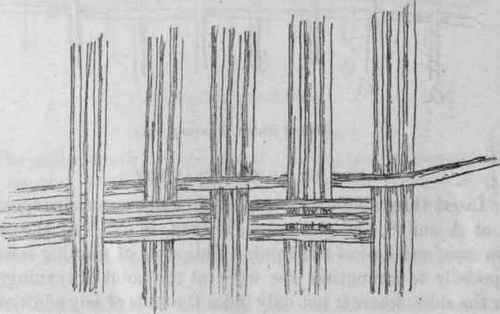
Triple Weaving.
Flower Basket.
Flower Basket
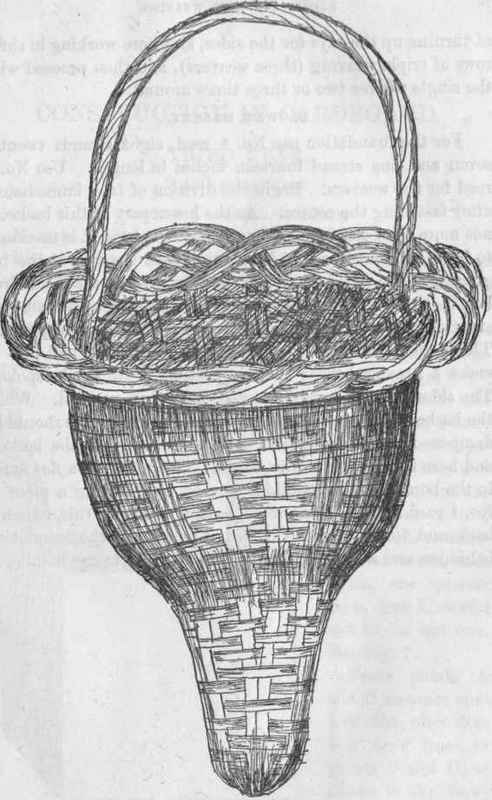
For the foundation use No. 4 reed, eight strands twenty-seven and one strand fourteen inches in length. Use No. 2 reed for the weavers. Begin the division of twos immediately after fastening the center. As the lower part of this basket is not more than one inch in diameter at the base, it is necessary to begin to form this part by turning back the rays at the beginning of the weaving. When the elongated part is the desired length, the division of ones is made, and after weaving but once around, an extra spoke is inserted alongside each single one. This is done so as to give solidity to the basket, and also to make a heavier border than is possible with single spokes. The sides are now turned outward and then upward. When the basket is the desired size, the ends of the spokes should be dampened and then turned at right angles with the basket, and here finish with border No. 3. This produces a flat finish to the border. The handle is formed by inserting a piece of No. 4 reed into the sides of the basket, and upon this, twisting back and forth, a length of No. 2 reed, until the foundation is hidden and a rope-like appearance is given to the handle.
Continue to:


My Books

