


Construction In Cardboard. Third Year. Fourth School Year
Description
This section is from the book "Raphia And Reed Weaving", by Elizabeth Sanborn Knapp. Also available from Amazon: Raphia and Reed Weaving.
Construction In Cardboard. Third Year. Fourth School Year
Model I. - Bill Holder
Material. - Essex bristol; size, 12 in. x 9 in.
Place the paper with its long edges parallel with the edge of the desk. Lay off the vertical lines, forming the spaces, one-quarter inch, two inches, three and one-half inches, two inches and three and one-half inches. Cut to the last line.
From the upper corners, measure down two and one-half inches, draw a line, and from here measure down three and one-half inches, again draw a line, and from here measure two inches, and, again, one-quarter inch, draw lines and cut to the last one. See Fig. 1.
From points A and B measure one-half inch, place dots and draw lines to points C and D, as shown in the drawing. Cut away all waste across the top. Now locate points E and F, and draw in the lines forming the laps. Score all lines, excepting the line C-D. Fold into shape and glue.

Model I. Bill Holder.

Fig. 1.
Model II. - Comb Case
Material. - Essex bristol; size 8 in. x 8 in.
From the upper left corner proceed to lay off the vertical spaces, two, three and one-half, and two inches wide. See Fig. 2. From the two upper corners measure down and lay off the horizontal spaces two, two, one, and two and one-fourth inches wide. Cut to the last line. Cut the squares away from the upper corners. Measuring in one inch and down one-half inch, draw lines and cut off the corners of the projecting piece, as shown in the drawings. From points A and B measure out one inch, place dots, and draw lines from these dots to the upper corners. Cut to these lines. From points A and B lay out the one-quarter-inch laps. Cut to these lines and shape as indicated. Score all lines excepting the one across the back. Fold into shape and glue.

Fig. 3.

Model II. Comb Case.
Model III. - Corner Bracket
Material. - Essex bris-tol; size, 11 in. x 7 in.
Place the paper with its short edge parallel with the edge of the desk. Find the middle of the upper and lower edges and draw a line across. Measure three inches down from the upper corner and draw a line across. From the point of intersection of the two lines measure three inches to the right and left, place dots, and draw lines from these dots to point A. See Fig. 3. Cut to these lines and cut in on line A-B. From B measure down six inches, place a dot, and draw lines from this dot to the ends of line C-D. Score the remaining lines and score through the center line. Measure one inch down from D and up from E. Locate dots and cut the curve from these points.

Model III. Corner Bracket.

Fig. 3.
Model IV. - Candy Box
Material. - Essex bristol ; size, 12 in. x 8 in.
Place the paper with its short edge parallel with the edge of the desk. From the upper corners measure down and lay off the horizontal spaces, viz.: three, one and one-half, three, one and one-fourth, and one and one-fourth inches each. Cut to the last line. See Fig. 4. Lay off the vertical spaces, one and one-half, four, and one and one-half inches each. Locate the middle of the upper edge, and cut the semi-circular opening. Bisect the lines A-B and C-D and from the point of bisection measure out one inch, and from these points draw lines to A, B, C and D. Cut to these lines. Cut away the oblongs from the lower corners. Bound the corners of the projecting piece. Score all remaining lines and fold to place. This box may be glued to shape if preferred.

Model IV. Candy Box.

Fig. 4.
Model V. - Folding Box
Material. - Essex bristol; size, 13 in. x 8 in.
From the upper corners lay out the horizontal spaces, viz.: two and one-half inches, one inch, two and one-half inches and one inch each. See Fig. 5. From the upper left corner measure off the vertical spaces, viz.: two and one-half, three and one-half, two and one-half, three and one-half and one-half inch each. Cut away all waste, leaving the projecting piece at the bottom. This forms the cover and the tongue (or the piece to slip inside the edge of the box). The piece projecting at the right forms the lap.
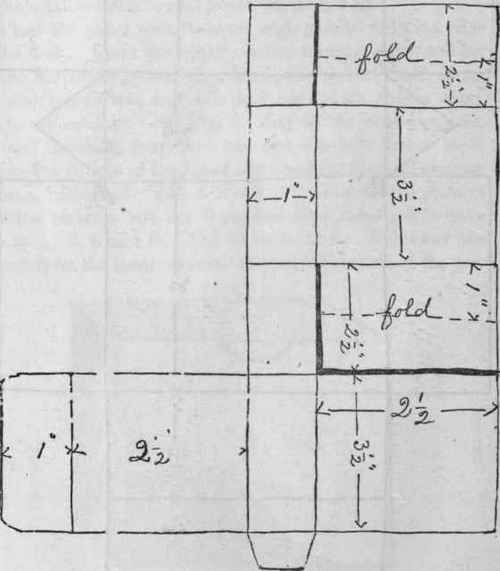
Fig. 5.

Model V. Folding Box.
Cut in on all heavy lines, as indicated by the drawing, and fold and crease on all dotted lines. Now bring the box into shape as shown in the sketch. Place glue on the one-half inch lap and fasten.
Model VI. - Lunch Box
Material. - Essex bristol; size, 9 in. x 8 in. From the upper corners measure down and draw lines for the horizontal spaces, viz.: two, three, and two inches each. Cut to the line drawn last. See Fig. 6. From the upper left corner lay off the vertical spaces, viz.: one and one-half, two, one and one-half, one-half and one inch each. Cut to the line drawn last. From points A and B measure up one and one-half inches, place dots, draw line across and cut to this line. Cut in on the lines A-X and B-X. Repeat this on opposite side at points C and D. Cut in to form the laps on the cover, making this lap one-half inch wide.

Model VI. Lunch Box.
with a projecting tongue of one inch (pointed at the end). Fold into shape, cut the openings in the front edge of the box and pass the tongue through this. Glue into shape.

Fig. 6.
Continue to:


My Books

