


Brick. Part 3
Description
This section is from the book "The Engineer's And Mechanic's Encyclopaedia", by Luke Hebert. Also available from Amazon: Engineer's And Mechanic's Encyclopaedia.
Brick. Part 3
The horizontal wheel e worked by d actuates the shaft c bearing the knives in the pug mill. At the lower end of the shaft c is fixed the large circular revolving bottom plate it, the periphery of which being furnished with teeth or cogs, as shown, take into the teeth of a circular revolving plate v, over which, as the mould box passes, the lower surface of the bricks becomes smoothed. At x is a small frame, working up and down in a casing, with a pulley and counterbalance weight, like a sash window; it is raised by the crank y as each mould box passes, when three little boards are placed across the frame by a boy, for the reception of the bricks. When these are deposited by the means described, the frame drops below the level of the endless strap n; the latter then receives them, and carries them off to their destination. At z is fixed a flat box, which acts as a gauge to regulate the thickness of the stratum of clay revolving upon the bottom plate n of the pug mill. The operation of this machine is as follows: the clay being worked in the ordinary manner through the pug mill, it passes out at the mouth, (not shown, being on the opposite side,) from thence under a flap which partly regulates the quantity on the bottom plate, and next under the gauge, which determines it precisely.
A mould box having passed over the highest inclined plane or riser k first falls on the stratum of clay, and chops out three bricks, filling the moulds therewith by the false bottoms rising up to the determined point from the pressure of the clay against them; the moulds, with the bricks in them, then slide over the polishing plate r, (which is kept wet by water constantly dripping upon it from a tub); from thence the moulds pass on to the frame x, when the weight q strikes against the protruded bolts of the false bottoms, and pushes out the bricks upon the boards on the frame; the frame then descends two or three inches by their weight, and delivers the boards upon the endless strap, which, being constantly in motion, carries the bricks away to be deposited on the hacks. The mould box being discharged is then carried upon its roller up the first riser k, drops into the water, thence rises again, falls upon the cushion, next into the sand box, whence ascending again, the highest inclined plane being duly prepared, it falls again upon the bottom plate of the pug mill, and chops out three more bricks, during which period each mould box has operated in a similar manner.
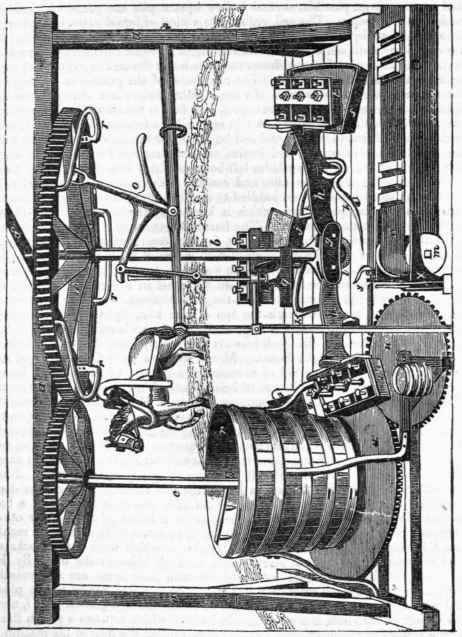
We shall now proceed to describe the brick-making machinery invented by Mr. Leahy, and erected by him for the Patent Brick Company; it is represented in the accompanying figure, a is the main horizontal shaft in direct communication with the steam engine or other first mover; b is a hopper-formed vessel, technically termed the pug mill, in which the clay and other materials are tem-pered and mixed up: it is for this purpose furnished with cross iron bars, or blades of steel; part of these are firmly fixed to the hollow vertical shaft c, and the remainder bolted to the sides of the pug mill, and they are so arranged, that those fixed to the shaft cut in as they revolve between the others. The clay is delivered into the hopper or pug mill by an endless chain of buckets (in the same manner as ballast is raised in the Thames); it is then cut up and tempered by the knives and bars in the pug mill, and gradually descending, it falls, or rather is forced by the superincumbent pressure upon the circular inclined plane d, which consists of a single thread or spiral turn of a very large screw, occupying the whole internal space of the lower cylindrical end of the mill, where it is exhibited in section.
This screw or circular inclined plane is fixed to the central shaft passing longitudinally the hollow shaft, and a slow reversed motion is given to it, by means of an intermediate wheel acting upon pinions in the upper part of the frame. The blades on the hollow shaft, revolve in the pug mill at the rate of fifteen turns in a minute, grinding and dividing the materials much more completely than in the ordinary mode of brick-making. In this attenuated state the materials are forced upon the circular inclined plane of the screw, and as this slowly revolves in a contrary direction at the rate of five turns in a minute, it takes hold of the clay (by a peculiar adaptation not easily described), and forces it out of the mill, in a very compact state, into a receptacle below: of this, one side is always in immediate contact with the moulds, and those two sides which are at right angles to the former side are closed by iron cheeks, between which the lever or forcing flap n acts by pressure, and, fitting closely, prevents the escape of the clay, so that it can only pass into the moulds. These moulds are placed round the periphery of a circular frame e made of flat iron rings, fixed upon bars or spokes, and turning upon a fixed shaft.
There are twenty-five of these moulding boxes in one circle; but as the frame e may be of any breadth, it may contain twice twenty-five or thrice twenty-five on the circumference of the cylinder, provided that the engine is capable of affording sufficient power or force to cut or mould so many bricks at each revolution. Each moulding box is furnished with a false or movable bottom to which rods are attached, for the purpose of pushing out the brick when moulded, and drawing back the bottom to its place to receive a fresh portion of the clay. The manner in which these operations are performed is extremely simple and ingenious. The ends of each of the moulding-box rods are bent at right angles, and an eccentric piece f is so fixed, that, as the moulds revolve, and at the moment that the surface of each is covered by being in contact with the clay, it gradually draws back the false bottom, and with it the clay, which is also urged on by the circular inclined plane d; and to render the bricks solid and compact, a powerful pressure is applied to them by means of the flap forcer n, to which a backward and forward motion is given by the thrusting of a rod attached to a revolving crank.
Continue to:


My Books

