


Home Recipes, Cooked Eggs, Poached Eggs, Stuffed Eggs, Names Of Protein Content In Different Foods, Proteins - Tissue Building Foods, Use Of Eggs In Desserts, Baked Caramel Custard With Whipped Cream
Description
This section is from the "Cooking" book, by Lilla Frich. Also see Amazon: Cooking.
Home Recipes, Cooked Eggs, Poached Eggs, Stuffed Eggs, Names Of Protein Content In Different Foods, Proteins - Tissue Building Foods, Use Of Eggs In Desserts, Baked Caramel Custard With Whipped Cream
Home Recipes
Cooked Eggs
Have ready a saucepan containing boiling water. A general rule is to allow one pint of water to two eggs, and an extra cupful for each additional egg. Place the eggs in the water with a spoon and cover the saucepan. For Soft-Cooked Eggs let them stand in the water on the back of the range where it may be kept hot and just below simmering point from 8 to 10 minutes. For Hard-Cooked Eggs let them stand in the water on back of range where it may be kept hot and just below simmering point from 40 to 45 minutes.
Poached Eggs
Prepare a slice of buttered toast for each egg and keep it hot. Have ready a shallow greased pan containing boiling salted water to cover the eggs. Break each egg separately into a saucer and slip it gently into the water, being careful that the water does not reach boiling point. Cook until the white is firm and film forms over the top of the yolk. Remove the eggs from the water with a skimmer or a griddle cake turner. Drain, trim off rough edges, and place each egg on a slice of toast.
Stuffed Eggs
Cut hard boiled eggs in halves lengthwise or crosswise. Remove yolks and mash them. Add half the amount of deviled ham and enough melted butter to make of consistency to shape. Shape into balls and refill whites. Form remainder of mixture into a nest on circular pieces of bread. Arrange eggs on the nest. Pour over them white sauce and sprinkle with buttered crumbs. Bake in moderate oven until brown.
Questions
1. Name the elements found in protein foods.
2. What is their chief office in the body?
3. What are they sometimes called?
4. Under what food heading do eggs come?
5. How should eggs be cooked?
6. Do you consider them a nourishing food?
7. Do you consider them a bulky or a concentrated food?
8. With what kind of foods would you eat eggs? Why?
9. Could we live on protein alone?
10. Could we live without protein?
11. What foods are the best heat and energy producers?
12. Why are eggs selected as the first in our series of protein foods?
13. Where are proteins digested?
14. What digestive fluids act on proteins?
15. Into what are they changed during the process of digestion?
Suggestions For Home Application
In Book I we learned the classification of food. No matter what the food may be, it may be classified under one of the five food principles or foodstuffs, as they are sometimes called.
Protein is listed first as it holds the most important place in our diet. The chief duty of protein in the body is to build and repair tissue and as it is the only food that can perform this duty, it ranks first and foremost. No matter how much food we consume, if protein is lacking we shall starve. In addition to building and repairing tissue, proteins can also furnish heat and energy, but at great expense to the kidneys. Carbohydrates and fats perform this duty and should therefore be combined with proteins. The protein foods differ from the other foodstuffs in that they contain nitrogen. Foods conspicuous in protein content, as a rule, are high priced. They include eggs, meat and fish. Milk, however, is not so high priced. Protein in combination with carbohydrates is found in cereals, peas, beans, lentils and nuts.
Proteins are partly digested in the stomach, where they are acted upon by the digestive fluids in the stomach. Pepsin, in the gastric juice in the stomach, acts on proteins, changing them into peptones, thus making them ready for absorption.
Names Of Protein Content In Different Foods
Eggs ................................. Albumen
Milk ................................... Casein
Meat .................................. Myosin
Wheat ................................. Gluten
Beans................................Legumen
The following table will show the protein content in some common foods:
Cheese about 45%. Peas and Beans 24%. Poultry about 21%. Egg White about 20%.
Beef about 20%. Mutton about 18%. Eggs about 15%. White bread about 8%.
Milk about 3%.
Proteins - Tissue Building Foods
Use Of Eggs In Desserts
Eggs and milk are used in combination in any number of dishes - such as custards, salad dressings and puddings. They are also used in batters and doughs. Egg has the power of thickening when added to a mixture.
MATERIALS:
1/2 Cup Scalded Milk.
1/2 Slightly Beaten Egg.
2 Tablespoonfuls Sugar (caramelized).
1-16 Teaspoonful Salt.
1/8 Teaspoonful Vanilla.
Baked Caramel Custard With Whipped Cream
Eggs and milk are called typical foods, as they are the two foods nature has provided, cither of which support life.
The infant lives on milk alone, which furnishes it with all the necessary nutrition to support its life.
Since the egg furnishes the sole source for growth and development of the chick for a considerable time, it is plain that it contains all the elements required to keep up life.
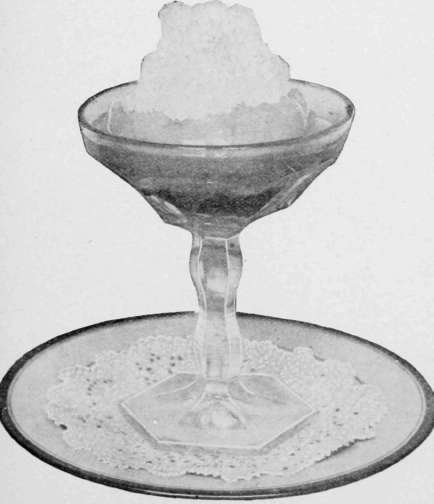
PROTEINS - TISSUE-BUILDING FOODS. EGGS - (Continued).
Careful experiments show that albumen begins to coagulate at 134 deg. F., and becomes jelly-like at 160 deg. F. When cooked at 160 deg. to 185 deg., F'., the albumen is rendered tender and readily digestible. Therefore, eggs should be cooked at a low temperature.
Continue to:


My Books

