


Activation Of Hydrogen Transfer Between Pyridine Nucleotides. Part 2
Description
This section is from the book "The Scientific Contributions Of The Ben May Laboratory For Cancer Research", by The University of Chicago. Also available from Amazon: The Scientific Contributions Of The Ben May Laboratory For Cancer Research.
Activation Of Hydrogen Transfer Between Pyridine Nucleotides. Part 2
Experiments With Fractionated Enzymes
The material precipitated from crude placental extracts by the addition of ammonium sulfate to 40 per cent saturation contained active, TPN-linked isocitric and glucose-6-phosphate dehydrogenases, and a steroid-sensitive pyridine nucleotide transhydrogenating system. It was devoid of endogenous substrates and pyridine nucleotides. The experiment depicted in Figure 1 shows that, over a 45-minute period without added substrate, this preparation did not reduce DPN, whether estradiol 17β (5 X 10^-6M)was present or not. Furthermore, the addition of 0.04 µmole of TPN after 45 minutes of incubation did not induce a reduction of DPN during the subsequent 45 minutes. When isocitrate was included in the incubation mixture, DPN was not reduced with or without the further inclusion of estradiol 17β. Later addition of TPN led to an instantaneous and complete reduction of the nucleotide by the highly active TPN-linked isocitric dehydrogenase in the enzyme preparation. In the absence of hormone, the subsequent change in absorbance at 340 mµwas very small over the following 45 minutes. However, with both isocitrate and extradiol 17β present, DPNH gradually accumulated after all the TPN had been converted to TPNH.

Fig. 1.-Estradiol-stimulated formation of reduced pyridine nucleotides. The reaction systems contained in 3.0 ml. the following ingredients: 300 µmoles Tris pH 7.4; 1 µmole DPN+; 1 µmole MnCl2; and 4.2 mg. protein of a 30-40 per cent saturated ammonium sulfate fraction of placenta. Paired cuvettes were run with (• • •) or without (O O O) 4 Mg- estradiol 170 in 0.01 ml. dioxane. Parallel experiments were carried out without added substrate (left), with 1.5 µmoles isocitrate (center), and with 3 /imoles glucoae-6-phosphate (right). At time45minutes, 0.04µmole TPN was added to all cuvettes. Optical measurement at 340 mµ in cuvettes of 1 cm. light path. Temp. 25°.
This experiment is in full accord with a stimulation by estradiol 17β of a mechanism which transfers hydrogen from TPNH to DPN. A corollary of this hypothesis would be that any other substrate which could reduce TPN in this system should substitute for isocitrate. This proved to be the case with glucose-6-phosphate. Figure 1 shows that DPN was not reduced by glucose-6-phosphate unless catalytic amounts of TPN were added, in which case the further reduction of DPN was stimulated by estradiol 17/3.
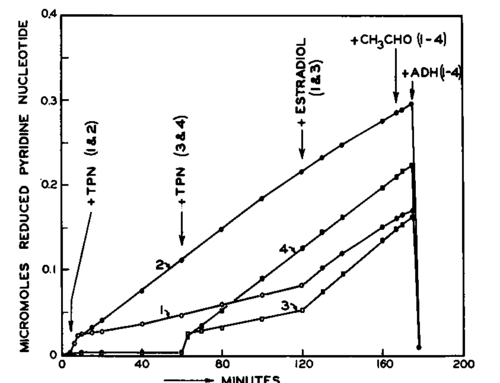
Fig. 2.-Time course of the formation of reduced pyridine nucleotides. The reactions were carried out in 3.0 ml. systems containing 300 µmoles Tris pH 7.4; 1 µmole DPN; µmole MnCl2; 1.5 µmole sodium isocitrate; 107 µg. purified rate heart isocitric dehydrogenase; and 1.92 mg. protein of a 0-35 per cent saturated ammonium sulfate fraction of a placental extract. Cuvettes 2 and 4 contained 4 µg- estradiol 17β in 0.01 ml. dioxane initially. TPN (0.023µimole) was added at 5 minutes to cuvettes 1 and 2. 4 µg. estradiol 170 was added to cuvettes 1 and 3 at 120 minutes. All cuvettes received 10 µmoles acetaldehyde in 0.01 ml. at 167 minutes and an excess of yeast alcohol dehydrogenase at 175 minutes. Optical measurements at 340 mµ against a control containing enzyme and buffer. Temp. 25°.
These considerations are amplified further by the findings summarized in Figure 2. The activity of the TPN-specific isocitric dehydrogenase in the enzyme preparation used in this experiment was rather feeble, so an excess of this TPN-reducing enzyme was added. All the cells contained isocitrate, DPN, and purified isocitric dehydrogenase. The DPN was not reduced under any circumstances unless TPN (0.02µmole) was also present. If the TPN was added 5 minutes after initiation of the reaction, it was reduced instantaneously. Without estradiol 17β, very little reduced pyridine nucleotide accumulated above the expected amount of TPNH, whereas a rapid formation of reduced nucleotide took place in cells containing the hormone. Similar changes were manifest if the TPN was added 60 minutes after the beginning of the reaction. The delayed addition of estradiol 17β also increased greatly the accumulation of reduced pyridine nucleotide in cells to which TPN had been added after 5 or 60 minutes of incubation. Finally, it will be seen that when acetaldehyde was added at the end of the experimental period, the rate of change in absorbance in cells containing TPN and estradiol 17β was unimpeded. But the further addition of yeast alcohol dehydrogenase caused a virtually instantaneous disappearance of all the reduced pyridine nucleotide. This is convincing evidence that the increase in absorbance at 340 mµ which took place after all the added TPN had been reduced reflected a gradual accumulation of DPNH and not of some other ultraviolet-absorbing product (e.g., reduced nicotinamide mononucleotide).
It is noteworthy that the steroid-sensitive transhydrogenating system can be readily fractionated with ammonium sulfate and that it is relatively stable, since its activity remains unimpaired after storage at 2° for several days and is not destroyed by repeated freezing and thawing.
Table 1. Effect Of Varying Concentrations Of Estradiol 17β On Stimulation Of Pyridine Nucleotide Transhydrooenation
Estradiol 17β (M) | Total Reduced Pyridine Nucleotide Formed µmolee) |
0 | 0.034 |
1.2 X 10⁻⁸ | 0.042 |
1.2 X 10⁻⁷ | 0.114 |
1.2 X 10⁻⁶ | 0.158 |
4.9 X 10⁻⁶ | 0.134 |
* Each cuvette contained 300 µmolea Tris buffer of pH 7.4; 1 µmole MnCl2; 1.5 µmole sodium isocitrate; 1 iimole DPN; 0.023 µmole TPN; 107 µf. of purified rat heart isocitric isocitric dehydrogenase and ammonium sulfate fraction from placenta (0-35 per cent saturation) containing 1.92 mgmg. protein, in a final volume of 3.01 ml. Estradiol 170 was added in 0.01 ml. dioxane. The reaction was initiated by the addition of the placental fraction. Time 100 minutes. Temperature 25°. The rate of formation of reduced pyridine nucleotide was approximately linear with time over the period studied.
Steroid Specificity
Table 1 shows that maximal stimulation of the transhydrogenating system occurred with estradiol 17/3 at a final concentration of 1 X 10⁻⁶ M. Marked activity of estradiol 17/3 was observed at a concentration of 1 X 10⁻⁷ M, and a small but detectable effect of this hormone could be demonstrated at 1 X 10⁻⁸ M.
The reactivity of various ammonium sulfate fractions toward other steroids differed somewhat from one preparation to another. At steroid concentrations of about 5 X 10 -6 M, the transhydrogenating mechanism was stimulated by estradiol 17β and estrone, but not by estradiol 17a or by diethylstilbestrol. At a steroid concentration of 3 X 10⁻⁶ M, stimulation of the reaction was observed with testosterone, but not by 17a-methyltestosterone or by cortisone. The transhydrogenating mechanism stimulated by testosterone appeared to be more labile than that which was activated by estradiol 17/3.
Reduction Of Pyridine Nucleotides By Steroids
Fractions of placenta obtained by precipitation between 0 and 40 per cent saturation of ammonium sulfate reduced DPN in the presence of substrate amounts of estradiol 17/3, in confirmation of the studies of Langer and Engel.8 The relatively crude enzyme was found to react almost equally well with DPN and TPN. Table 2 shows that, under conditions similar to those used to study the transhydrogenating system and at a steroid concentration of 2.5 X 10⁻⁵ M, 10-20 mµmoles of estradiol 17β were oxidized per hour per milligram of protein. Although, by necessity, these measurements of the hydroxysteroid dehydrogenase activity were carried out at higher steroid concentrations than were used in the transhydrogenase experiments, it has been observed that the rates of the estradiol 17/β-activated transhydrogenation and of the reduction of pyridine nucleotides by estradiol 17/3 are of the same order of magnitude. In a specific instance, 1 mg. of protein of an ammonium sulfate fraction of placenta at pH 7.4 catalyzed the oxidation of estradiol 17β; (2.5 X 10⁻⁶ M) at a rate of 59 mµ-moles per hour with DPN (3.3 X 10⁻⁴ M). The transhydrogenase activity of the same preparation at pH 7.4 (3.3 X 10⁻⁴ M DPN; 1.3 X 10⁻⁶ M TPN; and 4.9 X 10⁻⁸ M estradiol 17/3), with isocitric dehydrogenase as the reducing system, was 10.9 mµmoles per hour per milligram protein. The differences in steroid concentrations involved in this comparison are probably of no great influence on the reaction rates, since at least the bacterial 17/3-hydroxysteroid dehydrogenase has a Michaelis constant for estradiol 17/3 far less than 1 X 10⁻⁸ M9
Continue to:


My Books

