


Importance Of Steroid Oxidation Reactions In Uterine Tissue
Description
This section is from the book "The Scientific Contributions Of The Ben May Laboratory For Cancer Research", by The University of Chicago. Also available from Amazon: The Scientific Contributions Of The Ben May Laboratory For Cancer Research.
Importance Of Steroid Oxidation Reactions In Uterine Tissue
The absence of any significant amount of tritiated estrone in uterine tissue following the administration of tritiated estradiol does not necessarily imply that no oxidation of the 17-hydroxyl group has occurred. It is possible that reversible oxidation of estradiol to estrone could have taken place with the equilibrium far in the direction of reduction, so that no appreciable amount of estrone was present at any time. More conclusive information concerning possible transformations of the 17β-hydroxyl group in the immature rat uterus was afforded by the use of 17-tritiated estradiol, which was obtained with a specific activity of 171 millicuries per millimole by the reduction of the ketone group of estrone with sodium borotritide. If reversible oxidation of estradiol to estrone had taken place, the 17-tritium would have been transferred to the oxidizing coenzyme and eventually either to water or to some other cellular constituent, so that any estradiol which had participated in an oxidation-reduction process would have lost its tritium.
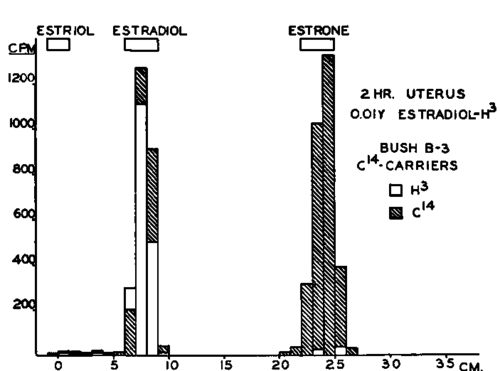
Fig. 25.-Distribution of radioactivity in B-3 paper chromatogram of ether fraction from 59 pooled rat uteri 2 hours after administration of 0.01 µg. (11.7 µC.) of 6,7-tritiated estradiol. C14-labeled estradiol and estrone added to chrotmtogram mixture. Upper limits of shaded and unshaded areas indicate respective counts of C14 and H3.
It was found that two hours after the administration of 0.1µg. of 17-tritiated estradiol, the fraction of the injected radioactivity appearing as a non-volatile component of liver tissue was only half as great as that observed under similar conditions with 6,7-tritiated estradiol, suggesting that some loss of tritium from the steroid takes place in the liver. In uterus, on the other hand, the traction 01 the administered radioactivity was the same or, in some experiments, slightly higher with the 17-tritiated than with the 6,7 -tritiated steroid. On fractionating the uterine tissues pooled from 225 animals two hours after administration of 0.1 µg. of 17-tritiated estradiol, essentially all the non-volatile radioactivity is recovered in the ether fraction, and this, on paper chromatography, shows estradiol as the only significant tritiated component (Fig. 26). In addition to this non-volatile radioactivity, there is an appreciable amount of volatile tritium in the uterine-tissue water amounting to about 20 per cent of the total radioactivity in uterus. But the concentration of volatile tritium in the uterine-tissue water is slightly lower than that in liver-tissue water, and both are lower than that in blood. Thus it appears that somewhere in the organism the 17-hydroxyl group is being oxidized with the transfer of the tritium to the body fluids, but there is no indication that this process takes place in uterus.

Fig. 26.-Distribution of radioactivity on paper chromatogram of ether fraction from 225 pooled rat uteri 2 hours after administration of 0.11 µg. (0.074 µc.) of 17-tritiated estradiol (Bush B-5 system).
Conclusive evidence against the occurrence of 17-hydroxyl oxidation in the immature rat uterus was obtained from a "double label" experiment in which a mixture of 17-tritiated estradiol and 6,7-tritiated estradiol was administered. The fraction of the total radioactivity contributed by each component was determined by oxidation of the mixture with DPN and the bacterial 17β-hydroxysteroid dehydrogenase of Talalay (71), followed by partition of the reaction products between water and benzene. As shown in Figure 27, the radioactivity in the benzene layer gives a measure of the 6,7-tritiated estradiol which was present, whereas that in the water layer indicates the amount of 17-tritiated hormone.
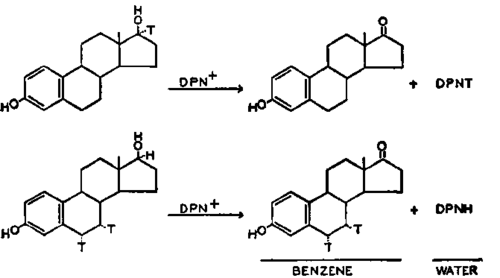
Fig. 27.-Enzymatic analysis of mixture of 6,7- and 17-tritiated estradiols.
Two hours after the administration of 0.1 µg- of a mixture assaying 52 per cent 17-tritiated estradiol to 23-day-old rats, the non-volatile radioactive substance present in uterus was found to be essentially all free estradiol containing 48 per cent of the 17-tritiated steroid. In a similar experiment, rats received 0.1 µg. of non-radioactive estradiol on days 22 and 23 to bring their uteri into a state of advanced growth. On day 24, two hours after the administration of 0.1 µg. of a mixture of labeled estradiols (analyzing 48 per cent of the 17-tritiated component), the radioactive substance present in the uterine tissue was found to be free estradiol containing 49 per cent of the 17-tritiated steroid.
It is concluded that in either the immature or the rapidly growing uterus, estradiol stimulates growth processes without being transformed into estrone or other metabolic products.
Continue to:


My Books

