


Nature Of The Radioactive Material In The Tissues
Description
This section is from the book "The Scientific Contributions Of The Ben May Laboratory For Cancer Research", by The University of Chicago. Also available from Amazon: The Scientific Contributions Of The Ben May Laboratory For Cancer Research.
Nature Of The Radioactive Material In The Tissues
To determine the chemical nature of the radioactive material present in the tissues, the radioactivity was first separated into volatile, protein-bound, ether-soluble (free steroid) and water-soluble (conjugated) components. Pooled tissues were homogenized in ten times their weight of cold water with the addition of 25 µg. each of non-radioactive estradiol, estrone, and estriol as carriers for the small amounts of radioactive steroids present in the tissue. Aliquots of the homogenate were dried from the frozen state, and the residue and the water distillate each were assayed to determine volatile and non-volatile radioactivity. The remainder of the homogenate was diluted with four volumes of absolute ethanol to precipitate the majority of the protein. The 80 per cent alcohol solution was evaporated to a small volume, and the residue was partitioned between ether and water.
Table 2. Per Cent Of Radioactivity Present In Different Fractions Of Rat Tissue Homogenate* At Various Intervals After Subcutaneous Injection Of 0.1 µG Estradiol-6,7 H3
Fraction | Uterus | LlVER | ||||
15 Min. | 2 Hr. | 6 Hr. | 15 Min. | 2 Hr. | 6 Hr. | |
Volatile............ | 5 | 2 | 3 | 1 | 2 | 3 |
Protein............ | 2 | 2 | 2 | 15 | 10 | 22 |
89 | 107 | 102 | 45 | 41 | 30 | |
Water............. | 4 | 2 | 2 | 24 | 25 | 45 |
Tissues pooled from 10 animals for 15-minute values and 30 animals each for 2- and 6-hour values.
A comparison between uterus and liver at 15 minutes, 2 hours, and 6 hours after a single subcutaneous injection of 0.1 µg. of tritiated estradiol to immature rats is given in Table 2. It can be seen that in the uterus there is little radioactivity except in the free steroid fraction, whereas in liver significant amounts of activity are bound to the alcohol-insoluble protein and are present in water-soluble form.
To determine the chemical identity of the ether soluble fraction, which in the case of uterus comprises practically all the radioactive material present in the tissue, the ether was evaporated and the residue subjected to paper chromatography, using slight modifications of the Bush B-3 and B-5 systems. In addition to the estradiol, estrone, and estriol carriers, which had been added during original homogenization of the tissue, small amounts of C14-labeled steroids were added to the chromatographymixture in some cases to aid in the precise identification of the peaks of tritium activity. After development of the chromatograms, the papers were cut into 1-cm. strips, each of which was counted directly in a liquid scintillation system by an efficient procedure developed for the purpose.
As can be seen in Figures 22 and 23, essentially all the tritiated substance present in the ether fraction of the 2-hour uterus moves with estradiol in both the B-3 and B-5 systems. Similar results were obtained with the material obtained from the 15-minute and the 6-hour uteri. In the case of liver, the situation is quite different. The ether fraction from the 15-minute liver shows a number of components which appear to include estrone and estradiol (Fig. 24), and a similar pattern was observed with the 2- and 6-hour liver, except that in these cases estrone predominates.
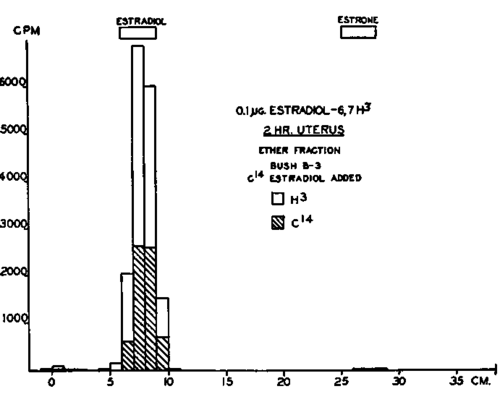
Fig. 22.-Distribution of radioactivity in B-3 paper chromatogram of ether fraction from 30 pooled rat uteri 2 hours after administration of 0.095 µg.(11.1µC) of 6,7-tritiated estradiol.
C14-labeled estradiol added to chromatogram mixture. Upper limits of shaded and unshaded areas indicate respective counts C14 and H3.
The finding of unchanged estradiol as essentially the only tritiated substance present in rat uterus raises the question whether 0.1 µg. of estradiol given subcutaneously in one injection might be more than a physiological amount, so that the steroid present in the uterine tissue, small though that amount is, still consists mostly of excess estradiol which is not participating in the growth-related processes. Accordingly, the foregoing experiments were repeated using only one-tenth as much administered hormone. If the free estradiol in the uterus really is non-functioning excess, and the physiologically active steroid is that represented by the trace amounts of radioactivity barely detectable in other tissue fractions or regions of the paper chromatogram, the ratio of the radioactivity in these other fractions to that in the estradiol fraction should be significandy greater at the lower dose level.
As seen from the data in Table 3, two hours after the administration of 0.01 µg. of tritiated estradiol, nearly all the radioactivity in the uterus again is found in the ether fraction, and, on paper chromatography of this fraction, this tritium moves with estradiol (Fig. 25). Thus it would appear that after the administration of either a 0.1 or 0.01µg. dose of tritiated estradiol, the radioactive substance in the uterus is essentially all estradiol itself, and any binding to protein must be so weak that cold 80 per cent ethanol readily disrupts it. The situation in uterus is clearly different from that in liver, where firm binding to protein and conversion to water-soluble material takes place, and where thefree steroid present consists of a mixture of compounds.
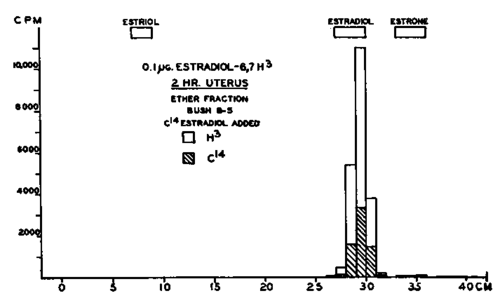
Fig. 23.-Distribution of radioactivity in B-5 paper chromatogram of ether fraction from 30 pooled rat uteri 2 hours after administration of 0.095 µg (11.1µC.) of 6,7-tritiated estradiol. C14-labeled estradiol added to chromatogram mixture. Upper limits of shaded and unshaded areas indicate respective counts of C14 and H3.
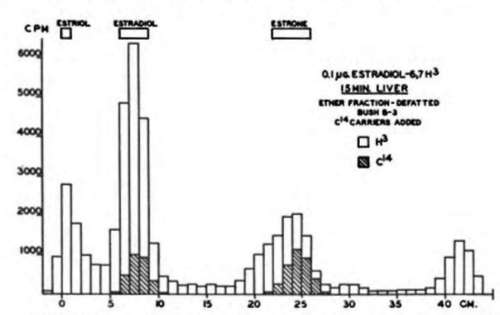
Fig. 24.-Distribution of radioactivity in B-3 paper chromatogram of ether fraction from 10 pooled median lobes of rat liver 15 minutes after administration of 0.095 µg- (11.1 µc.) of 6.7-tritiated estradiol. C14-labeled estradiol and estrone added to chromatogram mixture. Upper limits of shaded and unshaded areas indicate respective counts of C14 and H3.
Table 3. Per Cent Of Radioactivity Present In Different Fractions Of Rat Tissue Homogenate* 2 Hours After Subcutaneous Injection Of 0.01 µG. Estradiol-6,7 H3
Fraction | Uterus | Liver |
Volatile............ | 3 | 15 |
Protein............ | 0.2 | 19 |
Ether............. | 95 | 42 |
Water............. | 2 | 20 |
* Tissues pooled from 59 animals.
Continue to:


My Books

