


The Screw As A Fastening Device In Wood Construction
Description
This section is from the "Educational Woodworking For Home And School" book, by Joseph C.Park . Also see Amazon: Educational Woodworking For Home And School.
The Screw As A Fastening Device In Wood Construction
Another very important fastening device in wood construction is the screw. The screw, as one of the mechanical powers, is a modification of the inclined plane, and may be conceived as a cylinder with a spiral ridge called the "thread" winding about its circumference. To show the children that this is a modified inclined plane, cut a right-angled triangle from a piece of paper and wind it around a lead pencil so that the hypothenuse of the triangle marks the spiral thread of the screw. The vertical distance between any two consecutive threads of the screw measured parallel to the axis is called the "pitch" of the screw, and the angle of the inclined plane measured between any two successive points is spoken of as the "inclination" of the screw.
The screw is supposed to have been invented by Archimedes, a celebrated Greek philosopher, about 250 B.C. He constructed an instrument for raising water to a higher level. This instrument was made by winding a flexible tube around a cylinder in the form of a screw. When the screw was placed in an inclined position, with the lower end immersed in water, by causing the screw to be revolved, the water was raised to a higher level. Archimedes is supposed to have invented this screw for the purpose of lifting water high enough to launch a large vessel built under his direction. The screw was used in Egypt in the days of Hero of Alexandria, and at the beginning of the Christian era was used for various purposes by nations on the shores of the Mediterranean.
There are very many varieties of screws, but the wood screw, so called because of its exclusive use in wood, is the most common, and it has been made by machinery for many years. At first wood screws had blunt points, and it was necessary to make a hole in the wood before the screw could be driven. This, of course, had its disadvantages, and, as a result, improvements followed. In 1850 Thomas J. Sloan, a United States citizen, devised what is known as the gimlet-pointed screw and also the machinery for its construction. The threads of this screw were formed by cutting out the metal between the threads. This method of cutting tended to weaken the screw, so that when it was driven into hard wood it frequently broke. Now, by a system of rolling combined with compression, the threads are raised and all the metal of the wire out of which the screw is made is used in its construction. This makes a stronger screw and increases its holding power.
Wood screws are usually classified as flat head, round head, oval head, fillistered head, Rogers' flat head drive, and diamond point oval head drive. In determining the size of a wood screw two things are to be considered - the length of the screw and the size of the wire out of which it is made. The length varies all the way from a quarter of an inch to six inches, while the size of the wire varies from naught to thirty. Screws are made of steel, but may be finished in a variety of ways. They may be bright, blued, brassed, bronzed, Japanned, lacquered, or tinned. The finish depends upon their use.
The screw, when properly selected and driven, is capable of resisting a much greater force than a nail. The screw is a better fastening device than the nail, other things being equal, for when it works loose, it may be tightened, while nails have to be redriven. The use of screws, however, is not so great as the use of nails because they are more expensive and it is more of an effort to drive a screw than it is to drive a nail.

Wood screw.

Oval head.

Fillister head.

Rogers' drive.
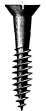
Spur point.

Flathead.

Round head.
Fig. 144. Wood screws.
Screws are used in wood construction where there is a great strain and where nails will not hold. They are sometimes used for aesthetic effects.
To drive a screw a screw-driver is used. This is a very common tool, but it is not always used properly. To understand and use any tool correctly, one must understand the function of the parts, and also the relation of the parts to the function of the tool. As a rule a good screw-driver has a long and slightly concave bevel which fits the slot in the screw, while as a rule a poor screwdriver has a short bevel and will press only on the top of the slot, causing it to slip. Such a screw-driver is not a desirable tool to use. A long screw-driver works much better than a short one. In theory one should keep the screw-driver in line with the screw, but in actual practice it wobbles, forming a circle as the screw turns, thus increasing the leverage. Now, the longer the screw-driver the larger the circle described, and the larger the circle the greater the leverage. On this fact is based the principle of the screw-driver bit which is used with a brace. With a brace and screw-driver bit one can drive a screw much faster and much easier than with an ordinary screw-driver.
Sometimes soap is rubbed on a screw to make it drive easily, but this is not necessary when working with soft wood. It is quite a help when driving a long screw into hard wood. With hard wood it is well to bore a hole to receive the screw, but this must be done with discretion. The hole must not be too large nor too deep. It must be remembered that screws will not hold well in end wood. In order for them to do their work effectively they must be driven between the fibers.
When two pieces of hard wood are to be fastened together, it is well to make a hole in the outer piece that will allow the screw to slip through freely up to the head of the screw, and when driven into the second piece the screw will act as a clamp, drawing the two pieces together. Usually a countersink is used in the hole before the screw is allowed to enter. This makes a hole so that the head of the screw enters the wood flush with the surface, or it may be driven below the surface of the wood so that the head can be covered up if desired.
In rough work with soft wood a screw may be started and driven about halfway with a hammer and finished with a screw-driver; but this method tends to lessen the holding power of the screw, for in driving the screw with a hammer, the fibers of the wood are broken so they cannot hold the screw sufficiently.
In the use of screws, as well as in all other operations in wood construction, great care should be exercised. One must know when screws are needed as a fastening device, the kind and size to select, and how to drive them effectively. The work must be thoughtfully done in order to become more intelligent regarding materials and operations. A study of Fig. 144 will help in the selection of the right screw for a given purpose.
Continue to:


My Books

