


Part IV. Fastening Devices Used In Wood Construction. Nails And Nailing
Description
This section is from the "Educational Woodworking For Home And School" book, by Joseph C.Park . Also see Amazon: Educational Woodworking For Home And School.
Part IV. Fastening Devices Used In Wood Construction. Nails And Nailing
We read that "a small, pointed piece of metal, usually with a head, to be driven into a board or other piece of timber, and serving to fasten it to other timber, or left projecting as from a wall, to hang any thing upon" is a nail. There are many kinds of nails, and they are named either from the use to which they are applied, or from their shape. According to the United States Patent office nails are classified as cut, wrought, horseshoe, shoe, barbed, composition, button, carpet, coffin, sheathing, galvanized, harness, leather work, picture, siding, slating, trunk, upholstery, weather tiling, and screw nails.
Before the beginning of the nineteenth century nails were usually made by hand forging. A large part of this work was done by women and children, and their poverty and degradation is one of the saddest phases in the history of English industrial life. In those days nails were expensive and consequently were not used as extensively as they are at the present time. Nails were first made by machines in the United States, and in fact all of the more important varieties originated and developed here. This is a natural result, for, since colonial times, wood has been used extensively in the building of houses, furniture, fences, etc., and as a demand arose for a certain kind of nail in the construction of certain things it was designed and wrought out of the most practical material which was available. Expense was not the first thing considered. Our forefathers did things in a practical way, even to the making of a nail. That nail had to possess strength, holding power, and lasting qualities, regardless of cost. We are told that the first cut nails were made in New England late in the eighteenth century by cutting strips from sheet metal and heading them with a hammer while held in a vise. Gradually the shape of these nails was changed to meet varied needs, and the demand increased so that it was impossible to make by hand all the nails that were needed. In 1810 a machine was invented in the United States which made nails at the rate of one hundred per minute. As a result nails grew cheaper and became popular fastening devices. During the past century about four hundred patents have been issued for improvements in the making of nails. They are now made very readily and with little expense.
The term "penny" is used to designate the size of certain kinds of nails; thus, threepenny, fourpenny, sixpenny, etc. The term "penny" when used in this way is supposed to be a corruption of "pound." A four-penny nail was such that one thousand of them weighed four pounds, eightpenny such that one thousand of them weighed eight pounds, etc.
The most common forms of nails are the wire nails, cut nails, and wrought nails. The wire nail consists essentially of a cylindrical piece of wire of suitable length, with one end properly sharpened and the other end flattened in such a way as to form a head. A good wire nail has great holding power and is very durable. It may be clinched, which is often necessary, and this adds to its practical qualities.

3d fine.

1 inch lining.
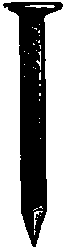
3d slating.

1 inch barbed roofing.
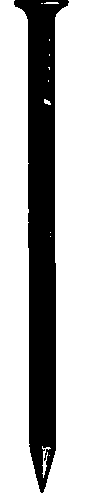
8d common.

8d barbed common.

8d common brads.

8d finishing.

8d casing.

8d flooring brads.

8d fence.

8d clinch.
Fig. 141. Steel wire nails.
A cut nail, as its name suggests, is cut from iron or steel, as the case may be. The thickness of the metal out of which the nail is cut corresponds to the thickness of the nail to be made. These nails thus have two flat sides which are parallel. The two edges taper from the head of the nail toward the point, forming a wedge. The point and head of a cut nail are rectangular in shape with the wide part of one corresponding to the narrow part of the other. To avoid splitting the wood in driving a cut nail, the wide part of the point should enter the wood across the grain and never parallel with the grain. By driving the nail in this way the wedge acts in the direction in which the wood is strongest, that is, in the direction of the length of the fibers, and this increases the holding power of the nail. The cut nails have not such universal use as the wire nails.
The wrought nails are made of wrought iron, which is the purest form of iron known in the arts. These nails are soft, very tenacious, and at a high temperature maybe welded. They are used where clinching is desired. One extensive use of these nails is in the hanging of barn doors with strap hinges.
To drive a nail, hold it between the fingers and thumb of the left hand in the desired position, grip the hammer near the end of the handle with the right hand, and, with a free movement of the right arm from the elbow rather than from the wrist, strike the head of the nail squarely with a quick, hard blow with the whole face of the hammer rather than with one edge. Repeat, driving the nail a little deeper into the wood at each stroke. The last stroke of the hammer is an important one, for it should send the nail into the wood so that the top of the nail head is even with the surface of the wood, and the stroke must be made in such a way that the hammer does not mar the wood. Sometimes in driving brads a nail set is used to drive the head beneath the surface of the wood. The holding power of a nail is increased if it is driven in the wood at a slight angle. Where several nails are used in fastening pieces of wood together, it is well to drive the nails in pairs in such a way that they form "dovetails" in the wood. They are able to resist a much greater strain when driven in this way, than when driven straight into the wood, for before the pieces can pull apart the wood must break, or the nails must bend, or both.
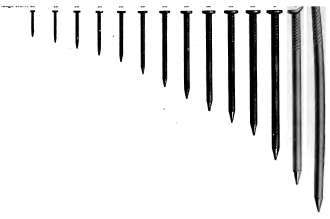
Fig. 142. Steel Wire Nails.
To draw a nail, place a block of wood under the head of the hammer to lift it up to the height of the head of the nail and to protect the wood underneath. Allow the claw of the hammer to catch the head of the nail, and pull the handle of the hammer over in such a way as to raise the claw and the nail will come out. Try to draw the nail straight out to avoid breaking and bending the nail. To use a hammer, the most ancient of all tools, in a skillful way, so that it is made to do its work with efficiency, requires no small amount of training, and its use should be introduced early in connection with manual training work.

Continue to:


My Books

