


Woodworking Machines. Part 2
Description
This section is from the "Educational Woodworking For Home And School" book, by Joseph C.Park . Also see Amazon: Educational Woodworking For Home And School.
Woodworking Machines. Part 2
82. Band Saw
A band saw is a power saw that can be used for a wide range of sawing. It cuts rapidly and accurately, and is simple in construction. Band saws are made in the following sizes: 30" (diameter of wheels over which the band saw travels), 34", 36", 38", 40", and 42". A band saw, like every other tool or machine, needs to be properly adjusted to do a given piece of work, and it should receive proper care and attention at all times to be the most efficient. There is considerable stretch, which is called surplus elasticity, to a new band saw and on this account the saw should receive very careful use at first. The speed for the tight and loose pulleys should not be more than 400 revolutions per minute. The tension of the saw must be perfect and uniform, and the saw should run without vibrating.
83. Scroll Saw
This saw is intended for sawing both inside and outside curves. It should have a tilting table so that curves can be sawed at an angle if it is desired. This saw, like the band saw, must have the proper tension. The driving pulley (81" x 3") should make about 800 revolutions per minute to give the proper speed. The saw blades arc made in different sizes. A 1/4", 16" long, is a good size for ordinary work.
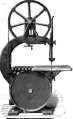
Fig. 125. Band saw.
84. Swing Saw
This saw is used in cross cutting lumber. It is especially adapted for use in getting stock ready for class use, or where lumber is to be cut into equal lengths, Swing saws are usually hung to the ceiling, although they may be made to swing from the wall or from under the table. The construction of the swing saw is shown in Fig. 127. They are made in different lengths, but the regular length is 7 feet 2 inches from the base of the hangers to the centre of the arbor. They are made to swing either right or left handed. The regular size of the saw used is 14" in diameter. The speed of the tight and loose pulleys (10" by 5") should be 400 revolutions per minute.

Fig. 126. Scroll saw.


Fig. 127. Swing saw and table.
85. Combination Saw Bench
The combination saw bench is a practical, all-round machine, and to be most efficient should embody all the conveniences and attachments required for general work to accurate lines. It can be used for ripping, cross-cutting, and grooving or dadoing. The best saw tables are provided with three gauges, - one slitting gauge, arranged to tilt to 45 degrees or less for bevel sawing, one adjustable, and one stationary cut-off gauge. The countershaft is placed on the, floor about five feet from the centre of the arbor, thus leaving the top of the table free from belting. The speed of the tight and loose pulley (12" x 6 1/4") on the countershaft should make 600 revolutions per minute. Patent groovers or dado heads as shown in Fig. 129 are used when grooving is to be done. These groovers will cut a perfect groove with or across the grain, if they are in perfect condition.
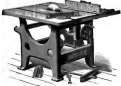
Fig. 128. Saw bench.

Fig. 129. Patent groover or dado heads.

Sample of work made with groover bead.
They are dangerous to use and one must handle them with great care.
86. Saw Guard
There is danger in operating a rip saw, or in using any power saw for that matter, and one cannot be too careful in using every precaution against accidents. The saw guard shown in Fig. 130 may help to prevent accidents. It prevents pieces of wood from flying back and keeps sawdust from flying into tinoperator's face, enabling him to see his work. This guard should be used by all means in a manual training shop, where unskilled people use the saw.
87. Circular Saws
A circular rip saw and a circular crosscut saw work on the same principle as ordinary rip and cross-cut saws work, and they are sharpened practically the same. The mandrel (sometimes called arbor) of a circular saw is the spindle to which the saw is fastened, and is run by means of a pulley which is connected with the driving pulley. The mandrel should be kept level and should be kept well oiled. Do not screw the saw too tightly on the mandrel, for it may heat and cause the saw to bind, or buckle. The saw should fit the mandrel perfectly true, when in place, so that every tooth will cut. If the saw heats too much at the center, it needs more set. If it heats at the rim, the backs of the teeth may be too high, or the saw may not run true. As a rule thick saws are more successful than thin saws, for it requires more than ordinary skill to successfully operate a thin saw. The greater the speed, the thicker the saw should be. The following table may be helpful in selecting circular saws: -

Fig. 130. Saw guard.
Diameter | English Gauge | Size of Hole |
3" | ...21 | ..1/2" |
4" | ..19 | ..3/4" |
5" | ..19 | ..3/4" |
6" | ..18 | ..3/4" |
7" | ..18 | ..3/4" |
8" | ..18 | ..7/8" |
9" | ..17 | ..7/8" |
10" | ..16 | ..1" |
11" | ..16 | ..1" |
12" | ..15 | ..1 1/8" |
14" | ..15 | ..1 1/8" |
16" | ..14 | ..1 1/8" |
18" | ..13 | ..1 1/4" |
A saw is right-handed when it turns towards you as you stand in front of it, the gauge being on the left-hand side of the saw. If the gauge is on the right hand of the saw, it is a left-handed saw. The most efficient saw is one that cuts the fastest and smoothest with the least expenditure of power.
Continue to:


My Books

