


7. The Gauge
Description
This section is from the book "Elements Of Construction", by Charles A. King. Also available from Amazon: Elements of construction.
7. The Gauge
The Gauge (A.), Fig. 10, is for the purpose of making lines parallel to the face or working side or edge. Usually it is made in four pieces: the "head" (a), which is held against the face side or edge; the "stick" (bb), upon which the head moves; the "thumbscrew" (c), which holds the head firmly in its position upon the stick; and the "point" (d), which makes the desired mark upon the wood.
(B.) A rule should be used in setting the gauge, unless one is certain that the point is located accurately with regard to the graduations upon the stick.
The point should be sharpened to work with either a push or pull cut, as at e.
(C.) The gauge should be grasped as shown in Fig. 11, and generally used with a push, though it is occasionally pulled toward the worker. One should always work from the face side of the piece.
If the point enters the wood too deeply, it may be set back, or the gauge carried on the corner of the stick as indicated, which will govern the depth of the cut. Do not use a dull gauge, or one with a round point like a pencil, as it will tear the wood, instead of making a clean cut or scratch.
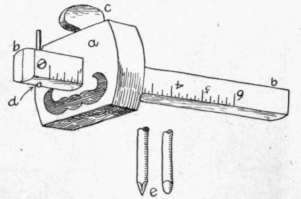
Fig. 10. - Marking Gauge.
a, the head; bb, the stick; c, the thumbscrew; d, the point.
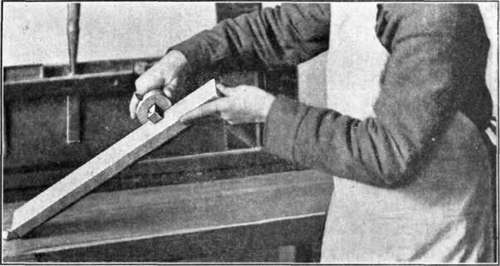
Fig. 11. - Marking Gauge in Use.
Continue to:


My Books

