


Exercise XVI. The Grooved And Cross-Tongued Mitred Joint
Description
This section is from the book "Manual Instruction: Woodwork. The English Sloyd", by S. Barter. Also available from Amazon: Manual Instruction: Woodwork.
Exercise XVI. The Grooved And Cross-Tongued Mitred Joint
Fig. 229. This joint is used to secure thin pieces of wood which could not easily be strongly joined by leaving a tenon on one half. In this exercise, however, the wood is rather thick, as the pupil would probably not be able to manage with thin wood at a first attempt.
Yellow deal 1 1/2 in. by 1 in., and of any convenient length, will be suitable for this exercise.
The wood should first be planed true and sawn at 45°. The two pieces obtained should be planed true on the mitred edges in the shooting board, with the stop adjusted to 45°. With the marking or mortice gauge, mark the grooves on the planed edges of both pieces. The tongue is made from a thin strip of wood planed true to 3/16-in. in thickness. The grain in this tongue must be at right angles to the mitred joint, as will be seen in the illustration (fig. 229), in order to give strength.

Isometric projector of mitred piece.

Side view of groove.
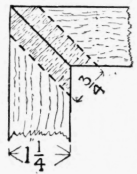
Elevation.
Fig. 229.
This is called a cross-tongued joint. Sometimes the tongue is made with the grain diagonally, but this is objectionable, as swelling or twisting in the tongue, when freshly glued, would cause the joint to open.
The joint should be glued up, and it is then finished.
Continue to:


My Books

