


Exercise XV. Another Form Of Mitred Joint, Showing Square Shoulders On The Back
Description
This section is from the book "Manual Instruction: Woodwork. The English Sloyd", by S. Barter. Also available from Amazon: Manual Instruction: Woodwork.
Exercise XV. Another Form Of Mitred Joint, Showing Square Shoulders On The Back
Fig. 226. This form of joint is stronger than the first form given, in Exercise XIV., and is much more commonly used in construction, where it is not essential that the mitred joint should show on both faces. The drawing should be either the completed joint, or the wood with the mortice and tenon made at either end, as in fig. 228.
A piece of yellow deal, 1 5/8 in. wide, 1 in. thick, and 11 1/2 ins. long, will be found suitable.
Fig. 227 shows the marking on the face edge and side at both ends, and fig. 228 shows the mortice and tenon made. About 1/4 in. of waste at each end is marked out to be removed in order to obtain a true surface, to gauge on. After the completion of the joint, there is, necessarily, a small projection on each edge, which must be sawn off, and the surface then planed from the corner inwards, so as to avoid breaking the end grain.
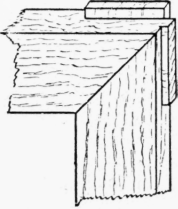
Fig. 226.
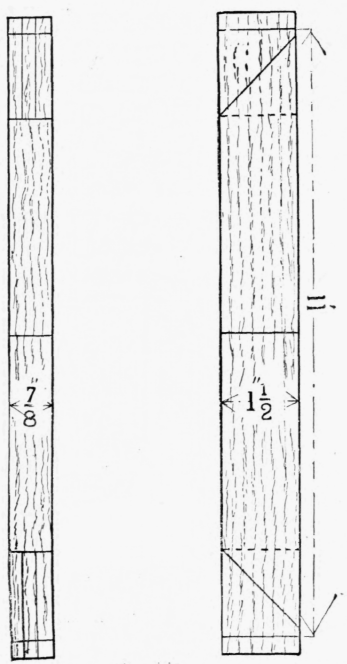
Fig. 227.

Fig. 228.
Continue to:


My Books

