


Paring Tools
Description
This section is from the book "Manual Instruction: Woodwork. The English Sloyd", by S. Barter. Also available from Amazon: Manual Instruction: Woodwork.
Paring Tools
Chisels And Gouges
The chisel consists of two parts - the handle and the blade.
The handle is generally made of beech, but sometimes of ash, and, in some of the light carving tools, of box. It is made in different shapes, according to the kind of work for which the tool is wanted.
The chief variation is in thickness. Some handles are severely treated in doing heavy work, and must be able to resist heavy blows with the mallet. They are accordingly stout and strong, but lighter chisels have correspondingly light handles.
The shape of the blade is also governed by the work for which the chisel is intended, Carving chisels and gouges have thin blades, inasmuch as they are required to pare or remove the wood gradually, in thin chips or shavings, and no great strength is required.
On the other hand, mortice chisels, which receive heavy blows, and must withstand great shocks and cross strain, have stiff, stout blades.
The principle of the cutting portion of chisels and gouges is alike. The face, or the under side of the chisel, when in use, is straight to the edge, but the back is cut off at the top, making the cutting angle.
This angle is small in carving gouges and light chisels, but, in chisels for heavier work and to cut harder wood, the angle is greater.
The tangs of chisels and gouges should be four-sided, with shoulders to take the wooden handle. The angles of the tang prevent the blade from turning under a twisting strain, and the shoulder prevents the handle splitting from a blow.
The Firmer Chisel
(fig. 42). The blade of this chisel is flat, the face being perfectly true, from 1/16 in. to 2 ins. wide, and from 5 ins. to 8 ins. in length.

Fig.42. - A, handle; b, tang; c, shoulder; D, ferrule; e, blade; f, grinding angle; g, cutting angle.
Very long chisels of this kind are called paring chisels.
The blade of the chisel is thin near the cutting end, and slightly stouter as it approaches the shoulder.
In the smaller sizes, 1/16 in. to 1/4 in., the thickness from back to front is greater to make up for the stability lost in width.
The grinding angle should be 25°, and the cutting angle 35°
If the tool is to be used in cutting very hard wood, the angle should be slightly increased, to prevent the risk of breaking the edge under heavy blows. As soon as the cutting angle becomes too great by frequent sharpening, the chisel should be reground.
Firmer Gouge
(fig. 43). The blade of the gouge is concave, but otherwise its characteristics are the same as those of the chisel. This form of gouge is ground on the convex surface.
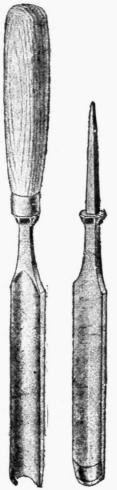
Fig. 43.
Scribing Gouge
Scribing Gouge (fig. 44) is a little thinner in the blade than the firmer gouge, and is ground on the inside.

Fig. 44.
Mortice Chisel
(fig. 45). This tool is not much used in the present course.

Fig. 45.
It is for cutting mortices or slots through the thickness of a piece of wood, and as it is Continually subjected, when in use, to heavy blows from a mallet, it is very strongly made, both in blade and handle.
The handle is sometimes bound round the bottom with copper wire, and the shoulder of the blade bedded on leather to prevent splitting.
Stiff Bent Gouge
This tool is used to cut out curved depressions in the surface of the wood; it is made in various sizes and with different curves. One or two kinds will probably be found sufficient.
Continue to:


My Books

