


Mechanical Water-Closets
Description
This section is from the book "Sanitary Fittings And Plumbing", by G. Lister Sutcliffe. Also available from Amazon: Sanitary fittings and plumbing.
Mechanical Water-Closets
A new form of valve-closet has been designed by Doulton & Co., in which a press-button takes the place of the usual handle. If the button is released, the water continues to flow through the valve until the regulated quantity has been admitted to the basin. A marble enclosure can be fitted to the closet instead of the usual wooden one.
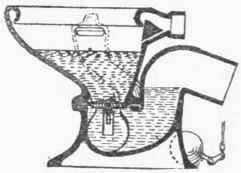
Fig, 90. Pedestal Valve-Closet.
Valve-closets are also made in "pedestal" form-that is to say, for standing without enclosures; but some of these are far from pleasing in appearance. One of the neatest examples is given in fig. 90. In this the valve swings in the trap of the closet, the separate valve-box being entirely omitted. The valve is operated by a lever and two bevelled cog-wheels, and, when open, fits into a recess at the side of the trap, so as not to interfere with the flow of the water. The overflow arm has a large opening at the top for the insertion of a brush, and is arranged to receive a small portion of every flush. The outlet of the trap is well above the floor. This closet is practically a wash-down closet with a valve inserted to raise the level of the standing water in the basin.
Adams's "Helios" closet (fig. 91) has a side outlet and valve, and the joint between the closet and trap is well above the floor. The water can be admitted from a cistern or through a regulating valve, the latter being shown in the view. The valve swings clear of the soil, but there is some danger of the seating being fouled, and thus preventing the valve fitting tightly. The overflow cannot well be cleaned, and no provision appears to be made for ventilating the valve-box.
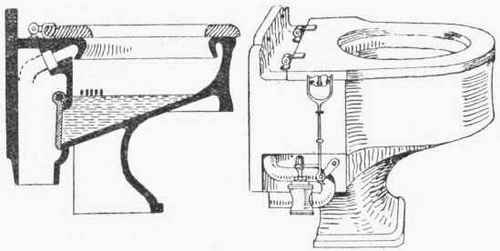
Fig. 91, Adams's "Helios" Valve-Closet.
The great advantage claimed for valve-closets is that they retain a large quantity of water in the basin. This gives a large surface for the reception of the soil, and consequently prevents the fouling of the basin and other objectionable results; it also ensures a thorough removal of the contents of the basin when the valve is opened. The disadvantages are that the closets are complicated, the mechanism is apt to get out of order, and the valve does not always fit tightly on its seat. Notwithstanding the high praise which the valve-closet has received, it is gradually being discarded.
The invention of good forms of wash-down closet did much to lessen its popularity, and the siphonic closet, which gives an equal water-area in the basin, seems destined to complete the process. Some of the most noted manufacturers of sanitary fittings do not even trouble to show a single valve-closet in their catalogues, whilst others devote the smallest possible space to the subject.
Continue to:


My Books

