


Chapter XVIII. Traps
Description
This section is from the book "Sanitary Fittings And Plumbing", by G. Lister Sutcliffe. Also available from Amazon: Sanitary fittings and plumbing.
Chapter XVIII. Traps
Definition
A plumber's trap is a vessel affording a free passage for water but not for air. In its simplest form it is merely a bent pipe (fig. 150); the bend retains the last portion of the water entering it, and as the water occupies the full bore of the bent portion of the pipe, it affords a barrier against the passage of air.
Disconnection
The waste-pipes from all sanitary fittings, except water-closets and perhaps slop-hoppers, ought to be disconnected from the drains by being made to discharge over or into trapped gullies placed in the ground outside the building. These drain-traps, however, are not sufficient to prevent foul air passing into the building. The water in the trap may be so charged with impurities as to give off unpleasant gases, and experiments have shown that if the air on one side of a trap is polluted, a small but appreciable amount of the pollution can after a time be traced on the other side; in other words, the foul gases may be absorbed by the water on one side, and given off again on the other. An untrapped waste-pipe, even though disconnected from the drain, may thus convey impure air from the drain into the house. But waste-pipes themselves are often seriously fouled by the passage of dirty liquids through them, and the deposits in the pipes decompose and give off foul gases which are drawn into the house unless a trap is interposed. The waste-pipes from sinks and urinals are often extremely filthy, and those from baths and lavatories are seldom entirely free from soapy deposits. Every sanitary fitting ought therefore to have a trap, either in itself or in the waste-pipe as near the fitting as possible.
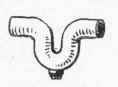
Fig. 150. Round-pipe "Running " Trap.
Traps Good And Bad
A good trap should be self-cleansing, and should have a sufficient depth of seal and a reasonable resistance to siphonage. Round-pipe traps are most easily kept clean, as the water passes through them with considerable velocity and there are no corners for the retention of filth. On the other hand they are more easily emptied by siphonage than traps of some other types. Siphonage can, however, under normal circumstances, be prevented by means of an air-pipe carried from a point near the outlet of the trap; and round-pipe traps, if properly ventilated, are undoubtedly the best. Several modifications of the round-pipe trap have been introduced for the purpose of reducing the risk of siphonage, and will be noticed hereafter. The seal of a trap (other than a round-pipe trap under a valve-closet) is seldom entirely destroyed either by siphonage or momentum, unless two or more fittings are connected to the same waste-pipe, but a considerable portion of the water may be drawn out by siphonage or carried out by the momentum of the discharge; the depth of the water-seal is therefore reduced, and, if the fitting is not used again for a long time, evaporation may lower the level of the water to a point below the dip, and air can then pass through the trap.
Continue to:


My Books

