


Seats
Description
This section is from the book "Sanitary Fittings And Plumbing", by G. Lister Sutcliffe. Also available from Amazon: Sanitary fittings and plumbing.
Seats
Water-closet seats are commonly made of wood, left plain, or painted, varnished, or polished. White enamel paint looks very well and is fairly durable, but in this country seats are generally polished. Where the closet may be used as a slop-sink or urinal, the seat must be hinged so that it can be readily raised, or swung on pivots and weighted behind the pivots so that it remains in an upright or inclined position when not in use. Hinged seats ought to have rubber buffers underneath to prevent injury to the basin; rubber "comfort pads" serve the same purpose, but are not necessary for men's closets. It is a great convenience to have the basin formed with an extension at the back to which the back-rail of the seat can be fixed. Sometimes the wood back-rail is omitted, the seat being hung to brass supports rising from the pottery seat extension; this allows the whole of the basin to be cleaned. Many seats are made of two thicknesses of wood, placed with the grain at right angles to each other to give additional strength and to prevent warping. Hinged lids or flaps are useful in deadening the sound of the water in the basin and in preventing splashing on to the floor, but the polish on the underside is soon destroyed by the moisture. Indurated wood-fibre seats have also been made.
Sheet-metal seats have been tried, but unless covered in some way are too cold for comfort. A very good covered seat of this kind is shown at A in fig. 114. It is known as Shanks's "Metallo-Vulcanite" seat, and consists of a piece of stamped sheet-steel covered on both sides with a substantial coating of black, red or brown polished vulcanite. The seat is light, durable, and non-absorbent, and has been used in hospital work. The hinges are at the back of the seat extension, so that the whole of the basin
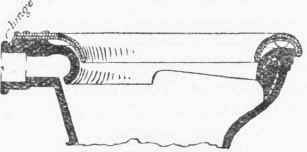
Shanks's "Metallo-Vulcanite " Closet Seat
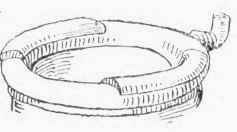
Fixed Wood Side-pieces in lieu of Seat.
Fig. 114. can be thoroughly cleansed. Rubber buffers are provided under the seat.
In workshops and some public places the seat is occasionally omitted, but this leads to fouling of the pottery. A better plan is to fix wood pieces on the side portions only of the closet rim (B, fig. 114), leaving the pottery exposed along the front and back, or to use a hinged seat with the front portion cut entirely away. The latter seat is not, of course, very strong, but it has certain sanitary advantages.
Continue to:


My Books

