


41. Sections
Description
This section is from the book "Elements Of Construction", by Charles A. King. Also available from Amazon: Elements of construction.
41. Sections
Sections. (A.) In order to show the construction of details which cannot be indicated upon any of the three views of the object, a drawing of the detail may be made separate from the main drawing, consisting of three views, or more, as required. It is often necessary also, in order that the construction may be, shown adequately, to make a sectional view; this is a drawing representing the plane which would be seen if a cut were made at any suitable place in the object.
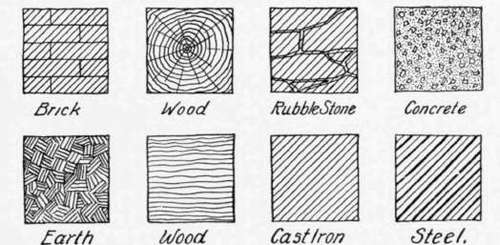
Fig. 77. - Conventional Sections.
The drawing of a plane thus made should include the section of all the different pieces through which such a cut would pass. A section is always indicated by line or tint shading, the nature of the lines, or the color of the shading, suggesting conventionally the material of which the section actually consists, as in Fig. 77, in which is shown the character of the lines generally used to represent the various building materials. If the section is colored, woodwork is illustrated by yellow; iron, by dark gray or black; brickwork, by red; and stonework, by light gray. Section lines running in different directions indicate that different pieces form the section.
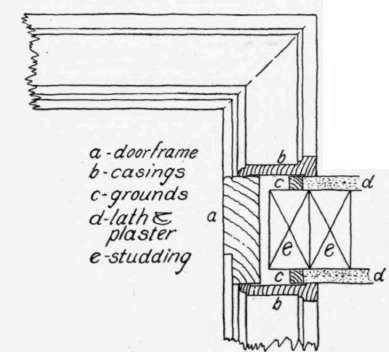
Fig. 78. - Section of Construction - a Door Frame.
Figure 78 shows the horizontal section of a door frame, its finish, and a part of the partition in which the frame is set.
(B.) It frequently happens that a detail may be too large in one or more of its dimensions to be drawn in the desired scale ; in such a case, if the shape of the detail permits it, the entire length may be shown by breaks being introduced in places where the part broken out is of the same dimension and detail as at the breaks, as shown in Fig. 79.
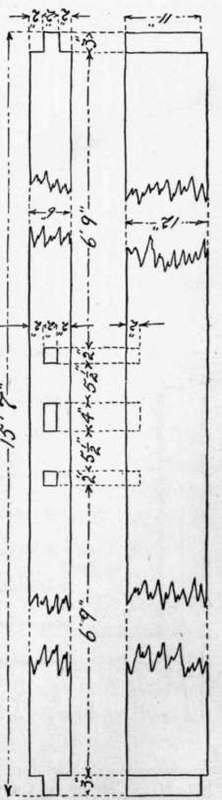
Fig. 79. - Method of Showing a Large Detail
Continue to:


My Books

