


46. Drawing Tools
Description
This section is from the book "Elements Of Construction", by Charles A. King. Also available from Amazon: Elements of construction.
46. Drawing Tools
Drawing Tools. (A.) The board equipment. - In making a working drawing, the student should have a drawing board (Fig. 85, a), a T square (6), and also a 45° triangle (c), a 30° and 60° triangle (d), and thumb tacks (/). (See also Figs. 163 and 164.)
Besides the above tools, there should be an architect's triangular scale, pencils, erasers, both hard and soft, and a set of drawing instruments, which may be as simple or as elaborate as desired. A medium-priced set, con-taining the compass with pen and pencil points, divider, ruling pen (if ink work is to be done), and one or more of the spring bow instruments, will be found serviceable and convenient, though the latter instruments may be omitted if desired, as they are necessary only upon small details where accuracy is required. It is false economy to purchase the cheapest set possible, as satisfactory results cannot be obtained by their use; on account of the poor material of which they are made, repeated adjustments will quickly strip the screw threads. A ruling pen with either a wood or a metal handle will be found more serviceable than one of bone, as the latter will break easily.
(B.) In ordinary architectural drawing, and in the drawing connected with this series, by far the larger part of the work will require only the board equipment; therefore, on account of the space required, special instructions in the use of the instruments will be omitted. The writer has observed that the average student will master the use of the instruments in less time than is required for him to attain a moderate facility in the use of the board equipment.
In using the board tools, the head of the T square should invariably be kept upon the left of the board, as in Fig. 85; it may be moved from top to bottom of the board to allow horizontal, parallel lines to be made at any point upon the paper, as indicated by lines m m.
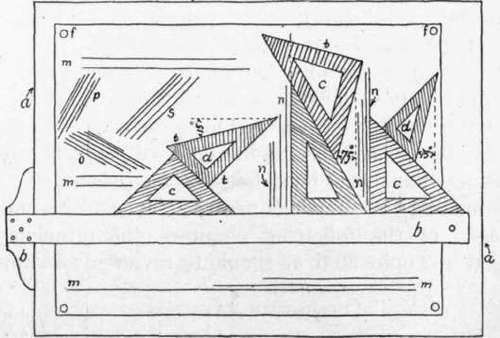
Fig. 85. - Drawing Board, T Square, and Triangles.
Vertical lines (n n), or lines at an angle of 90° with the T square, should be made by the triangles, but if these are not large enough to allow the required line to be made, the T square may be used. Lines at an angle of 30° or 60° with the T square, as at o and p, should be made by the 30° and 60° triangle, resting upon the T square as indicated. Lines at an angle of 45° should be made by the 45° triangle, as at s. The 15° and 75° lines may be made by placing the triangles as shown at t; in fact, any degree divisible by 15 may be drawn by the manipulation of the triangles from the T square in its horizontal position.
To make parallel lines in any part of the paper, which cannot be made by either of the triangles resting upon the T square in its horizontal position, place the T square at any angle that will allow the triangles to rest upon its edge and coincide with the desired angle.
The paper should be placed square with the left end of the board, as shown. The pencils should always be kept sharp, and in drawing horizontal lines should be used only upon the top edge of the T square and upon the edges of the triangles, not against the edge of the rule. The latter should be used only for measuring; if used for guiding the pencil, the graduations will soon become so indistinct that it will be difficult to read them.
In making the drawings necessary in working out the exercises of the following chapters, the principles explained in Topics 39 to 43 should be reviewed and applied.
Continue to:


My Books

