


Non-Mechanical Water-Closets. Part 2
Description
This section is from the book "Sanitary Fittings And Plumbing", by G. Lister Sutcliffe. Also available from Amazon: Sanitary fittings and plumbing.
Non-Mechanical Water-Closets. Part 2
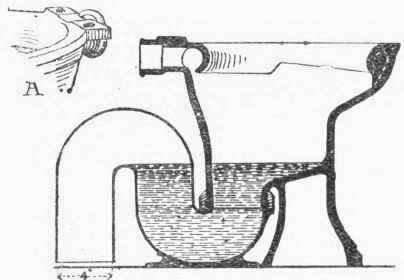
Fig. 97. Shanks's "Compactum" Wash-down Pedestal Closet with Lead Trap.
The next example (fig. 97) shows a more recent closet of the same type, the "Compactum." In this the waterarea measures 8 1/4 in. by 6 1/2 in., and the depth of the trap-seal is increased to 3 in. The flushing rim is also of improved form, so as to discharge the bulk of the water towards the front of the basin, and the basin is made with an extension at the back (shown at A) to which the seat can be attached; this is better than fixing the seat to the wall. The extension is raised so as to keep the seat clear of the basin. The "Compactum" is a pedestal closet, and is made with a drawn-lead trap of P or S form, or with a pottery trap in one piece with the basin. The lead trap can be turned in any direction at the rear of the basin within an angle of about 90 deg.-that is to say, 45 deg. on either side of the central line of the closet. This is a great convenience in many situations. The joint between the trap and basin is below the level of the standing water, so that a leak cannot fail to be observed.
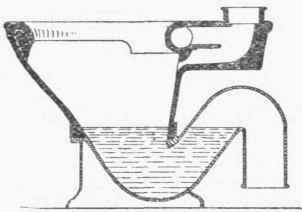
Fig. 98. Shanks's "Citizen" Wash-down Pedestal Closet with Cast-iron Trap.
Fig. 98 shows a "Citizen" closet, with glass-enamelled cast-iron trap and glazed fireclay basin; it is intended for use in industrial dwellings and other places where the apparatus may be subjected to rough usage. Pedestal closets are also made with half-traps, as in fig. 99, the advantage being that the joint between the pottery and metal is below the water-line, and that leaks can be discovered as soon as they occur.
The pedestal closet was a great improvement on the enclosed closet, as it allowed the floor and wall around the closet to be kept clean. But a further improvement was effected by supporting the closet on lugs or brackets, so as to be entirely clear of the floor. An example of this kind with drawn-lead half-trap is given in fig. 99. The basin is of white glazed earthenware with half-trap, having a flanged outlet D, to which the flange B of the lead half-trap is joined by means of a rubber washer C, and a loose brass collar A secured with hook-bolts. The trap may be of P or S form. The basin has a "slop-top" with raised rim, and is supported on an iron band E bedded in putty, this band being in turn supported by iron brackets. The surface of the water in the basin measures 7 in. by 5 1/2 in., and the depth of trap seal is 2 in.
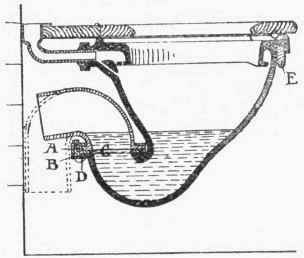
Fig. 99. Milne's "Suspension" Wash-down Closet with Lead Half-trap.
Closets with basin and trap in one piece are almost invariably made as independent pedestal or bracket closets. The designs for pedestal wash-down closets are innumerable. The position of the trap outlet modifies the design to a very considerable extent. Fig. 100 shows a wash-down closet with central outlet intended to take the place of a valve or pan closet without altering the position of the branch of the soil-pipe. The joint at the outlet of the trap is not above the floor, and the closet therefore contravenes the regulations of the London County Council. The water-area in such closets is necessarily small. In most closets of this kind it is impossible to make a thoroughly good joint at the outlet of the trap or to inspect it afterwards. In the example given, however, the side portions of the pedestal are made loose, as shown at A, so that the joint can be made and afterwards repaired. The trap itself is not ventilated. It is a great mistake to fix a new closet on old plumber's work-at any rate if this was formerly connected with a pan-closet
-as the old plumbing is in all probability as insanitary as the old closet.
The closet with back outlet (fig. 101) is intended for fixing in the place of an old "wash-out" apparatus, without having to alter the branch of the soil-pipe. Like the previous example, it has only a small area of water. The trap has a ventilationsocket, although not in a good position, and the outlet joint of the trap, although accessible from the back of the pedestal, is not above the floor.
The well-known "Simplicitas" closet, 1898 pattern, is one of the best modern wash - down apparatus. The water-area (fig. 102) is about 10 1/2 in. by 6 3/4 in., and the exposed surface of the basin is very small. The depth of the trap-seal is 2 in., and the outlet of the trap (which may be of P or S form) is well above the floor. The original "Simplicitas" closet had a water-area measuring only about 6 in. by 5 in., or less than half that of the new pattern.
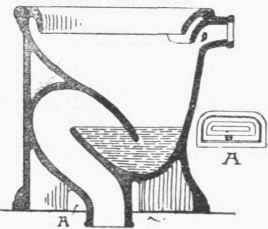
Fig. 100. Wash-down Pedestal Closet with Central Outlet.
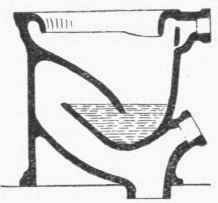
Fig. ioi. Wash-down Pedestal Closet with Back Outlet.
Bracket wash-down closets, in one piece of fireclay, are made by different firms under licence from Mr. Hellyer, the original patentee, who, we believe, was indebted for the idea to Mr. Keith D. Young, F.R.I.B.A., although he had previously made specially shallow wash-down closets and supported them on flat cast-iron brackets. They have the advantage of leaving the floor perfectly unobstructed, and have been adopted largely for hospitals and asylums. They are known by various names, such as Bracket, Corbel, Console, and Projector. The projection ought to be such that the joint between the outlet and the branch of the soil-pipe is within the room, and not in the thickness of the wall. Fig. 103, known as the "Projector," is satisfactory in this respect; the water-area is about 7 in. by 6 in. The bottom of the closet is 3 in. above the floor.
Continue to:


My Books

