


Non-Mechanical Water-Closets. Part 3
Description
This section is from the book "Sanitary Fittings And Plumbing", by G. Lister Sutcliffe. Also available from Amazon: Sanitary fittings and plumbing.
Non-Mechanical Water-Closets. Part 3
It is impossible in the space at our disposal to discuss all the different forms of wash-down closet. Strong glazed fireclay or enamelled cast-iron closets are made for workshops and other places where they will be subjected to rough usage. For prisons the fireclay closet is sometimes encased in sheet-iron, the space between being filled with cement, while the flushing apparatus is actuated from an adjacent corridor. In some cases, prison closets are made to fit an angle of the cell. Some pedestal closets are made with a flat back to fit closely against the wall; this does away with a confined space which is difficult to keep clean, but the outlet joint must be formed in the thickness of the wall and cannot be inspected without removing the closet or providing an inspection opening on the outside of the building.
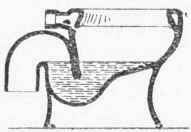
Fig. 102. Doulton's "Simplicitas" Wash - down Pedestal Closet (1898 pattern).
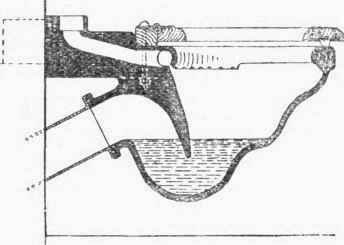
Fig. 103. Shanks's "Projector " Wash-down Closet.
The wash-down closet shown in fig. 104 represents a new departure in some respects. It is known as the "Anti-fouling and Non-contagious Water-Closet," and was designed by an architect (Mr. Lanyon, of Belfast) for use in public places, and in barracks, workhouses, and other institutions. The plan of the basin is long and narrow, measuring at the water-line about 10 1/2 in. by 4 1/4 in.; the back is nearly vertical and is kept well in the rear of the opening at the top of the basin; in the front of the basin a shallow recess or groove is formed, which is continued forward through the rim and seat. The flushing-rim has the openings equal in area to the area of the flush-pipe, the openings being increased in size towards the front, so that the principa part of the flush is discharged in the front part of the basin. The rim is 3 in. wide, and slopes inwards, so that the closet can be conveniently used for slops or as a urinal. There is a good depth of water in the basin, so as to prevent fouling of the bottom. The seat also is specially designed. The outlet of the trap is above the floor, and is provided with a ventilation socket. A three-gallon flush is required to clear the basin and trap.
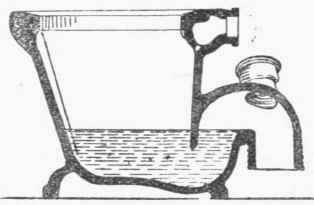
Fig. 104. Lanyon's "Anti-Fouling" Wash-down Water-Closet.
The closet shown in fig. 105 is one of Adams's and is peculiar in having the outlet of the trap turned to the side. This is convenient when a range of closets is required, or when a single closet must be fixed with the back against a return wall at right angles to the external wall. The basin and trap may be in one piece of "Titanite" as shown, or a half-trap of lead may be used after the manner illustrated in fig. 99. The wood seat is supported on the extension at the back of the basin, and the cistern is operated automatically (by means of the spindle A) when the seat is released.
Disinfecting wash-down closets have been designed, but have not come into general use. In one closet of this type a chamber is formed behind the basin to receive a block of disinfectant, and a portion of the flush passes through the chamber and carries with it the solution which has been formed since the previous flush. In ordinary closets disinfectants are in normal circumstances unnecessary, and in cases of infectious disease, disinfectants of a known strength ought to be applied every time the closet is used.
3. Wash-out Closets.- These closets were very popular from fifteen to twenty years ago, but are now little used. The special feature (fig. 106) is a shallow basin for the reception of the faeces. This basin holds water to the depth of about 1 or 1 1/2 in., and has a weir on one side, over which the contents are driven by the flush of water from the cistern into the trap below. The force of the water is broken by the basin, so that the trap is seldom cleared with one 2-gallon flush. The lip of the weir and the sides of the vertical tube leading to the trap are quickly coated with filth, and the depth of water in the basin is too little to cover and deodorise the soil. The closets are made for enclosure in woodwork or as pedestals, the trap (which may may be of S or P shape) being sometimes in one piece with the basin (as in the illustration) and sometimes in a separate piece. An after-flush chamber A is provided on the inlet horn to recharge the basin.
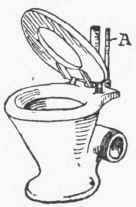
Fig. 105. Adams's Wash-down Closet with Side Outlet.
4. Siphonic Closets.- We have seen that the wash-down closet was evolved from the hopper closet. The siphonic closet is merely another step in the process of evolution. The basin is practically a wash-down basin, but with a greater depth and area of water and a greater depth of trap-seal. The outlet-arm of the trap is also continued well below the bottom of the basin, in order that the greater portion of the contents of the basin may be removed by siphonage. The essential difference between the wash-down and the siphonic closet is that in the former the contents of the basin are driven out by the flush, while in the latter they are drawn out by siphonic action which is indeed started by the flush, but, when once started, continues independently. The method of starting the siphonic action varies in different closets.
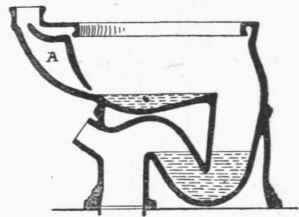
Fig. 106. Wash-out Pedestal Closet.
Siphonic closets are almost invariably made in pedestal form, and may therefore, when fixed in houses, be used as slop-receivers. In some closets the siphonic action will be started if a pailful of slops or water is poured into the basin, and the contents of the basin will be siphoned out without the flushing cistern being put into operation. The seal of the closet-trap may therefore be destroyed or very much reduced. Other closets, however, are so designed that the siphonic action can only be started by the water from the flushing cistern. Others, again, are so arranged that if from any cause the siphonic action of the basin is started, the flushing cistern is automatically set in action.
Many siphonic closets require a trap on the branch of the soil-pipe in addition to the trap in the closet itself. This forms a double safeguard against the entrance of drain air; but as the pipe between the two traps cannot be properly ventilated (otherwise the siphonic action could not take place), it may contain foul air, and some of the most recent closets substitute for the second trap one or more square bends in the branch pipe, which ensure siphonic action by checking to some extent the escape of the water.
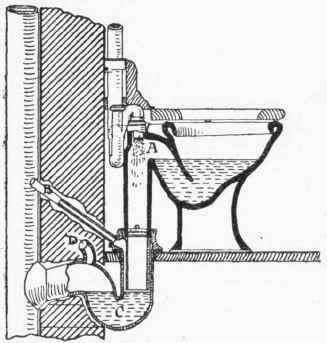
Fig. 107. Jennings & Morley's "Closet of the Century "- Siphonic.
Jennings & Morley's "Closet of the Century" (fig. 107) is one of those with two traps, although it can also be used with a weir bend, instead of the lower trap. Siphonic action is started by part of the flush-water passing through a nozzle,
Continue to:


My Books

