


Lavatories For Schools, Etc
Description
This section is from the book "Sanitary Fittings And Plumbing", by G. Lister Sutcliffe. Also available from Amazon: Sanitary fittings and plumbing.
Lavatories For Schools, Etc
Enamelled fireclay lavatories are largely adopted in schools and other places where they are likely to be subjected to rough usage. The ordinary basin (fig. 53) contains no special features. The overflow is formed in the fireclay, and the ends of adjacent slabs are either formed with plain butt-joints or with an enamelled fireclay joint-piece which overlaps as shown at A. Sections of two of these basins are given in fig. 54. These lavatories may be supported on glazed brick piers, enamelled fireclay pedestals, or iron brackets or standards. The sizes of the tops range usually from 20 in. by 18 in. to 26 in. by 20 in., but many School Boards prefer smaller dimensions, particularly for infants' use.
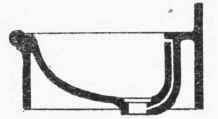
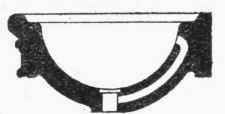
Fig. 54. Sections of Fireclay Lavatories with Ordinary Overflows.
To facilitate the cleaning of the floors and walls,

Fig. 55. Shanks's "Projector" Lavatory.
"corbel" lavatories are now made, having fireclay lugs for building into the walls. The example in fig. 55 is known as Shanks's "Projector"; it has a rounded front, a safety waste, and an improved overflow, and the glaze is continued under the basin. The sizes range from 18 3/4 in. by 15 1/2 in. to 25 in. by 19 1/2 in. Adams's "Helios" lavatory range (fig. 56) has fireclay brackets in addition. The chief objection to fittings of this class is the difficulty of removing and refixing them.
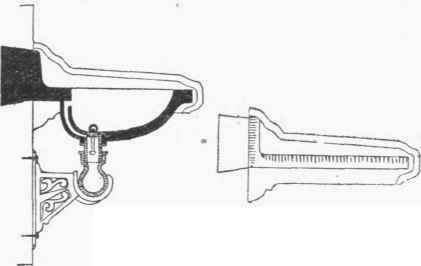
Fig. 56. Adams's " Helios" Lavatory.
"Constant-stream" Lavatories are now largely used for schools and other public institutions. The great advantage they possess over the ordinary basins is that the water is constantly changing, and two or more children cannot therefore wash in the same water; this reduces the risk of spreading contagious or infectious diseases. A further advantage is that a great number of persons can wash in a short time, as no time is lost in waiting for the emptying of basins. A single tap can be fitted to a range, and this tap can be so arranged as to be under the sole control of the attendant. One of the earliest lavatories of this kind is the trough lavatory with sprays (fig. 57). The illustration shows Doulton's arrangement, the troughs being 40 in. long and 12 in. wide, supported on iron brackets. The waste-pipes are of glass-enamelled iron and discharge into a floor channel. The sprays are 20 in. apart. Splashing, either wilful or accidental, is almost certain to occur where such lavatories are used.
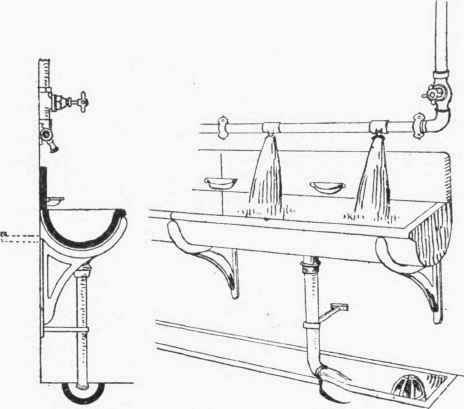
Fig. 57. Doulton's Trough Lavatory.
Fig. 58 is a section of Shanks's "Instanter" lavatory, in which the water is admitted to the shallow basin through a series of perforations B in the front, and overflows over a weir at the back; a small hole A is provided for emptying the basin when the water is turned off. No plug or other waste fitting is required. The iron standards are arranged to carry a horizontal waste-pipe C, into which the water from each basin flows directly. For schools the slabs measure 18 1/2 in. by 17 1/4 in., and for asylums 27 1/4 in. by 18 1/2 in.
Cassels's Patent " Clarifont " lavatories are also of the constant-stream type, and are better known in Scotland than in England. The essential feature is a shallow circular bowl rising in the middle of the trough-shaped slab. The type illustrated in fig, 59 is primarily intended for single basins, although it can also be fixed in ranges. The water enters the waste compartment A (which is plugged by the indiarubber ball B), and passes thence through the hole C to the bowl D, where it rises and overflows into the trough or channel E. From this it is conducted to the waste-pipe either by a tube F formed in the basin itself or by a separate iron or lead pipe. To facilitate the cleansing of the overflow channel F, a hinged metal grating is now fixed at G instead of the pottery grating shown. A large number of persons can wash in rapid succession, and the taps need not be turned off or the waste-plug removed until the last person has finished washing. This basin is made in two sizes, 25 in. by 20 in., and 27 1/2 in. by 21 1/2 in.; an angular basin with 24-in. sides is also made. Fig. 60 illustrates another type of "Clarifont" lavatory more suitable for ranges. The water enters the compartment A, rises in the bowl B, and overflows into the trough C. When these basins are fixed in ranges, holes are made in the adjacent ends as shown at D, connecting the troughs and conducting the water to a single outlet grating in the central lavatory. When the taps are turned off, the water drains from each bowl through the small hole E. No waste-plug is required, and one waste-pipe will suffice for a range of lavatories. For adults the basins are 24 in. long with one bowl in each; for children they are 30 in. long with two bowls in each.

Fig. 58. Shanks's "Instanter" Lavatory.

Fig. 59. Cassels's "Clarifont" Independent Lavatory.
The third type (fig. 61) is also intended for ranges, and a single valve supplies the whole of a range. The supply-pipe A is carried horizontally under the basins, and a vertical branch B is carried to each bowl. The channel C in this case is at the back, and the bowl is therefore nearer the front of the lavatory, which is a distinct advantage. The channels are continuous, so that a single waste-pipe serves for a range of basins. The valve is placed under the range, as shown at D, and serves both for supply and discharge. It consists of a short cylindrical vessel, to which the main supply-pipe E and the discharge-pipe F are connected. On closing the supply-valve the discharge-valve opens, and the water in the bowls drains away through the pipes B, A, and F to the main waste-pipe. An objection to this arrangement is that secret waste may easily occur without detection. The end basin may be supplied through a pedal valve, so that it can be used independently of the others. A soap-dish G is formed on the slope of the channel behind each bowl. For adults a single bowl is provided in a 24-in. basin, and for children two bowls in 26-in. and 30-in. basins.
Lavatories of the first type are made of earthenware, fireclay, or cast-iron, and those of the other types of fireclay or cast-iron. The cast-iron is either plain painted or metallic enamelled. The various basins may be supported on fireclay pedestals or on iron brackets or standards. It is said that the time required by school children to wash their hands in these basins is on an average 30 seconds per child, and that the amount of water required by each is only one quart.

Fig. 60. Cassels's "Clarifont" Lavatory for Ranges.
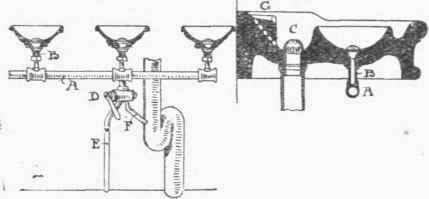
Fig. 61. Cassels's "Clarifont" Lavatory for Ranges with Single Supply Valve.
Surgical lavatories are now almost invariably made with treadle action, so that the hot and cold supplies and the waste can be operated by the foot or knee; this is a great convenience to the surgeon, and does away with the risk of contaminating the taps with foul or possibly infectious matter from the operator's hands. Fig. 62 shows a pair of the surgical lavatories, fitted by Shanks & Co., in the operating theatres of the Western Infirmary, Glasgow. The basins are of white vitro-porcelain, 1 ft. 6 in. in diameter, and fixed 2 ft. 2 in. from centre to centre on short vertical studs rising from circular cast-iron rims, the rims being carried by central back supports fixed clear of the wall. Every part of the framework can therefore be easily cleaned. The slabs are of glass f in. thick, and are fitted with a patent catch arrangement so as to be removable and adjustable. The hot and cold supplies are actuated by treadles fitted with rubber pads. The gun-metal box fitted to the wall above the basins has inlets for hot and cold water, and a swivel arm at each end for douche and spray. The standing waste-and-overflow is actuated by a knee treadle fitted with rubber pad, and can be easily removed for cleaning. The waste-pipe is of copper, held in position by a patent clutch, so that it can be removed for cleaning, and discharges into an open channel in the floor.
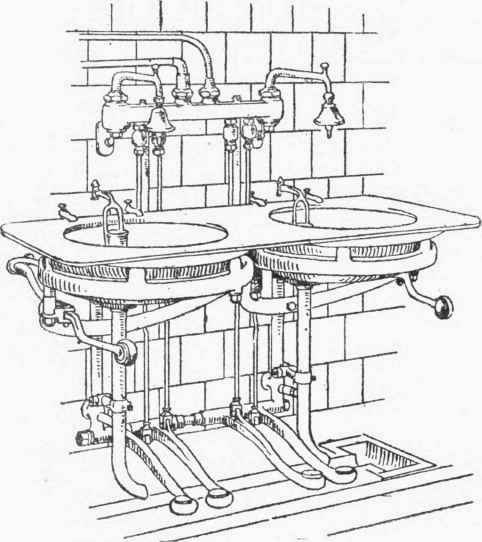
Fig. 62. Shanks's Surgical Lavatory.
A modification of the supply arrangements consists in having a single treadle for both cold and hot supplies. A slight depression of the treadle opens the cold-water supply, and a further depression opens the hot-water supply, the hot and cold water being mixed in the gun-metal box before reaching the basin. This prevents the risk of scalding the hands or breaking fragile instruments.
"Constant-stream" lavatories are also made for surgical purposes. In these a constant stream of water is admitted in a series of jets from perforations in the front of the basin, the water being continuously discharged over a weir at the back (see fig. 58). After the valves are closed, the water in the basin drains away to the waste-pipes through a small hole in the bottom. The valves are actuated by treadles, and the hot and cold water passes through a mixing box before reaching the basin. With lavatories of this kind a waste treadle is not required.
Supports
The prejudice against exposed lavatories and waste-pipes is now nearly dead, and the practice of supporting them on metal brackets or legs is rapidly increasing. We need not enter into the details of these supports, but may point out that elaborate scrollwork and ornamentation are quite out of place. The simpler the support is the better. For cheap fittings the brackets and frieze are generally of painted iron; sometimes the iron is vitreous-enamelled, but this is more expensive. In one of Doulton's recent lavatories the frieze is in one piece with the basin and slab, and entirely hides the T-iron brackets which support the lavatory. The neatest arrangement we have seen consists of round nickel-plated brass brackets or legs with similar rails fixed horizontally a few inches below the slab to form towel-rails. Sometimes porcelain-enamelled fireclay legs are used; for the most expensive work marble brackets or legs are sometimes used in conjunction with marble friezes, tops, and skirtings. As already stated, some fireclay lavatories are supported on lugs built into the walls; these are neat in appearance and do not obstruct the walls and floors below, but they are difficult to replace.
Continue to:


My Books

