


Chapter VI. Sinks
Description
This section is from the book "Sanitary Fittings And Plumbing", by G. Lister Sutcliffe. Also available from Amazon: Sanitary fittings and plumbing.
Chapter VI. Sinks
Varieties
Sinks are of various kinds. Among these may be mentioned (1) the sink-of-all-work, commonly known as a scullery or kitchen sink, which, being without a waste-plug, does not hold water; (2) the sink with waste-plug and overflow, often known as a butler's sink; (3) the nursemaid's sink, which is merely a variety of the butler's sink; (4) the vegetable sink; (5) the sink for washing pans and other hardware; (6) sinks for special purposes, such as laboratories, photographer's studios, operating rooms of hospitals, etc.; and (7) the housemaid's sink, which is generally fixed in connection with the slop-hopper, and will be more conveniently described in the chapter on fittings of the latter kind.
Materials
The different materials used for sinks include stone, slate, glazed ware of various kinds, cast and wrought iron, steel, tinned copper, wood, and wood lined with tinned copper or lead. There is not one of these materials which can be considered perfectly suitable for every kind of sink, but the most generally serviceable material is good glazed ware, which has the great advantage of cleanliness. The chief objection to such ware is its hardness, which results in damage being done to delicate crockery and glass. This danger can, however, be much reduced by the use of wood grids and drainers, as will be hereafter explained.
1. Scullery Sinks. - In workmen's houses the sink is often the only sanitary fitting which can be afforded. Such sinks are of the ordinary type without either plug or overflow. In former years they often consisted of a solid slab of stone with a portion dished out to a depth of 3 in. or 4 in., but this material, although durable in a sense, has the disadvantages of being pervious to moisture, and therefore difficult to keep clean, and of wearing away in places so that the water will not flow away to the waste outlet. Salt-glazed or enamelled fireclay is now generally preferred on account of its greater cleanliness. Sinks of this kind are commonly oblong, ranging in size from about 20 in. by 15 in. to 48 in. by 24 in., the outside depth being 5 in. to 6 in. The stock sizes of different manufacturers vary, so that it is now possible to obtain from stock a sink of almost any dimensions. Angular sinks of the shape shown in fig. 11 are also made.
Somewhat similar sinks, but of small size, are sometimes fixed in the floors under water-taps to catch the drippings, and are known as draining sinks.
The defects to be avoided in these and other pottery sinks are sharp arrises, as these are often damaged in transit or by contact with heavy pans, sharp internal angles, which render the cleaning of the sink more difficult, warping, which is often so serious as to prevent the water running to the waste-outlet unless the sink is purposely placed out of level, cracks in the body of the ware, and flaws in the enamel.
Kitchen sinks of this type are also made in cast iron, either finished black, or galvanised, or enamelled, and are suitable for tenement dwellings and other places where rough usage may be expected. The example given in fig. 12 cannot be recommended, as the trap is of the "bell" form. Such a trap is objectionable for several reasons:-The flow through it is so sluggish that the trap is not self.
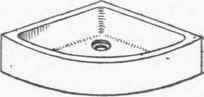
Fig. 11. Quadrant Scullery Sink.
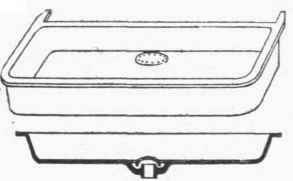
Fig. 12. Cast-iron Sink with objectionable Bell-Trap.
cleansing; the depth of seal is only 1/4 in., and the seal is therefore easily lost by evaporation; and the bell grating is often removed (for the purposes of cleansing the trap and expediting the discharge of the water from the sink), thus admitting more or less impure air through the waste-pipe into the house.
The "Sanitary" wrought-steel sink (fig. 13) is light and strong, and has the advantage of a roll-edge. The angles are well rounded,and the sink is finished inside with white metallic enamel, and supported on iron brackets. An anti-splash back of the same material is also made as shown. Porcelain-enamelled iron sinks are easily damaged, as the enamel chips off under a comparatively light blow or if very hot water is suddenly poured on to it. Galvanised iron is better, unless the water is soft moorland water, when the coating of zinc is soon eaten away and the iron exposed to the corroding influences of moisture and air.
2. Butler's Sinks.- Sinks of the kind already illustrated are really nothing but fittings for the reception of the foul water poured from vessels of different kinds, and of water dripping from the taps or draining from articles which have been washed. They do not hold water, and "washing-up" must therefore be performed in a vessel of wood, papier-mache, or metal, placed in the sink. Such an arrangement is often inconvenient, and in large establishments unworkable. The desired improvement is obtained by fitting a plug to the waste-outlet, so that the sink will retain water, and this alteration necessitates an overflow, so that, if a tap is left running when the waste is closed, the water can escape without overflowing the sides of the sink. A sink of this kind is shown in fig. 14; the overflow is of an old-fashioned type consisting of a pottery bend (in one piece with the sink), to which a lead pipe can be attached to convey the water to the sink side of the trap, or (if the local regulations demand) the lead pipe can be taken straight through the wall to the open air. These sinks can be obtained from 15 to 27 in. long, 12 to 16 in. wide, and 7 to 10 in. deep, outside measurements.
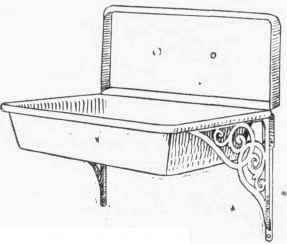
Fig. 13. The "Sanitiry" Wrought-Steel Sink and Back.
Continue to:


My Books

