


Chapter XVII. Urinals
Description
This section is from the book "Sanitary Fittings And Plumbing", by G. Lister Sutcliffe. Also available from Amazon: Sanitary fittings and plumbing.
Chapter XVII. Urinals
In ordinary houses special urinals are not required, as the water-closets serve the necessary purpose, provided that they are not enclosed with woodwork. A slop-top renders the closet more serviceable, but is not indispensable. In large houses (especially those containing billiard and smoke rooms) urinals may be of service, and in hotels, clubs, public buildings, schools, railway stations, and other places where men congregate, they are a necessity. They may be broadly divided into three classes-basins, troughs, and stalls. When basins and troughs are used the adjacent walls and floors ought to be of impervious materials, such as glazed tiles or glazed fireclay slabs, as a certain amount of splashing is unavoidable. All urinals ought to be provided with some kind of flushing apparatus, as they are extremely difficult to keep clean. Urine soon forms a coat of "fur" even on the smoothest surfaces, if these are not thoroughly flushed. The objectionable smell of urinals is greatly reduced, if not entirely removed, by keeping a piece of soda in each basin, trough, or stall, and the fur can be removed by a solution of spirits of salts.
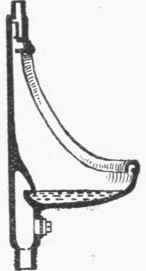
1. Urinal Basins. - These may be of enamelled cast-iron or of glazed pottery, the latter being the better material. Fig. 137 shows a "cradle-back" basin of cast-iron with fan-spreader inlet. It is obvious that the flush cannot reach every part of the basin. As in water-closets and slop-sinks, a flushing-rim is essential for the proper cleansing of the fitting; such a rim is shown in section in fig. 138, which represents a "flat-back" porcelain basin of good shape.
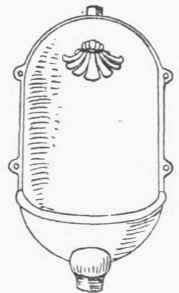
Fig. 137. Cast-iron Cradle-back Urinal with Fan-spreader Inlet.
Urinal basins may be "wide-fronted," as in fig. 137, or "lipped,"as in fig. 139. The lipped urinal was introduced with the idea that the projecting lip would prevent urine dropping on to the floor, but many men are afraid of soiling their clothes if they stand sufficiently close for the lip to serve the purpose for which it was intended. This is particularly the case when the basin is fixed too high. The urinal shown in fig. 139 is designed for fixing in the angle of a room. The pottery grating at the outlet cannot be regarded as satisfactory, as it is apt to become foul, and also renders the cleaning of the waste-pipe much more difficult. A loose brass grating is better.
One of the difficulties connected with urinal basins is that the users seldom take the trouble to flush them. When the water companies have no regulations to the contrary, a stop-cock is often fixed in the supply-pipe immediately above the fitting, but comparatively few people take the trouble to turn it. In some places where the basins are largely used the water is kept constantly running throughout the day, but this is a practice to which water companies object. A supply of water during the usage of the fitting is, however, most important, as it cleanses the basin and at the same time dilutes the urine, and thus reduces the risk of "fur" being formed in the trap and waste-pipe. The apparatus shown in fig. 140 is a simple contrivance for effecting this object. The basin is fixed in a wooden framework and is covered, when not in use, by a lid hinged at the top. The raising of the lid opens the supply-valve, and the water continues to run until the valve is closed by shutting the lid.
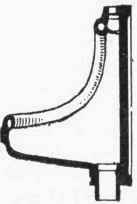
Fig. 138. Porcelain Flat-back Urinal with Flushing Rim.
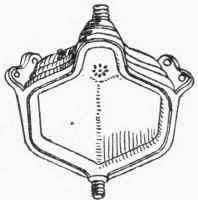
Fig. 139. Lipped Urinal-basin with Flushing Rim.
There is more woodwork around the fitting than is desirable, and the part below the basin might with advantage be omitted.
Folding urinals, generally of enamelled cast-iron, are sometimes fixed in offices and houses, but are apt to become very foul on account of the difficulty of flushing the surfaces of the containers, into which the urine falls when the basins are lifted up.
The ordinary urinal basin has a grating in the bottom or back with a nozzle for connection to the waste-pipe, and does not retain water. Theoretically this is not an entirely satisfactory fitting, and basins are sometimes made to retain a quantity of water, either by forming a trap in one piece with the basin after the manner of a wash-down closet, or by raising the waste-pipe so as to form a trap behind the basin. A trapped basin was designed by Mr. Hellyer some years ago, but the outlet of the P-trap was behind the basin, and the joint was therefore in the wall and difficult to inspect and repair. This objection has been removed in Tylor's urinal basin (fig. 141), but the seal of the trap is very small, and the outlet appears to be very contracted, and therefore difficult to clean. The amount of water retained in the basin is also too small to be of any practical use. If an ordinary wash-down closet, holding several pints of water is used as a urinal, and is not regularly flushed immediately after use, the surface below the water-level will soon be covered with fur. The dilution of urine, however satisfactory in theory, cannot be carried out to a sufficient degree in urinal basins to render it of any value, and it is much better to adopt a simple draining basin and to keep it clean by flushing and washing.
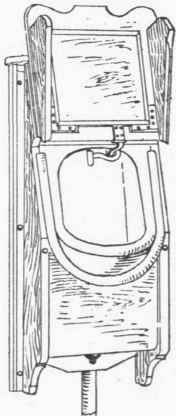
Fig. 140. Shanks's enclosed Urinal-basin with Lid-action Water-supply.
Continue to:


My Books

