


Exercise XII. Stopped Dovetail Halving
Description
This section is from the book "Manual Instruction: Woodwork. The English Sloyd", by S. Barter. Also available from Amazon: Manual Instruction: Woodwork.
Exercise XII. Stopped Dovetail Halving
This is similar to the ordinary dovetail halving, except that the dovetail does not go completely across the width of the timber. This form of halving is used where the end grain of the dovetail showing through the outside of the socket would be objectionable.
The dovetail must then be cut to the exact length required. It is, therefore, cut off true and square before commencing. The cut line for the shoulder should be very carefully marked at the proper distance from the end of the wood, at a in fig. 190, and with the gauge set at the same measurement make the line, b b, for the socket.

Fig. 189.
The other marking on the socket half will only be on the face edge and face side, and when the dovetail is applied to the pencil lines after cutting the wood in halves at c, it will leave about 3/8 in. of solid wood beyond the socket (see fig. 192).
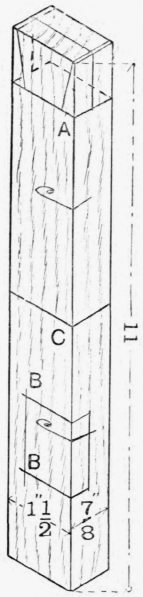
Fig. 190, showing setting out.

Fig. 191, showing dovetail cut.

Fig. 192.
The socket should be mortised out with a chisel, part of the inclined sides being cut with the tenon saw.
Continue to:


My Books

