


Standing Wastes
Description
This section is from the book "Sanitary Fittings And Plumbing", by G. Lister Sutcliffe. Also available from Amazon: Sanitary fittings and plumbing.
Standing Wastes
Combined wastes and overflows are now made in almost endless variety, but they are, as a rule, merely modifications of the old standing waste and overflow, of which the simplest form is shown in fig. 37. The vertical tube is made to fit into the washer of the waste-outlet, and so take the place of the plug. When the tube is in position and water is turned into the sink, the water will rise to the level of the top of the standing waste, and will then overflow down the standing waste to the waste-pipe below. A simple improvement consists in attaching the standing waste to a hook and knob above, so arranged that, when the knob is raised and slightly turned, a projection on the spindle passes into a corresponding socket or over a bar, and holds the standing waste clear of the grated outlet; by a backward turn of the knob, the waste is released and drops back into the washer.
Sometimes these standing wastes are concealed in small chambers formed at the back of the sink, but this arrangement cannot be recommended, as neither the chambers nor the standing wastes can be kept clean. The grease and other objectionable matters present in the water of sinks will soon render concealed parts of the apparatus extremely foul, and it is, therefore, highly desirable that standing wastes should be exposed to view, and should be easily detached for cleaning. A very good form of waste (Shanks's "Simplex") is illustrated in fig. 38, which is adapted either for lavatories or sinks. To empty the basin, the standing waste is raised and slightly turned; a further turn will permit the waste to be taken out. If desired, the waste is furnished with a set-screw, so that it cannot be removed from the guide; this arrangement is suitable for asylums, schools, etc.
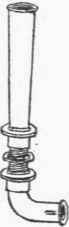
Fig. 37. Standing Waste and Overflow.
Standing wastes are generally made of copper, brass, or gun-metal, and often have a rubber seating around the lower end to form a watertight joint with the washer or with the pottery itself. Porcelain standing wastes have also been made, and xylonite has recently been pressed into service. Porcelain and xylonite, however, will not stand rough usage, suitable though they may be in other respects; for this reason porcelain cannot be recommended, and xylonite only for lavatories in private houses, where they will be carefully used. They are not suitable for sinks.
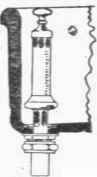
Fig. 38. Shank's "Simplex " Waste and Overflow.


Fig. 39. Brass Overflow Grates and Tail Pipes.
Overflows - Several kinds of overflows have already been described and illustrated, from the old-fashioned pottery overflow in fig. 14, page 36, to the more modern forms of pottery overflows and of combined metal wastes and overflows. Two simple overflows for connection with lead pipes are shown in fig. 39. In that marked A the joint is made tight by bedding the metal in suitable cement and screwing the grating to the bent tail-piece; the grating of B is fixed with two screws to the back plate. These overflows and the pipes connected with them cannot be easily cleaned, and are therefore not as satisfactory as some of the other kinds which have been described.
Continue to:


My Books

