


Chapter X. Bath Overflows And Wastes, Etc
Description
This section is from the book "Sanitary Fittings And Plumbing", by G. Lister Sutcliffe. Also available from Amazon: Sanitary fittings and plumbing.
Chapter X. Bath Overflows And Wastes, Etc
Improvements in bath wastes and overflows have in the main followed the same lines as the improvements in the corresponding parts of sinks and lavatories. The tendency has been to make the various parts more accessible for cleansing, to increase the size of the waste-outlet in order that the bath may be emptied more quickly and the waste-pipe and trap be self-cleansing, and to render the parts as simple and as easily adjusted as possible.
Overflows And Wastes
In some towns the by - laws require that every bath shall be fitted with an overflow - pipe carried through an external wall, and left with the end exposed, so that any waste of bath-water can be detected by the water-inspectors without entering the building. It is not customary to place a trap on such a pipe, as the flow of water through it is so irregular that the trap would probably be unsealed by evaporation. An untrapped pipe, however, will serve as an air-inlet unless some method of closing the opening is adopted.
The simplest arrangement consists in fixing a flap-valve
(fig. 74) on the end of the pipe. A is a copper valve and tube with curved spring on the top to prevent the valve opening too far, B is a brass valve with union for iron pipe, and C a brass valve for connection with lead pipe. The overflow-pipe is connected to the bath by means of a brass union and grating as shown in fig. 39, page 51.
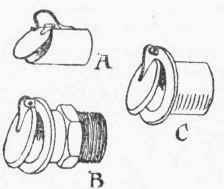
Fig. 74. Flap valves for Overflow Pipes.
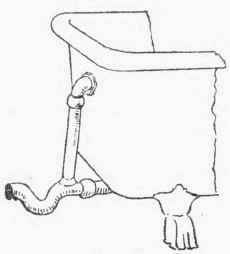
Fig. 75. Connection of Overflow with Waste-pipe.
This kind of overflow is commonly adopted in cheap baths, a plain hole being left in the iron or other material to receive the grating. In towns where the connection of the overflow and waste-pipe is not prohibited, a pipe is often taken from the overflow grating and connected with the waste - pipe.
The joint ought to be between the bath and the trap, as shown in fig. 75, but the writer has known several cases where ignorant plumbers have fixed the trap close to the bath and connected the overflow-pipe to the waste-pipe at some point beyond the outlet of the trap. A free current of air can therefore pass up the waste-pipe to the junction with the overflow-pipe, and then up the latter to the bath-room. As the waste-pipe of a bath is often to some extent fouled with soapy or other matter, the air may be contaminated, and, unless the foot of the bath is properly disconnected, still fouler air from the drains may be carried into the house.
With grated overflows of the type already described, the waste is generally an ordinary washer with fly-nut, union, and bent tail (fig. 76), fitted with a plug and chain.
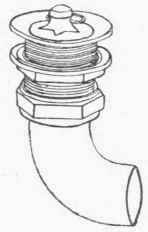
Fig. 76. Bath-waste Washer and Union with Bent Tail.
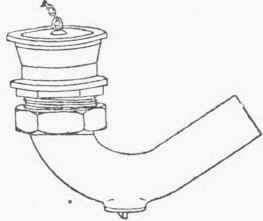
Fig. 77. Brass Bath Trap with 3-in. Inlet and 2-in. Outlet.
Sometimes in cast-iron baths a cast-iron trap is fitted to the outlet. If an ordinary chain and plug is used, the overflow-pipe cannot be connected to the waste-pipe between the trap and bath, and must therefore be carried through an external wall for the reasons already stated, or made to discharge over a lead safe from which a pipe must be carried through the wall, and finished with a flap-valve.
Many bath-traps are of the "dip" type and are far from satisfactory.
The brass bath-trap shown in fig. 77 is of better shape, and has a 3-in. rubber or vulcanite plug with cross - bars below, and a trap tapering to 2 in. at the outlet. The flange is 4 5/8 in. in diameter, and the screw 3 1/2 in., the total height being 8 in., and the trap is provided with a cleansing screw.
Instead of the lead overflow-pipe and trap shown in fig. 75, other metals may be used. In Milne's "Exposed Combined" bath-fittings (fig. 78), the principal parts are gun-metal, either polished or nickel-plated. These fittings are made in three sizes, having respectively 2 1/2-in., 3-in., and 4-in. vulcanite plugs, 2-in., 2 1/2-in., and 3-in. cast brass traps, with 1-in. or 1 1/4-in. couplings for anti-siphonage pipes, 2-in., 2 1/2-in., and 3-in. overflows and standards, and 1-in. or 1 1/4-in. solid-drawn copper supply pipes (13 B.W.G.). A perforated soap-tray, 4 5/8 in. in diameter forms the top of the overflow standard, and can be unscrewed for cleaning the standard and trap.
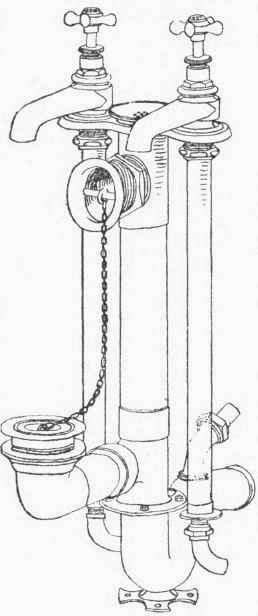
Fig. 78. Milne's "Exposed Combined" Bath Fittings.
In many cast-iron baths the overflow-tube forms part of the casting; fig. 79 is an example. The trap is of cast iron 2 1/2 in. in diameter and glass-enamelled inside, and forms a connection with the foot of the overflow-tube. The plug is of the safety type, and is actuated by a spindle passing through the outlet grate, which is fitted with a bayonet catch so as to be easily removed when the valve or trap requires cleaning. It is an advantage to have the grating above the plug, as the openings in it can be more easily kept clean than when the grating is in the washer below it. A slab of porcelain is fitted across the foot of the bath to form a tray for soap, sponges, etc. This tray drains into the bath through the perforation in front of the taps; another perforation is made near the back of the slab, so that a brush can be passed through to clean the overflow-tube.
The overflow in Shanks's "Perfecto" bath (fig. 80) is merely a modification of the last. The upper part of the foot of the bath is made with a slope, so that the overflow is vertical and more easily cleaned. The overflow-pipe is oblong in section, and is of glass-enamelled cast iron, swelling out at the foot to fit the 2 1/2-in. glass-enamelled cast-iron trap, which is fitted with a brass union for connection
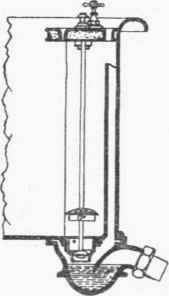
Fig. 79. Cast-iron Bath with Overflow Tube, Trap, to the lead waste-pipe. A special feature of the bath is the waste arrangement, with valve working horizontally and actuated by a spindle and knob, and with a hinged nickel-plated brass grating. The porcelain soap-tray supported by the taps is quite detached from the bath itself, so that every part of the bath and tray can be easily cleaned. Instead of the porcelain tray, a nickel-plated brass soap-and-sponge holder is sometimes used and has the advantage of being easily removed.
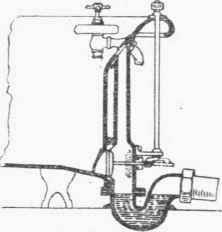
Fig. 80. Shanks's "Perfecto" Bath.
Continue to:


My Books

