


Lead To Brass And Copper
Description
This section is from the book "Sanitary Fittings And Plumbing", by G. Lister Sutcliffe. Also available from Amazon: Sanitary fittings and plumbing.
Lead To Brass And Copper
Joints between lead and brass or copper present no peculiar difficulty. After the end portion of the brass or copper pipe has been "tinned," it can be united to the lead pipe either by a copper-bit or a wiped joint.
Lead To Iron
In uniting lead to iron, a flanged brass or copper thimble or "sleeve" is generally used, as shown in figs. 182 and 183. In fig. 182 the lead pipe is united to the upper end of the thimble by a wiped joint, while in fig. 183 the lead pipe is passed through the sleeve-piece, the two being united at the top by a wiped joint. This is by far the better arrangement. In both cases the lower end of the brass or copper is placed in the socket of the iron pipe, and the joint completed by running the socket full of molten lead and thoroughly caulking it. A few strands of yarn may be caulked into the bottom of the socket to prevent the lead running through the joint into.the iron pipe. The thimbles must be strong enough to resist the strains caused by the caulking tools. Brass thimbles can be obtained in two thicknesses, known as "light" and "medium," and in sizes increasing by 1/2, in. from 2 in. to 4 in. Brass sleeves are generally made 1/4 in. larger in diameter to allow the lead pipe to pass through. As a rule thimbles and sleeves are of cast brass, but solid-drawn brass ferrules are now made in sizes varying by 1/4 in.
from 1 1/2 in. to 4 3/4 in. The brass connections ought to be of sufficient length so that the wiped joint will be quite clear of the iron socket. Connections 1 3/4 in., 2 1/4 in., and 2 3/4 in. in diameter can be obtained from 3 1/2 in. to 6 in. long, and larger sizes from 4 in. or 4 3/4 in. to 6 in. long. Heavy cast-brass sleeves for uniting lead to iron soil-pipes (4 in. in diameter) are made 4 3/8-in. bore, 4 7/8 in. over the flange, and 6 1/2 in. long.
Another form of joint (fig. 184), known as Taylor's, is intended for uniting a lead branch to an iron soil-pipe. The iron junction-pipe is cast with an oval flanged opening, A, and a loose iron collar, B, is supplied of the same shape as the flange. The oval opening allows the branch to be made at various angles. The end of the lead branch must be cut to the required bevel, passed through the loose iron collar, and tafted back about three-quarters of an inch all round. The face of the iron flange is then covered with red-lead putty, and the joint is completed as shown at C by tightening the four bolts, the lead flange on the end of the branch being compressed between the iron flange and collar. This joint has been approved by the Sanitary
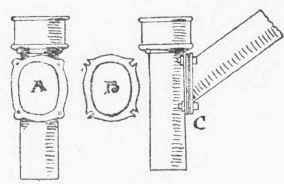
Fig. 184. Taylor's Lead to Iron Joint.
Authorities in Manchester and other towns in the North of
England, and has the advantage of being easily disconnected for the purpose of repairing the closet or soil-pipe. The same sizes of junction and collar are used for connecting a lead anti-siphonage pipe to an iron soil-pipe, but in this case a wide flange of sheet-lead must be wiped to the end of the lead pipe.
Robinson's "Enable" caulking thimble (fig. 185) is of iron covered inside with lead, which is also turned over to the outside of the iron at the top and bottom. A soldered joint can be made between the lead pipe and the lead covering of the thimble, and the annular space between the thimble and the socket of the iron pipe can be caulked with lead in the usual way. The thimble is of smaller diameter than the iron pipe to which it is connected.
When the position of the lead and iron pipes is reversed-that is to say, when the flow of water is from the iron to the lead pipe-a different form of joint is required. A brass socket with tinned tail may be used, as shown in fig. 186. The spigot end of the iron pipe or trap is placed in the socket, and the joint completed with neat Portland cement, or (better, if the brass is of sufficient strength) with caulked lead. The tinned tail is united to the lead pipe by means of a wiped joint.
Sometimes a flange is cast on the outlet of the iron trap, and a corresponding flange is formed on the lead pipe by tafting; the two flanges are then bolted together with an indiarubber washer between. A loose collar of brass or iron is placed outside the lead flange, after the manner shown in fig. 184.
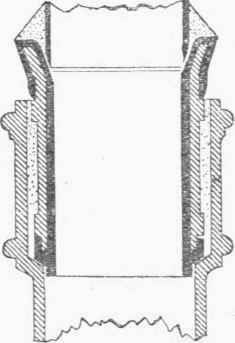
Fig. 185. Robinson's "Enable" Caulking Thimble.
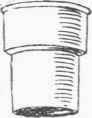
Fig. 186. Brass Socket.
Continue to:


My Books

