


Chapter VIII. Lavatories
Description
This section is from the book "Sanitary Fittings And Plumbing", by G. Lister Sutcliffe. Also available from Amazon: Sanitary fittings and plumbing.
Chapter VIII. Lavatories
Materials
The material generally used for household lavatories is white earthenware or pottery, commonly known as porcelain or by some special name such as queensware. The great defect of this material is its fragility, and in cheap ware (as in cheap household crockery) the glaze soon "crazes" into a network of fine lines which detract very much from the appearance of the fittings. Better fittings are now made of a semi-vitrified porcelain, while for the strongest lavatories enamelled fireclay is often adopted. Cast-iron basins are also made, enamelled in various ways. Tinned copper is also an excellent material, especially for folding lavatories; the copper is extremely durable, but the coat of tin wears off; the copper can be retinned, but this necessitates the removal of the fitting. Many high-class lavatories are made with porcelain basins and marble or onyx slabs and skirtings, about I in. thick; it is an advantage to have the slabs slightly dished (fig. 40) to prevent water flowing over the slab on to the floor. Slate slabs are used instead of marble for cheaper fittings.
Shape
The common lavatory has generally a round or oval basin, but the D-shaped basin is now preferred as more convenient in use. Pottery slabs are as a rule rectangular, but lavatories with rounded fronts are made and are very convenient in confined spaces, as also are angle basins for fixing in the corners of rooms. Sometimes the central part of the front is slightly recessed, so that the person using the lavatory can stand more closely to the basin. The slab is usually in one piece with the basin, and a low pottery skirting along the back and ends also forms an integral part of the fitting. The bottom of a lavatory basin ought to have a good slope to the waste outlet, so as to prevent as much as possible the deposit of soapsuds. Figs. 41 to 45 show different sections of basins.
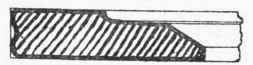
Fig. 40. Dished Marble Slab for Lavatory.
Some lavatories have been made with flushing rims, so that the surface of the pottery can be cleansed by simply turning the tap. They are, however, seldom used, although the rims have the double advantage of cleansing the basins and preventing splashing.
Twin lavatories, containing two basins with slab and skirting, are now made in one piece of pottery, and, as already mentioned, combined sinks and lavatories can be obtained in a single piece of enamelled fireclay.
Size
The most general size of lavatory slabs is about 27 in. by 20 in., but many smaller sizes are made, and also larger sizes up to about 30 in. by 22 in. A specially large lavatory made by one firm has a slab measuring 39 3/4 in. by 28 1/2 in., with a rectangular basin 24 1/2 in. by 16 1/4 in. The marble slabs used for lavatories range in size from about 30 in. by 24 in. to 36 in. by 25 in.
Common Defects
The ordinary lavatory, with pottery overflow-nozzle for connection with lead pipe, and with plug waste, is too well known to need illustration. It is generally defective in several important details-the overflow is too small to carry off the water from a high-pressure service, and cannot possibly be kept clean, and the waste is too small to admit of the basin being emptied with sufficient rapidity either for convenience in use or for cleansing the trap and waste-pipe. The grating under the plug is also so small that it is soon choked with hairs, soap, etc, and is placed at such a depth that these cannot easily be removed. At one time the dishes for soap and brushes were sunk below the slab, and the water drained away through small holes into pottery nozzles, from which it was conveyed by small pipes to the trap under the basin. These holes and pipes could not possibly be kept clean, and have long been superseded by simple grooves which convey the water from the dishes directly into the basin.
Wastes And Overflows
Ordinary lavatory wastes are practically the same as those used for sinks. Rubber or vulcanite plugs are less dangerous than metal, and ought to be 11/2 in. in diameter for use with a 1 1/4-in. trap and waste-pipe.
In order to simplify the plumber's work, the overflow is often formed entirely in pottery from the overflow openings to the waste-outlet, a perforated washer being used for the plug, as shown in fig. 35, Page 49.This overflow is quite as difficult to clean as the old-fashioned pipe, and a further improvement has been effected by continuing the overflow tube up through the slab in the manner described and illustrated in the chapter on sinks. The opening in the slab is generally fitted with a loose porcelain or metal cover. Such an arrangement is shown in fig. 41; in this case a safety-plug with spindle and knob takes the place of the ordinary plug and chain, the advantages being that the plug cannot be removed, that the basin cannot be damaged by letting the plug fall upon it, and that the grating is level with the bottom of the basin, and can, therefore, easily be kept clean and free from obstruction.
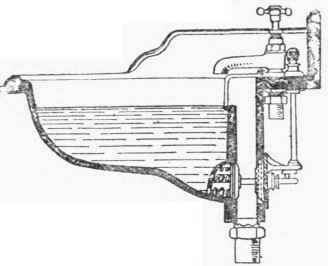
One of the latest modifications of this kind of overflow is shown in fig. 42, in combination with a new waste arrangement. The overflow is of large area, so as to be capable of carrying away the water from a high-pressure service, and is covered with a nickel-plated brass grating, hinged at the top. The valve, or plug, which is covered with soft rubber, works horizontally instead of vertically, and is actuated by the lever handle above the back part of the slab.
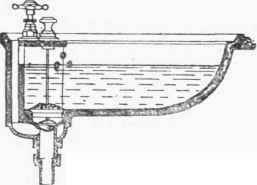
Fig. 41. Lavatory with Open-tap Overflow and Safety Plug.
Continue to:


My Books

