


11. Saws
Description
This section is from the book "Elements Of Construction", by Charles A. King. Also available from Amazon: Elements of construction.
11. Saws
Saws. (A.) The saws used by the carpenter are for cutting parallel with, or across, the grain, or a combination of the two, and all are composed of two parts, the "handle" and the " blade."
The teeth of a ripsaw (Fig. 17, A) are suitable for sawing in a direction parallel with the general direction of the grain. The points of different saws may be from one third to one seventh of an inch apart, and form a series of chisels, the cutting edges of which are filed so that they are at right angles to the sides of the blade. In action, the saw is pushed against the wood, each tooth cutting a little deeper than the one preceding it.
The cutting-off saw (Fig. 17, B) has from six to twelve knife-pointed teeth to an inch, the cutting edges being parallel to the sides of the blade, and filed so that the point of the tooth is upon the side which is set beyond the side of the blade. In all except the finest saws, the teeth are set; that is, the points are bent a very little in such a way as to make the cut wider than the thickness of the blade, so that the saw may cut through the wood without binding, which it could not do if the cut were of the same thickness as the blade. The blades of all high grade saws are thinner upon the back than upon the cutting edge, but if a saw is to be used upon the finest work, this difference in the thickness of the two edges of the blade is supposed to make the setting of the saw unnecessary. For general work, it will be found that a saw will be much more efficient if it is given a set adapted to the size of the teeth, or to the nature of the work it is expected to do.
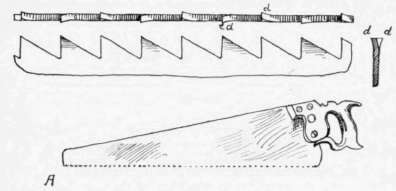
Fig. 17, A. Ripsaw. dd, view and section of setting of teeth.
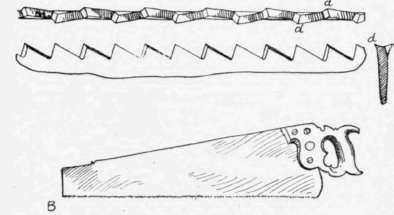
Fig. 17, B. Cutting-off Saw.

Fig. 17, C. Compass, or Keyhole, Saw.
Fig. 17. - Saws. (In each of the three varieties of saw teeth shown above, the set of the teeth is exaggerated.)
The compass, or keyhole, saw (Fig. 17, C) is used where it is necessary that the saw should cut both with and across the grain. It is used to start the cut for a rip- or cut ting-off saw, when a cut has to be made in the surface of a board. This saw is used also in many places where it is not practicable to use a larger saw, and for sawing curves. In order to allow it to cut around curves easily, the face, or cutting edge, is considerably thicker than the back, and the blade is made of soft metal. It may then be given a heavy set, so that it will bend instead of breaking or kinking, as it would be liable to do from the nature of its work if made of tempered steel.
Some carpenters, working upon job work, where it is desirable to carry as few tools as possible, have a narrow 20" or 22" saw sharpened like a compass saw, which for ordinary work is quite satisfactory as either a cutting-off or a ripsaw, thus making another saw unnecessary.
The hacksaw (Fig. 18) is used upon fine work; it is filed like a cutting-off saw, but the teeth have rather more hook, and it often has as many as fifteen teeth to the inch, though a twelve-tooth saw is as fine as is generally used. The thick back is to stiffen the blade of the saw, and if the latter becomes sprung, a light blow upon the back, as though to drive it upon the blade, will usually straighten it.
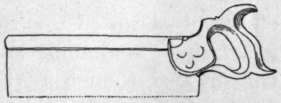
Fig. 18. - Backsaw.
(B.) In buying a saw, select one which is thicker upon the cutting edge than upon the back; this allows the saw to be used upon very fine work with little or no setting. See that the handle fits the hand, and that the saw hangs to suit, or "feels right." This is a matter concerning the balance and the weight of the tool, which cannot be described, but which any one accustomed to using tools will miss when a tool not possessing this quality is placed in his hand.
A saw blade, unless very short and thick, should bend so that the point may be put through the handle, and, upon being released, should instantly resume its shape. It should also bend evenly in proportion to the width and the gauge of the saw, and should be as thin as the stiffness of the blade will permit, as a saw of this sort cuts less wood and therefore runs with less resistance. A compass saw, being softer, is not expected to stand the above test.
A 26" or a 28" blade is best for a heavy rip- or cutting-off saw to be used upon coarse work; but for fine work, a 22" blade, commonly known as a "panel saw," is a convenient size, though a 20" or a 24" blade is preferred by many workmen.
(C.) A hard saw is best for fine work. For general work, most workmen prefer a saw of medium hardness, as the teeth of a hard saw are apt to break in setting. Moreover the edge of a hard saw, if it comes in contact with metal, requires filing just about as quickly as that of a soft saw, and is much more difficult to sharpen than the latter. If always filed by an expert filer, however, a hard saw is superior in every way to any other.
(D.) The handle of the saw should be grasped firmly by three fingers, as in Fig. 19, with the forefinger extended along the side of the saw, thus making more room for the three fingers, and giving better control of the saw. Very little strength should be used in forcing a fine saw to cut, as its own weight generally is sufficient. If the saw is forced, it will not run smoothly, but will bind; and if a thin board is being worked, the saw is apt to split it. The saw should be used from the face side of the material, so that any splinters or variation will be upon the back side and out of sight.
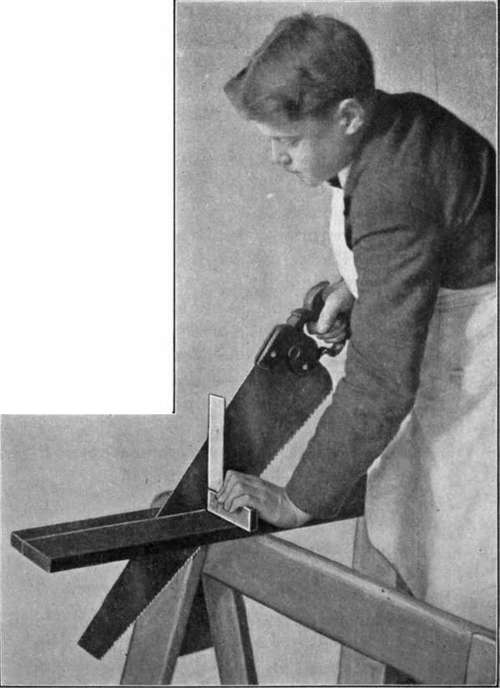
Fig. 19. - Use of the Saw. Showing the method of using a try-square to insure accuracy.
(E.) It is the custom of some carpenters to reset the handles of their heavy saws by drilling holes through the blade, so that the handle may be fastened as close to the cutting edge as possible, as in Fig. 20. This brings the force of the stroke nearer the direct line of the cut, which obviously allows a more economical application of force. Never leave a saw in a cut, for if the piece of wood falls off the trestles, the saw is apt to be broken. (Saw-filing will be discussed later.)
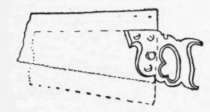
Fig. 20. - Reset Saw Handle.
Continue to:


My Books

