


Baths. Continued
Description
This section is from the book "Sanitary Fittings And Plumbing", by G. Lister Sutcliffe. Also available from Amazon: Sanitary fittings and plumbing.
Baths. Continued

Fig. 65. Braby's "Empress" Sheet-Steel Bath.
The parallel plate-zinc bath (fig. 66) is made of plate-zinc 1/8 in. thick, and has a roll edge on the front and head, and a square raised rim on the back and foot for fitting in the angle of a room. The waste is formed with an ordinary plug and washer with bent union, and an ordinary overflow can be fitted in the end. The surface may be either polished or japanned. Polished zinc is difficult to keep clean, and it must not be forgotten that some waters have a solvent action on the metal, and where this is the case it must be protected by enamelling.
Sheet-metal baths for hospitals are furnished with rubber-tyred wheels, and are fitted with plugs and washers or draw-off cocks, so that the baths can be emptied over floor channels or gullies. Tinned copper is the best material for the purpose, but other metals are also used. Indurated wood-fibre baths lined with tinned copper are adapted for hospital use by mounting them on wrought-iron carriages with rubber-tyred wheels. A lip is formed around the inner edge of some hospital baths to prevent splashing while the baths are being wheeled about.
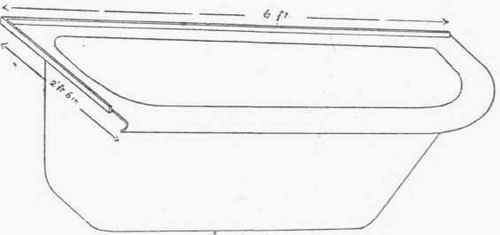
Fig. 66. Parallel Plate-Zinc Bath.
2. Cast-iron Baths.- Cast iron is cheap, impervious, and stiff, and can be moulded in a variety of forms. The objections to the material are that it is somewhat heavy and liable to fracture, and that, in the inferior kinds at any rate, the enamel is rather easily chipped off, thus exposing the metal to the water and air, which cause it to rust. The latter objection loses some of its force if the bath is "vitreous-enamelled," as the process of manufacture ensures a close adhesion of the enamel and iron. For a long time this enamel could only be applied to the inside of the bath, but after many experiments it has been found possible to apply it both inside and outside, and the best cast-iron baths are now made in this way. Cheaper baths are japanned or metallic-enamelled, in the manner already described. The vitreous enamel is not only smoother and less pervious, but is not acted upon by inferior soaps or by the acids and salts sometimes used by bathers, which is more than can be said for the ordinary japan or metallic enamel.
The ordinary cast-iron bath is too well known to need complete illustration. It may be encased with woodwork or left exposed. In the former case a simple flanged rim is formed at the top to receive the wood margin. A similar rim is also provided in some Roman baths so that wood margins can be screwed to them, as these are occasionally preferred because the wood is warmer to the touch than an iron roll-edge. The iron roll-edge is, however, more generally adopted. The ordinary roll is an almost exact semicircle, the diameter ranging from about 2 in. to 4 in.; the "Anti-splash" roll (fig. 67) introduced by Messrs. Doulton & Co. is an improvement. Other details will be illustrated in the chapter on bath-wastes and overflows.
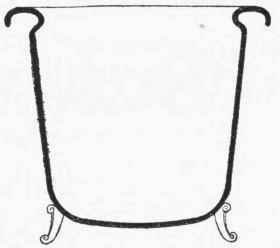
Fig. 67. Bath with Doulton's "Anti-Splash" Roll.
Cast-iron baths are made in various sizes, the length being the standard dimension. All iron baths were formerly measured inside just below the roll, but some makers now measure from centre to centre of the rolls, so that their 5 ft. 6 in. baths are really only about 5 ft. 3 in. inside. It is necessary, therefore, to specify distinctly whether the length is to be measured within the rolls or from centre to centre. 3. Enamelled Fireclay Baths. - These were first made about fifty years ago, and many have been used. The porcelain enamel is the one great advantage which these baths possessed over those in vogue at the time when the fireclay baths were introduced, but the manufacture of vitreous-enamelled cast-iron baths (which have a practically identical surface) appears likely to prevent enamelled fireclay baths being largely used in the future. Fireclay baths are expensive and very heavy, a full-sized bath weighing about 5 or 6 cwt. For hospitals, where a "hot" bath is often required for an urgent case, the thickness and non-conductivity of the material are a serious disadvantage, as the bath itself remains cold for some time after the hot water is turned into it, and may chill the patient, so that the "hot" bath, instead of being salutary, may be positively injurious. On the other hand, enamelled fireclay baths are strong, clean, and durable, and are easily kept free from infectious taint.

Fig. 68. Twyfords' "Cliff" Vale " Roman Fireclay Bath.
Fireclay baths are made with parallel or taper sides, and in lengths of 4 ft., 5 ft., 5 ft. 6 in., and 6 ft. (outside dimensions), and can be obtained with or without roll edges and enamelled inside only, or both inside and outside. They are sorted into qualities-a common classification being "best," "all but" (or "selected second"), and "second." The bottom of the bath is sometimes fluted with a main longitudinal channel, and with cross channels or ridges leading to it, so as to reduce the risk of the bather slipping. The bath shown in fig. 68, known as the "Clifife Vale" Roman, is supported on enamelled fireclay feet, and has a wood rim inserted in the front roll. An enamelled tray, draining into the bath, is fitted at the back between the bath and wall, and forms a convenient receptacle for soap, sponges, brushes, etc.
4. Other Materials. - Baths made of slate or marble slabs bolted together have been used, but as they are heavy, cold, difficult to keep clean (on account of the angles), and apt to leak, they cannot be recommended. Concrete baths were advertised some years ago, but the material has not proved suitable. Wood has the advantage of warmth, but is unsuitable in other respects. The appearance of lead-lined wood baths is not agreeable, and, as explained in the chapters on sinks, the lead forms into ridges under repeated expansion and contraction, and ultimately cracks.
Continue to:


My Books

