


Chapter IX. Baths
Description
This section is from the book "Sanitary Fittings And Plumbing", by G. Lister Sutcliffe. Also available from Amazon: Sanitary fittings and plumbing.
Chapter IX. Baths
Materials
Baths are made of zinc, copper, sheet steel, sheet iron, cast iron, enamelled fireclay, slate, and marble, and also of wood, either naked or lined with lead, but probably cast iron is more used in this country than all the other materials put together. It is cheap, durable, impervious, and can be cast with widely-rounded angles and in a variety of forms, either for standing exposed or for enclosing in wood. Aluminium has also been used.
Shape And Size
Exposed baths are generally known in the trade as "Roman," and can now be obtained in almost any material. They are much to be preferred, as a wood enclosure not only renders access to the pipes more difficult, but also provides in many cases a convenient harbour for dirt and vermin. Baths are commonly 5 ft., 5 ft. 6 in., or 6 ft. long, but smaller sizes are made for children and others. The sides may be either "parallel" or "taper," and generally slope inwards towards the bottom; the foot of the bath is frequently vertical, while the head has a long slope. The object of the sloping head and sides is to reduce the quantity of water required, with the further advantage of producing obtuse angles, which can be more easily kept clean than right angles.
Fixing
Baths are generally fixed by the waste and supply-pipes, and if space can be afforded, it is a good plan to place them clear of the walls or with only the head or foot near a wall, as such arrangements admit of the floor of room and the sides of the bath being kept clean. For hospitals, however, movable baths on wheels are largely used.
1. Sheet-metal Baths. - Under this head baths of copper, zinc, sheet-steel, and sheet-iron may be considered. Formerly these baths were made to be supported on wood cradling, which was concealed by a wood enclosure, but many are now made with roll edges and sufficiently strong to stand alone.
The old form of copper bath shown in fig. 63, has a flanged rim for fixing in wood casing; the sides weigh 28 oz. to the superficial foot, the ends (where the curve adds to the strength) 24 oz., and the bottom 32 oz. The total weight of copper in a bath of this design is only 65 lb., the dimensions being as follows:- Length, 5 ft. 6 in. inside, and 5 ft. 9 in., outside flange; width, 24 1/2 in. at head, and 20 in. at foot, inside flange; depth, 21 in. inside; height from floor, 27 in. Baths 5 ft., 5 ft. 3 in., and 6 ft. long are also made. There is a copper waste-well in the centre of the bottom, from which a copper pipe 1 1/2 in. or more in diameter leads to the foot of the bath, where a connection can be made with a lead trap. Sometimes hot and cold inlets are arranged in the sides of the bath with copper pipes attached, as shown in fig. 65.
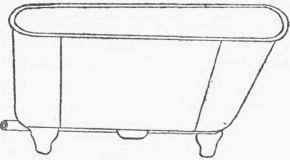
Fig. 63. Copper Bath-old shape.
The bath shown in fig. 63 has a flat bottom, and the angles are difficult to keep clean. It is better to have the angles well rounded, as in the steel bath (fig. 65). In the best modern baths only three sheets of copper are used (for the head, body, and foot), each being bent or pressed to the necessary curves. These are a great improvement on the old form. In cheaper baths of the form shown in fig. 63 the sides and heads are of sheet-steel or iron, the bottom only being of copper. This reduces the cost about 40 per cent., as copper is, of course, an expensive metal; but a cast-iron bath is better than a composite bath of this kind.
When copper baths are to be fixed without wood enclosure, the flat flange at the top is replaced by a copper bead, or fitted with a hardwood bead, and the bath is japanned outside or finished in some other way. Sometimes a roll-edge of nickel-plated brass is used instead of the copper or hardwood bead.
Copper baths may be finished in a variety of ways. The surface of the copper may be "planished"; this has a good appearance, but is difficult to keep smooth and bright. The cheapest finish is obtained by japanning. A plain finish, either white or (say) pale green, has the best and cleanest appearance. If the japan is polished to give a smoother surface, the cost is slightly increased. The cost also varies according to the number of coats applied. A slightly more expensive finish is obtained by metallic-enamelling, the process being practically the same as japanning, and consisting in the application of successive coats of metallic (generally zinc) paint, each of which is burnt on to the metal at the necessary temperature. Three or four qualities of metallic enamel are quoted, the price varying according to the number of the coats and the smoothness of the finish. Before the metallic enamel is applied the copper is generally tinned, as this gives a better result. Tinned copper baths are often planished or highly polished. The appearance of a new bath of this kind is very pleasing, but it is difficult to keep the surface clean and bright. The coat of tin is generally obtained by dipping, but in some cases sheet tin is used and united to the copper by hydraulic pressure.
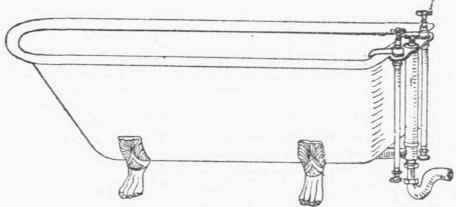
Fig. 64. Indurated Wood Fibre Bath lined with Copper.
There can be no doubt that copper is an excellent material for baths. The metal is thin, and does not therefore abstract much heat from the water; it is also durable and can be repeatedly re-enamelled, and when the bath is ultimately worn out it will fetch a good price on account of the intrinsic value of the metal. Perhaps the principal objection to copper baths is that the first cost is so high.
Fig. 64 shows an "Indurated Wood Fibre " bath, lined with highly-polished tinned copper. The top has a French-polished wood capping, and the bath is supported on cast-iron feet.
Cheaper baths of similar design and dimensions to that shown in fig. 63 are made of zinc (plain or japanned), and sheet-iron (galvanised or tinned), with beaded or flanged tops. A sheet-steel bath (Braby's "Empress") is shown in fig. 65. The plates are riveted together, the rivets being flush inside, and the whole bath is galvanised after manufacture, and afterwards japanned or metallic-enamelled. The angles are well rounded, and as the baths are light and tough and "nest" closely together when packed, they are very suitable for export.
Continue to:


My Books

