


Special Baths
Description
This section is from the book "Sanitary Fittings And Plumbing", by G. Lister Sutcliffe. Also available from Amazon: Sanitary fittings and plumbing.
Special Baths
The ordinary plunge bath is often fitted with a hood containing pipes and other fittings by which the water can be admitted in a shower, spray, wave, and other ways. The "shower" is admitted through a rose placed over the head of the bather at the outlet end of the bath. The "douche" is a stream of water admitted through a nozzle in the centre of the shower rose. The "wave" is a stream of water admitted through a wide but shallow orifice at the back of the hood so as to play upon the hips of the bather. The "spray" consists of a number of very fine jets of water admitted through perforations in tiers of horizontal pipes or in a series of vertical pipes placed at intervals around the hood. Sometimes a "sitz" or ascending spray fitting is placed in the bottom of a plunge bath, but as this inlet is below the water-level of the bath it cannot be recommended. A sitz bath ought to be a separate fitting.
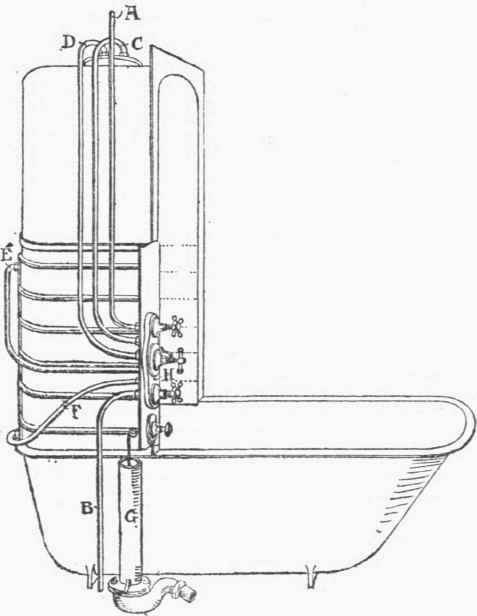
Fig. 69. Plunge Bath, with Shower, Douche, and Spray.
The spray, douche, and shower are the special forms of inlet most commonly adopted, and a bath fitted with these is shown in fig. 69, A being the hot-water supply-pipe, B the cold-water supply, C the shower supply, D the douche supply, E the spray supply (connected with six horizontal spray pipes), F the plunge supply, G the overflow and waste, and H the hot and cold mixing-box, with taps and dial-plate. This bath is intended to be cased with wood, but independent baths containing these fittings are also made, and are certainly preferable on sanitary grounds. A door is arranged in the outer metal casing for access to the pipes immediately behind the mixing-box. In cheaper baths a single spray-pipe is fitted around the lop of the hood. The plunge bath may be of cast iron, enamelled fireclay, or other material; the hood is generally of plate zinc or copper, finished to match the bath.
The bath shown in the illustration has parallel sides, and the hood is on the same lines. This shape does not entirely prevent splashing over the edges of the plunge outside the hood, and the keyhole-shaped bath (fig. 70) is a decided improvement in this respect.
Sometimes the metal hood is omitted, and the skeleton of pipes left exposed. A waterproof curtain can be suspended on rings around the pipes to prevent splashing. The pipes are generally of copper, polished, tinned, or nickel-plated.
For industrial schools, and other institutions where a large number of persons must bathe in a short time, and where water must be economised, the plunge-bath is often superseded by a skeleton of spray-pipes with shower above. These are also useful adjuncts to swimming-baths, so that bathers may have a preliminary wash; by this means the water in the swimming-baths is not so quickly fouled. The water for a range of baths of this kind may be controlled by the attendant at a single mixing-box, to which a thermometer may be attached so that the temperature can be properly regulated. The floor may be dished or widely channelled, or may have an enamelled fireclay bath-tub sunk in it, as shown in fig. 71. This bath is somewhat elaborate, and has seven heights of 5/8 in. copper spray-pipes, 1 1/2-in. vertical supply-pipe at the back, four 1 1/4-in. vertical supporting tubes, wave fitting at A, shower at B, and waste-valve at C; the valves are under the control of the bather.
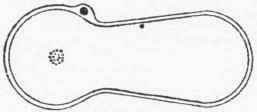
Fig. 70. Keyhole-shaped Bath.
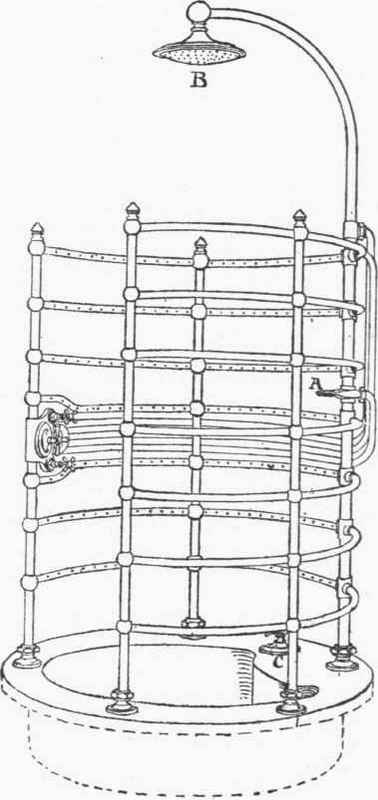
Fig. 71. Skeleton Bath, with Shower, Spray and Wave.
The control of the water supply to combined baths of the kind illustrated in fig. 69 was originally effected by two taps (hot and cold) for each kind of inlet, that is to say, two for the plunge, two for the shower, and so on. The next step in advance was made by having a mixing-box to which the hot and cold supplies were connected, and from which pipes, controlled by valves or taps, led to the different fittings. In a bath containing plunge, spray, shower, and douche, eight taps would be required under the former arrangement, and six under the latter. The most modern arrangement requires only three taps for any number of fittings. By turning the hot and cold taps, the water is run into a small mixing chamber, to which the pipes supplying the different parts of the bath are attached. On the face of the mixing-chamber a dial is formed, containing a central spindle and knob to which an indicator or pointer is fixed. The dial is marked with the words "plunge," "shower," "douche," etc, and the supply of water is admitted to either of these fittings by simply turning the pointer to the word on the dial. Only one inlet can be in operation at one time.
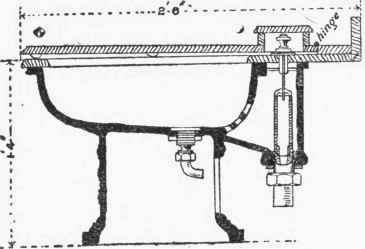
Fig. 72. Pedestal Bidet.
Sitz baths are shaped somewhat like armchairs, the essential feature being a rose in the sunk bottom, through which a spray of hot and cold water can ascend. A rose is often placed also in the back of the bath to give a horizontal spray, and above this a slit is sometimes provided for a "wave" inlet. The bath must be fitted with waste and overflow gratings. The supply for the ascending spray ought not on any account to pass through the waste-pipe on its way to the bath. Sitz baths are made in enamelled fireclay, cast-iron, plate zinc, or copper, and may be independent or enclosed in wood. The fittings are in all essentials similar to those of good plunge and spray-baths.
Bidets are small baths on which a person can sit. The principal feature is an ascending spray near the centre of the basin. Fig. 72 shows a pedestal bidet in white ware or vitro-porcelain, fitted with outlet grating and standing waste and overflow similar in design to those used in many lavatory basins. The porcelain pedestal is better than a wood enclosure.
Foot baths are useful in schools and other places, the best material being glazed fireclay. Enamelled iron is also used. Fig. 73 is a section of a fireclay foot-bath, with supply nozzle, overflow, and waste-plug. The overflow is not accessible for cleansing, and this is certainly a disadvantage. The length of the bath is 19 in.; the other dimensions are figured on the drawing. This bath is intended to be laid on the floor. In the case of a range of baths, the wastes may discharge into a single pipe trapped beyond the furthest fitting, and carried through the wall at the other end for ventilation. Access to the pipe will be facilitated if it is placed below the ceiling of the room under the bath-room. Sometimes the baths are raised on feet, so that the total height is about 16 in. or 17 in.; a floor-channel can then be arranged to receive the waste water.
Other special baths are used in hydropathic establishments, but these need not be discussed.
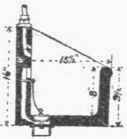
Fig. 73. Foot-Bath.
Continue to:


My Books

