


Expansion-Joints
Description
This section is from the book "Sanitary Fittings And Plumbing", by G. Lister Sutcliffe. Also available from Amazon: Sanitary fittings and plumbing.
Expansion-Joints
Long lead waste-pipes from fittings discharging hot and cold water, such as sinks and baths, sometimes crack in consequence of the alternate expansion and contraction. To prevent this, expansion-joints are used. Two simple forms are shown in fig. 180. In that marked A the end of the lower pipe is formed into a socket about 5 in. deep by means of a hardwood mandrel; a vulcanised india-rubber ring is sprung on to the upper pipe close to the end, and when this pipe is pushed into the socket, the ring closes the annular space between them and is rolled to its final position. In the joint marked B an indiarubber cone with beaded edge is used, and the socket is conical, the upper pipe being slightly tapered to fit. Lead tacks are often soldered to the lower pipe at the joint for the purpose of fixing the pipe to the wall. The expansion joint shown in fig. 181 is formed by means of a lead socket and tacks with copper core like that illustrated in fig. 176, but with a tinned gun-metal screw-gland stuffing-box, A, riveted to the copper body and tacks; the socket is made in sizes to receive 1 1/2-in., 2-in., 2 1/2 -in., and 3-in. pipes. It is doubtful whether any of these joints will remain permanently tight, but there cannot be much objection to their use in external waste-pipes, if these are properly disconnected and ventilated. The necessity for expansion joints can be reduced by using a greater number of lead tacks for supporting the pipes, or the main pipes may be of iron instead of lead.
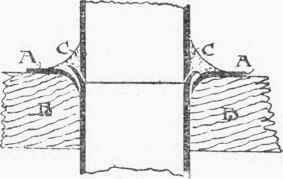
FlG. 179. Block Joint.
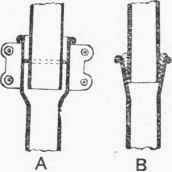
Fig. 180. Expansion Joints in Lead Pipes.

Fig. 181. The "Century" Expansion Joint.
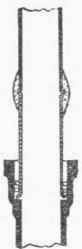
Fig. 182. Lead to Iron Joint with Brass Thimble.

Fig. 183. Lead to Iron Joint with Brass Sleeve.
Continue to:


My Books

