


Lead To Pottery
Description
This section is from the book "Sanitary Fittings And Plumbing", by G. Lister Sutcliffe. Also available from Amazon: Sanitary fittings and plumbing.
Lead To Pottery
For connecting a lead soil-pipe to a stoneware drain, a brass sleeve, similar to those shown in figs. 182 and 183, but with a wider flange for fitting into the stoneware socket, should be wiped to the lead pipe. The joint is completed by running the socket full of neat Portland cement, care being taken to prevent the cement riming through into the drain.
For connecting lead flush-pipes to the inlet horns of water-closets, slop sinks, etc, india-rubber cones are generally used; both straight and elbow cones are made as shown in fig. 187. No paint or putty must be used in contact with the rubber, as these A destroy its peculiar properties. Twyfords' patent rubber connection (fig. 188) makes a watertight joint without having to wrap cord around it, as is necessary when ordinary cones are used; the rubber is shown in section at A. The objections to the use of indiarubber have led to the introduction of a new form of joint, known as Fullerton's "full - flush," shown in fig. 189. For lead flush-pipes the connection is of lead. The spigot A is passed into the socket of the inlet horn of the closet, and the lugs B B are then bent till they come in contact with the outside of the horn; they are kept in position by copper wire wrapped round the horn, as shown at C. Red
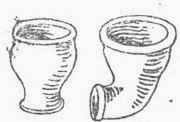
Fig. 187. Indiarubber Cones.

Fig. 188. Twyfords' Rubber Connection lead is spread on the contiguous surfaces to make the joint tight. The socket at D is intended for the reception of the flush-pipe, the joint being made with solder or red lead.
When the flow of water is from the pottery to the lead pipe, different forms of joint must be used. Brass washers and unions with tinned linings or tails are generally used for the outlets of pottery sinks, lavatories, and baths, and details of these have been given in the chapters on these fittings. The principal joint remaining to be considered is that between the trap of a water-closet or slop-hopper and the lead branch of a soil-pipe. The joint specified by the London County Council (fig. 190) is made by means of a brass connection A, into the socket of which the outlet of the trap is fitted, the annular space between the pottery and brass being then filled with neat Portland cement; the tail of the brass connection is tinned, and is united to the lead branch by means of a wiped joint. It is a good plan to have the socket of greater diameter at the bottom than at the top. The outside of the pottery spigot ought to be corrugated and without glaze, so that the cement will adhere thoroughly to it.

Fig 189. Fullerton's "Full-flush" Connection.
A patent cast-lead "socket" is now made by Claughton Bros. to take the place of the brass socket; the socket portion is lined with iron, which is corrugated to offer a firmer attachment for the cement with which the annular space is filled.
Sometimes a screw-thread is formed on the pottery outlet, to which a screwed lead socket is attached, but this joint can only be used when the outlet of the closet is specially made for the purpose. In Twyfords' "Detachable Screw Cone" joint (shown at D in fig. 109), a screwed brass washer is fixed to the pottery outlet, and the joint is formed between the washer and the bent lead tail by means of a brass union.
A flanged joint can be made watertight and airtight, and has the advantage of allowing the closet to be easily removed in the event of damage being done either to the closet or branch. Flanged joints, however, ought always to be made above-and not at or below-the floor-level, and the screws ought to be tightened periodically. The old method of bringing the lead pipe through a hole in the floor and tafting it back to form a flange resting on the boards, and then covering the flange with red lead and screwing the closet through it to the floor, is very unsatisfactory and ought never to be adopted. Fig. 191 represents a good form of flanged joint. The end of the lead pipe is opened out and tafted back to form a socket and flange; an india-rubber ring A is placed between the lead and pottery flanges, and a brass collar B is fitted under the lead flange to give the necessary rigidity. Three or more brass clips C are placed at intervals around the joint, and the connection is completed by tightening the set-screws D,
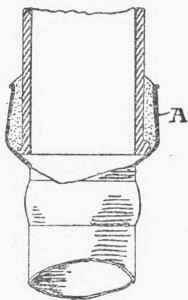
Fig. 190. Pottery to Lead Joint with Brass Socket.

Fig. 191, Flanged Joint, Pottery to Lead.
Robinson's "Enable" connection (fig. 192) consists of an earthenware socket corrugated inside and covered outside with lead. The joint between the socket and lead pipe is made with solder in the usual way, and that between the socket and pottery with neat cement. The socket is 2 1/4 in. deep, and is made in three diameters-3 3/4 in., 4 3/8 in., and 4 1/2 in.
The pottery outlets of many modern water-closets and slop-hoppers are fitted into lead sockets, so that a wiped joint can be made directly between the latter and the lead branch pipes. The first joint of the kind was Doulton's "Metallo-keramic" (fig. 193). The pottery outlet is metallised, so that a lead socket can be united to it by means of a soldered joint; to the tail of this socket the branch pipe can be wiped in the usual way. This and kindred joints have been largely adopted, and are thoroughly satisfactory in the hands of good workmen.
Continue to:


My Books

