


Anti-Siphonage Pipes
Description
This section is from the book "Sanitary Fittings And Plumbing", by G. Lister Sutcliffe. Also available from Amazon: Sanitary fittings and plumbing.
Anti-Siphonage Pipes
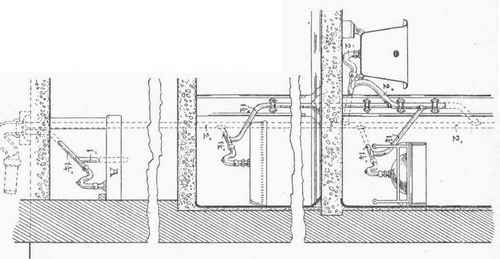
The size of anti-siphonage pipes merits careful consideration, but no hard and fast rule can be laid down. For a single fitting the sectional area of the anti-siphonage pipe (A, fig. 196) need not be much more than half that of the waste-pipe, as follows:-
Fig. 196. Waste-pipes and Anti-siphonage Pipes.
1 1/4 | in. | waste-pipe, | I | -in. | A.S. | pipe, |
1 1/4 | ,, | ,, | I | ,, | ,, | |
1 3/4 | ,, | ,, | 1 1/4 | ,, | ,, | |
2 | ,, | ,, | 1 1/2 | ,, | ,, |
When a number of fittings on different floors are connected to a main waste-pipe of great height, especially if the fittings are of modern quick-waste type, the branch anti-siphonage pipes ought not to be less than the branch waste-pipes to which they are connected, and the main anti-siphonage pipe not less than the main waste-pipe. It cannot be too often insisted upon that quick-waste fittings subject traps to very severe strains, the effect of which must be mitigated as much as possible by ample ventilation. Anti-siphonage pipes connected with waste-pipes are generally fixed inside the buildings, and although it is better to fix them outside, there is not the same objection in this case as in the anti-siphonage pipes of soil-pipes, as the waste-pipes are disconnected from the drains, whereas the soil-pipes, as a rule, are not, and drain-air will therefore pass through the soil-pipes and through the anti-siphonage pipes connected with them. The main anti-siphonage pipe is generally connected to the upper continuation of the waste-pipe above the highest fitting; this economises piping, and is quite as effective as carrying it up independently to the same height as the waste-pipe vent.
Fig. 196 represents the waste-pipes and anti-siphonage pipes from the fittings of an ordinary terrace house, having a kitchen sink on the ground floor and a bath and lavatory on the first floor. The basement sink A is not connected with the main system of pipes, but has a separate waste-pipe discharging into the same gully, and a separate anti-siphonage pipe. The lavatory waste is often connected with the branch from the bath, but it is much better to connect it directly with the main waste and above the point where the bath waste is connected, as shown in the illustration; there is then less risk of the lavatory trap being unsealed by a discharge from the bath, and the bath cannot possibly be fouled by the water from the lavatory.
Continue to:


My Books

