


85. Bookshelf
Description
This section is from the book "Elements Of Construction", by Charles A. King. Also available from Amazon: Elements of construction.
85. Bookshelf
Bookshelf. Fig. 162.
Material:
2 ends, 18 3/4" X 6" X 5/8". 2 shelves, 23 1/4" X 5 3/8" X 5/8". 1 back, 23 1/2" X 6" X 1/2". 1 back, 23 1/4" X 4" X 1/2".
Construction of model: The ends of the bookcase should be grooved or housed, as at f, to receive the shelves, the length of which should be 3/4" less than the outside length of the case, to allow for the depth of the groove. These grooves should be laid out by knife marks, and to insure their fitting the shelves closely, should be made a little less in width than the thickness of the shelves which enter them, just as the cuts in a halved joint are made smaller than the pieces that go into them. Attention is called to the horizontal section a a, which shows that the groove is stopped 1/2" from the face edge of the end, and that the shelf is notched 7/16, as at g, so as to prevent the groove from showing on the front edge of the end, as it would if it were cut through. The shoulder cuts, or the cuts across the face edges of the shelves, should be made upon all the shelves at once, clamping the pieces together for that purpose. The distance between them should be carefully calculated so as to make each shoulder about 1/16" less than the extreme length of the shelves; this will allow the ends of the shelves, beyond the shoulders, which fit into the grooves of the ends of the case, to be a little less than the depth of the grooves, as at h, thus insuring a good joint at c and g, at each end of the shelf. The depth of the shoulder should be about 7/16". This is the most important joint of the case, and the fitting should be done carefully, as a poor joint at c will be in the most conspicuous place.
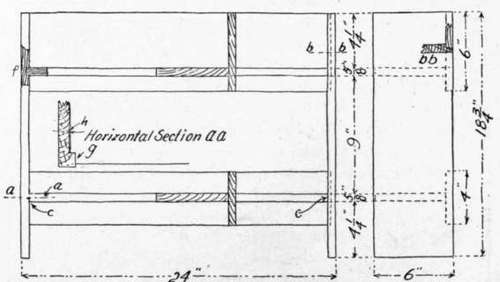
Fig. 162. - Bookshelf.
The face edges of the shelves should set back from the face edges of the ends about 1/8", as it is an almost invariable custom that two pieces should not be finished flush in work of this sort. This, to some extent, hides an imperfect joint, if one is made, or any opening after the work is finished.
The backs should be fitted into a rabbet made in the back of the ends, as shown by the section b b. Any suggestion of the shape of the ends is purposely omitted, as the student should make his own design, being governed by the advice of the teacher.
This model may be finished in the natural wood with shellac, well rubbed down, or may receive a dark stain and a wax finish.
Continue to:


My Books

