


Lavatories. Continued
Description
This section is from the book "Sanitary Fittings And Plumbing", by G. Lister Sutcliffe. Also available from Amazon: Sanitary fittings and plumbing.
Lavatories. Continued
Fig. 42. Lavatory with Open-top Overflow and Side-motion Waste Valve.
The discharge grating may be of porcelain, or of nickel-plated brass hinged so that the plug and seating can be cleaned.
This lavatory is known as
Shanks's "Perfecto." The standing waste and overflow has also been applied to lavatories. In the earlier arrangements the apparatus was concealed in a pottery chamber at the back of the basin, and was not easily accessible for cleansing; an overflow of this type is shown in fig. 43. A modified form, known as Milne's patent "Lift - out" accessible waste, is illustrated in fig. 44; the chamber is of good size, and the standing waste, together with the knob and shield, can be removed by a simple pull, and can be pressed back into position with equal ease. The shape of the chamber is better than that shown in fig. 43, the long acute angle at the bottom of the latter being avoided by making the back of the basin vertical.

Fig. 43 Lavatory with Secret Waste and Overflow.
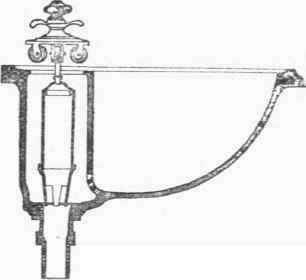
Fig. 44. Lavatory with Milne's "Lift-out" Accessible Waste and Overflow.
Other forms of standing waste are exposed to view-in the basin. The "Neros" waste (fig. 45) is of this type. By lifting the knob and giving it a quarter-turn the waste is suspended above its seat, so that the water can escape through the holes in the lower portion; the holes near the top are for the overflow. Doulton's "Waverley" waste (fig. 46) is a modification of this type, and possesses some interesting features. An outlet grate is provided in the shape of a perforated flange around the bottom of the cylinder in which the standing waste slides. When the waste is raised from its seat the water escapes through the grating. As in the other types, the waste can be suspended by raising the knob and giving it a quarter-turn. The grating is fitted into a screwed washer, and can be easily removed by unscrewing it, and the standing waste can then be taken out.
One of the most recent forms of standing waste is also the simplest, being nothing more than a tube slightly tapered at the bottom to fit into the outlet washer. An arched metal bar is fixed across the top for the attachment of a chain or hook. This waste can easily be kept clean, and is made in brass, gun-metal, xylonite, and other materials. On account of its somewhat fragile nature, xylonite can only be recommended for places where the fittings will be carefully used; being lighter than metal it is less likely to damage the basin, and its clean appearance is in its favour.
The syphonic discharge has been applied to lavatories as to water-closets, but a type of overflow which is automatically set in action when the water in the basin reaches a certain level, and which continues in action until the basin is emptied, can scarcely be recommended. A modified form of syphonic overflow has, however, been recently introduced, in which this defect is guarded against. As shown in fig. 47, it consists of a standing waste of ordinary type, but covered with a dome through which a small hole A is pierced. When the water reaches a certain level syphonic action is started, but continues only until the water has been lowered about 2 in. The discharge is very rapid, and this is a distinct advantage, as there is little or no danger of the basin overflowing, however quickly it is supplied with water. This fitting, which is known as Shanks's "Perfecto Siphonic Waste" (although it is really a standing waste with syphonic overflow), is also applied to sinks. As will be seen from the illustration, a flange with india-rubber ring B is fixed to the lower part of the waste, and seats itself against the rounded pottery outlet of the basin; the outlet is flanged, so that the lead or brass trap can be bolted to it. The stud C slides in the groove of a metal bracket projecting from the back of the basin; the groove has a recess on one side, so that the waste remains open when the stud is in the recess.

Fig. 45. Twyfords' "Neros" Waste and Overflow.

Fig. 46. Doulton's "Waverley "Waste and Overflow.
The "Loco" lavatory basin (fig. 48) has a standing waste and overflow of different type. The illustration shows the outlet open at A and closed at B. To close the outlet the lever a is drawn forward, thus raising the other lever to which the standing waste is attached and bringing the plug upwards against its seat b. When the lever is pushed back, the standing waste falls to the position shown in A, and part of the water passes down the tube while part escapes through the grating in the bottom of the basin. The overflow tube is thus regularly flushed. The apparatus can be easily taken to pieces, and can be applied to sinks and baths as well as to lavatories.

Fig. 47. Shanks's "Perfecto" Waste and Siphonic Overflow.
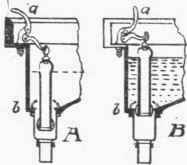
Fig. 48. Lynde's "Loco" Lavatory.

Fig. 49. Tip-up Lavatory Basin and Container.

Fig. 50. Adams' "Tip-over" Lavatory.
Tip-up Lavatories were at one time much used for hotels, railway stations, and other places where it is essential that the water should be rapidly emptied, but they are not as satisfactory in other respects as the modern ordinary basin. They consist as a rule of two principal parts-the basin and the container, as shown in fig. 49-and are made either of porcelain or cast iron. The basin is fitted outside with two metal bushes, one at each side, to receive the ends of two trunnions, on which the basin swings; a buffer is provided to keep the basin at its normal level. An improved form of pivot is made, so that the basin can be removed without pulling out the pin or unscrewing the trunnion. Adams's "Tip-over" lavatory (fig. 50) is of more novel form, but is only made in metallic-enamelled cast iron, and is intended for cheap work. In this the ordinary container is superseded by a horizontal outlet at the back of the basin. As shown in the illustrations, the back of the basin is curved over, and is continued in each direction as a pipe stopped at one end and connected at the other with the waste-pipe A, by means of a joint which permits the basin to be raised so that the water can escape down the waste-pipe. Unless the waste-pipe is of large size, the rapidity of discharge will be no greater than in the ordinary basin with large plug, and in any case there will be considerable risk of splashing.
Continue to:


My Books

