


Flushing Cisterns. Continued
Description
This section is from the book "Sanitary Fittings And Plumbing", by G. Lister Sutcliffe. Also available from Amazon: Sanitary fittings and plumbing.
Flushing Cisterns. Continued
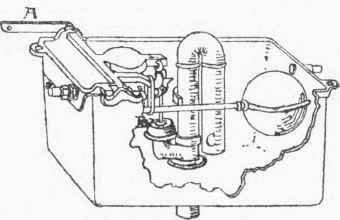
Fig. 117. Valve-siphon Cistern.
Two examples of the dome siphon cistern are given in figs. 118 and 119. Winn's "Acme" cistern (fig. 118) has been very largely used. The dome or cap A forms with the stand-pipe B an annular siphon. On depressing the flushing lever at C the dome is raised, and the water in the annular space rises with it and charges the siphon. The lever may then be released, and the siphonic action will continue till the cistern is practically empty. The trap at D renders the starting of siphonic action more certain and more easy. The mechanism is extremely simple, and there are no valves (except the ball-valve) to get out of order. The cistern is made with tapered sides to reduce the risk of breakage by frost, and can be obtained of cast-iron, as shown, or of wood lined with lead, and in sizes from 1 to 4 gallons.
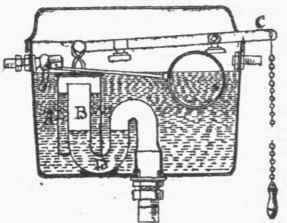
Fig. 118. Winn's "Acme" Siphon Cistern.
The cistern illustrated in fig. 119 is made of white or amber enamelled stoneware with the movable dome of the same material. The stand-pipe is of lead 1 1/2 in. in diameter, extending a little above the top of the cistern to prevent secret waste, and the flushing lever is of cast-iron. Although known as Duckett's "A 1" Plunger Cistern, it is really of the dome type. The flushing lever is forked at the inner end and attached to the dome by a link on each side as shown by the dotted lines. The lower portion of the dome is of greater diameter and fits somewhat closely into the sunk portion of the cistern. On depressing the lever at A, the dome B is raised, and when the lever is suddenly released, the dome acts as a piston sliding in the sunk portion of the cistern, and forces the water upwards over the lip of the stand-pipe, thus starting the siphonic action, by which water is drawn through the holes in the lower part of the dome until the cistern is nearly empty. Very similar cisterns are made of cast-iron with cast-iron domes. In order to ensure a sufficiently rapid descent to force the water over the lip of the stand-pipe, the dome must be heavy; it is therefore almost invariably noisy in action, and even in the best cisterns of this type the siphon cannot always be started at the first or even second attempt.
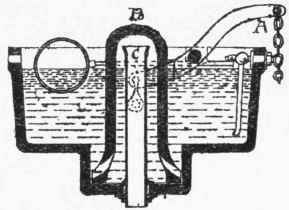
Fig. 119. Duckett's "A 1" Stoneware Siphon Cistern.
In the plunger siphon-cistern the siphon is started by water forced into it by means of a plunger or disc. In some cisterns of this type siphonic action stops when the handle attached to the flushing lever is released; these have the disadvantage of the ordinary valve-cistern in not giving the full flush every time the closet is used. Others, however, continue to act after the handle is released. Fig. 120 is an example of the latter kind, known as the "Monarch." When the handle is pulled, the disc A (shown by dotted lines) is raised and forces a small quantity of water over the bend at the top of the siphon, and thus starts the siphonic action. In other cisterns of the same type, the plunger works horizontally, and in others vertically. These cisterns are less noisy than those with heavy domes, and siphonage is more readily started. They are, however, somewhat more complicated. The plunger and cylinder in the best cisterns are made of brass. In some cases, the disc itself contains a valve through which the water is drawn after the siphonic action has been started, but this valve introduces another possibility of defect.
In some recent cisterns, such as the "Aqua Jet," the movement of the handle or the pressure of a button actuates a small disc or plunger, which forces water over the bend of a small pipe into an air-pipe connected at the top to the main siphon bend, and at the foot to the flush-pipe, a dip-trap being interposed between the siphon and flush-pipe. The passage of the water down the air-pipe draws air from the siphon bend, and thus gradually starts the siphonic action. The mechanism is operated with the greatest ease, and is silent in action.
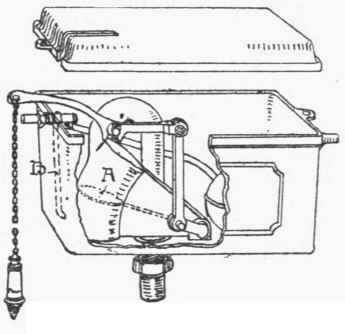
Fig. 120. The "Monarch" Siphon Cistern.
Siphonage is sometimes started by means of a large "displacer" attached to the flushing lever and dipping into the water. The displacer is so designed that, when the lever is depressed, the bulkier portion of the displacer enters the water and raises the level sufficiently to cause the water to overflow the stand-pipe of the annular siphon. In these cisterns, the top of the stand-pipe must obviously be below the top of the cistern, and secret waste may possibly occur.
3. Tipper Cisterns. - Cisterns of this type are not often used for water-closets, as they give rise to a considerable amount of splashing, and are also somewhat noisy. The essential part of the apparatus is a tipper or tumbler swung on pivots and attached to the flushing lever in such a manner that, when the handle is pulled, the tipper is partially turned and the contents are discharged into the chamber in which the tipper is swung, and pass thence down the flush-pipe.
4. Pneumatic Cisterns. - These are only adapted for high-pressure supplies. The cistern is a closed galvanised-iron cylinder regulated to hold a certain quantity of water, in addition to a quantity of compressed air. When the closet is not in use the cistern is empty, and there is therefore no risk of breakage by frost. In one apparatus of this kind pressure on the seat of the closet opens the supply-valve, closes the lower portion of the flush-pipe, and allows water to flow up the flush-pipe into the cistern, where the contained air is compressed to an extent corresponding with the pressure of the water. With a water pressure of 70 lbs., 2 gallons will enter the cistern in less than a minute. As soon as the pressure on the seat is withdrawn the supply-valve closes automatically, and in so doing opens the flush-pipe, down which the water in the cistern is forced by the compressed air with great velocity into the closet-basin. There is, of course, a possibility of the valves and other mechanism getting out of order. This apparatus has not yet passed beyond the experimental stage.
Materials
Cisterns are commonly made of cast-iron painted inside and outside, but the paint soon wears off, and the metal rusts and discolours the water, and eventually stains the basin. Galvanised-iron cisterns (either cast-iron or sheet-iron with seamed or riveted joints) are very little better in this respect if the water is soft. Vitreous enamel is often applied to cast-iron cisterns, and is a much better protection. Iron cisterns are, however, somewhat noisy, and are apt to be cracked by frost, especially if fixed in external closets. Wood cisterns are better in both respects, and may be lined with lead weighing 4 lb. or 5 lb. per superficial foot, or with copper. Glazed fireclay or porcelain cisterns are also occasionally used, but are not suited for external closets on account of the risk of breakage by frost. All cisterns in houses ought to be provided with covers to deaden the sound, or entirely cased with woodwork.
Continue to:


My Books

