


Ranges Of Fittings
Description
This section is from the book "Sanitary Fittings And Plumbing", by G. Lister Sutcliffe. Also available from Amazon: Sanitary fittings and plumbing.
Ranges Of Fittings
In the case of ranges of fittings the same principles can be applied, as shown in fig. 197, each fitting being separately trapped and each trap being ventilated. Ranges of lavatories, however, are often supplied with cast-iron or brass traps and waste-pipes, and many of these are seriously defective, the horizontal pipe being fixed perfectly level, and the waste-pipes being exactly vertical. The result is that the discharge from a basin flows in both directions along the horizontal pipes and then drains slowly away to the outlet, leaving a soapy deposit behind. Such pipes ultimately become very foul. In many cases no provision is made for ventilating either the traps or waste-pipes. Sometimes the traps under the basins are omitted and a single trap is fixed at the outlet of the horizontal pipe. Fig. 198 shows such a range in cast-iron, the tops and basins and the inside of the waste-pipe being porcelain-enamelled; the trap is below the floor. This trap is often 2 1/2 in. in diameter, and is never thoroughly flushed by the ordinary usage of the basins, as the volume of the discharges is too small and as the force is lost in the horizontal pipe. Both pipe and trap, therefore, become foul, and some of the foul air contained in the pipe is forced out through one basin whenever another basin is discharged.
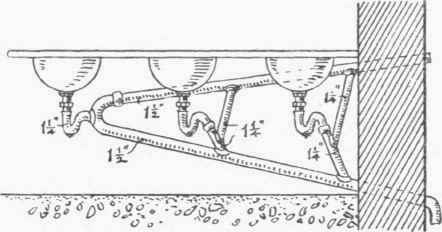
Fig. 197. Waste-pipes for Lavatory Range.
Ranges of lavatories supported on glazed-ware piers are often fitted with glazed-ware horizontal waste-pipes passing through holes in the piers; these look clean outside, but as the pipes are dead level they cannot be recommended.
All waste-pipes of the kind mentioned ought to be supported on separate brackets quite independent of the standards or brackets carrying the basins, or ought to be attached to these standards or brackets by adjustable bearers, so that sufficient slope can be given to them, and the branch-pipes from the basins ought to be of varying lengths to correspond. The main waste-pipes ought also to be ventilated, and ought not to be too large.
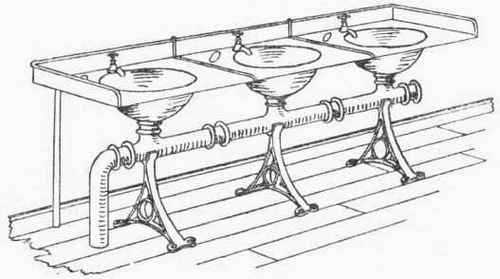
Fig. 198. Cast-iron Lavatory Range.
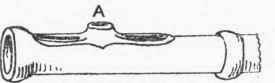
Fig. 199. Glazed-ware Horizontal Waste-pipe for Lavatory Range with Inspection Openings.
Instead of the closed horizontal waste-pipe an open channel is sometimes fixed under the basins, so that it can be easily inspected and cleaned. In this case the basins need not be trapped, a single trap at the end of the channel sufficing for the whole range. Glazed-ware horizontal wastes are also made with inspection slits as shown in fig.199; the branch waste from the basin is connected at A. Floor-channels. - Frequently a glazed-ware channel is laid in the floor, and a separate pipe is taken from each basin to the channel. The objection to this arrangement is the splashing of the water, although this can be to a great extent avoided by turning the end of each waste-pipe in the direction of the flow, and by making the channel of sufficient depth and with a slightly projecting rim. The advantages are the great simplification of the plumber's work, and the facilities afforded for cleansing the conduits and for removing and replacing the fittings. Floor-channels are generally used for ranges of wash-tubs, and frequently also for ranges of baths. Of course the floors ought to be of impervious materials, and laid to fall towards the channels. The floors and channels can then be easily washed with a hose-pipe.
Continue to:


My Books

