


Chapter XVI. Slop-Hoppers And Sinks
Description
This section is from the book "Sanitary Fittings And Plumbing", by G. Lister Sutcliffe. Also available from Amazon: Sanitary fittings and plumbing.
Chapter XVI. Slop-Hoppers And Sinks
Water-Closets As Slop-Hoppers
In small houses the water-closet generally serves also as slop-hopper, and is well adapted for the purpose of removing the slops, but affords no facilities for cleansing the bedroom utensils. There is also a danger of the enamel being damaged by the pails, and a further objection is the risk of splashing either on to the floor or the seat. As already pointed out, some siphonic closets are set in action by a pailful of slops, and are therefore unsatisfactory unless fitted with an automatic arrangement for starting the flushing cistern. Valve-closets are also unsuitable, for the purpose, as the slops may overflow if the handle of the closet is not pulled at the moment of emptying. When the water-closet is intended to serve as a slop-hopper it ought to have a wide rim sloping inwards, or to be fitted with a "slop-top," in order to reduce the risk of splashing. If the closet is enclosed with woodwork, a square slop-top of enamelled fireclay ought to be fixed to the basin under the hinged seat, as otherwise the floor is certain to become very foul.
Slop-Hoppers
A proper slop-hopper or sink is, however, a great convenience, and a suitable number must be provided in all large houses, and also in hotels, hospitals, and other buildings where a large quantity of slops may be produced. The term "slop-hopper" is often applied to fittings for the simple removal of slops, and the term "slop-sink" to those provided with hot and cold water in addition to the flushing apparatus.
The simple slop-hopper is in shape very similar to a wash-down pedestal closet; a movable grate of porcelain or brass (the latter being the better material) is often fitted in it to prevent brushes and cloths being carried into the waste-pipe and drain, and the apparatus is all the better if the sides and back are raised to prevent splashing.
The material may be enamelled cast-iron, or some kind of glazed pottery. A wood or metal rim is sometimes fixed along the front to prevent the enamel being chipped by pails. The hopper ought to be of sufficient size to receive without splashing a pailful of slops. A hopper only 9 in. in diameter is too small, and a circular hopper set in the bottom of a deep square sink is also objectionable, as the flats around the hopper are certain to be fouled and are not touched by the water used for flushing.
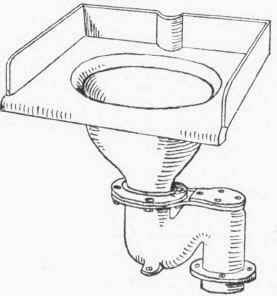
Fig. 131. Ordinary Type of Slop hopper.
The slop-hopper shown in fig. 131 is of cast-iron, and may be painted, vitreous-enamelled, or white porcelain-enamelled. Plain painting cannot be recommended. The hopper is of the ordinary short-hopper water-closet type, but with a square top and raised back and sides. A flushing-rim is provided with a nozzle for connection to the flush-pipe of a cistern or to a simple supply-pipe. The trap may be of S or P shape. Similar hoppers are made of enamelled fireclay. This form of hopper is, however, objectionable in several respects. The large exposed surface of the hopper renders cleansing somewhat difficult, and the outlet of the S trap is not above the floor. The pedestal slop-hopper
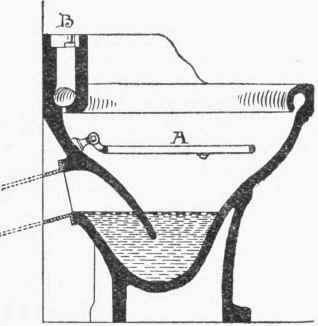
Fig. 132. Pedestal Slop-hopper.
(fig. 132) is of better design. The back part is raised to reduce the risk of splashing, the basin and trap are in one piece of enamelled fireclay, the outlet of the trap is above the floor and clear of the wall, and a hinged brass grate,
A, is fitted in the hopper to form a stand for jugs and other utensils which are being washed or filled from the draw-off taps projecting from the wall above.
In addition to these taps, a flushing cistern, having a capacity of two or three gallons, is connected to the nozzle at B, and operated in the same manner as a water-closet flushing cistern. Fig. 133 shows a "bracket" or " projector " slop-hopper on the same general lines, but fixed clear of the floor and with the back part of the top inclined upwards towards the wall instead of the raised back and sides. Adams's slop-sink (fig. 134) has a flat back, so that the pottery fits closely against the wall; the trap is of
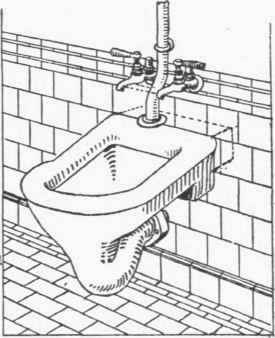
Fig. 133. Shanks's "Projector " Slop-hopper.
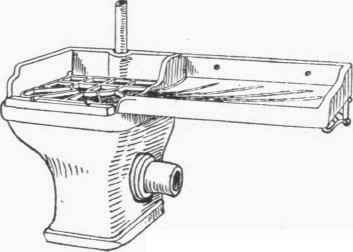
Fig. 134. Adams's Slop-hopper with Draining Slab.
P shape, with the outlet in the side of the pedestal. The hopper has a raised back and side, flushing rim, and hinged brass grating, and can be fitted with a bed-pan flushing nozzle for hospital use. At one side an enamelled draining slab is fixed to receive the washed utensils. In Twyfords' "Birmingham" slop-sink the hopper is square in plan, and a draining slab is provided on one side, the whole being in one piece.

Fig. 135. Shanks's "Victorian" Slop-hopper and Sink for Hospitals.
Slate or marble skirtings are sometimes used instead of pottery, and may be supported on iron brackets or on a framework of wood, but the latter is not a suitable material.
Hospital Slop-Hoppers And Sinks
In slop-sinks for hospitals provision must be made for washing bedpans. The "Victorian" slop-sink (fig. 135) is a good example. The hopper and trap are in one piece of glazed ware. A brass grating, A, covered with impervious vulcanite, is hinged at B in such a manner that it can be swung upwards and held by a catch when not required. The grating is fitted with a rose and jet, C, for washing bedpans, one of these being shown by dotted lines. Water is supplied to the rose and jet by means of two taps (for hot and cold water respectively), one of which is shown at D. Two other taps, E, supply water to the draw-off nozzle, F, which is swivel-jointed at G, so that it can be turned up out of the way. The sink is flushed from a cistern containing two or three gallons, the down-pipe being shown at H; the flush can be started in the usual way, or by pressing a button. The nozzle for receiving the flush-pipe is vertical, thus facilitating the formation of the joint, and doing away with the usual bend in the flush-pipe. The outlet of the sink is well above the floor and clear of the wall, and is flanged to receive the soil-pipe branch, which is of cast-iron, glass-enamelled inside, with a socket for the trap-ventilation pipe.

Fig. 136. Twyfords' "Middlesex" Slop-hopper and Washing-up Sink.
Flushing Apparatus
Many slop-hoppers are fixed without flushing rims and cisterns, but cannot be recommended. Urine is a very foul liquid, and slop-hoppers are even more difficult to keep clean than water-closets, and ought therefore to be flushed in a similar manner. The joints at the outlets of the hoppers ought also to be designed on similar lines.
Housemaid's Sinks
A scalding, or washing-up, sink is often fixed at the side of the slop-sink, and forms a most useful adjunct. The example given in fig. 136 is known as the "Middlesex," and consists of a large slop-sink with rectangular top, flushing-rim, and P-trap in one piece of enamelled fireclay, and a washing-up sink of similar material with standing waste, A, and overlap joint, B. The hopper and sink are now also made in one piece, thus doing away with the joint at B. A rose, C, can be fitted in the slop-sink for the purpose of washing bed-pans. The waste-outlet of the washing-up sink is connected to the trap of the slop-hopper as shown, although this is not an ideal arrangement; it is much more convenient to have the hopper fixed at a lower level than the sink, and when this is done the sink can be drained into the hopper at some height above the standing water in the latter. The hopper and sink shown in fig. 136 are supported on three enamelled cast-iron brackets, and a 3-gallon cistern is provided for flushing the hopper, in addition to the hot and cold supply taps. "Inserta" wood rims can be fixed along the fronts of the hopper and sink, after the manner illustrated in figs. 19 and 20, and have the advantage of protecting the enamel and of reducing the risk of breaking pottery utensils. In some hoppers a brass grate is provided to cover the front roll, and is hinged in such a manner that it can be raised so that the roll and grate can be cleaned; this forms an excellent protection, and is cleaner and more durable than wood.
Housemaid's sinks are sometimes made of wood and lined with lead, but these materials are far from satisfactory.
Continue to:


My Books

