


Urinals. Continued
Description
This section is from the book "Sanitary Fittings And Plumbing", by G. Lister Sutcliffe. Also available from Amazon: Sanitary fittings and plumbing.
Urinals. Continued
Fig. 141. Tylor's Trapped Urinal Basin.
Urinal basins are generally fixed with brass screws, but sometimes lugs are provided at the back for fitting into slots in the wall-slab. As pottery often warps in the kiln, the backs of good fittings are ground to a level surface after burning, so that they will fit closely against the wall. 2. Trough-urinals.- These consist, as a rule, of a glazed fireclay trough with a weir at one end so that a certain quantity of water is retained in the trough, and an inlet at the other end for the supply of fresh water from a flushing tank. They are therefore very similar to trough-closets, but smaller; the back may with advantage be higher than the front, in order to reduce the risk of fouling the wall, and the front edge ought to slope inwards, so that droppings will not run down the front and on to the floor. The dilution of the urine is a point in their favour, but they are seldom used now for high-class work, as the retention of the urine causes furring, and as users do not always discharge all the urine into the trough, but allow some to soil the front of the trough or the apron and floor below it. Floor-channels and draining slabs must be fixed under these as under urinal basins. Painted cast-iron troughs are sometimes used, but the paint is soon destroyed. Enamelled iron is better. Slate trough-urinals are also made, but the joints and angles are very objectionable.
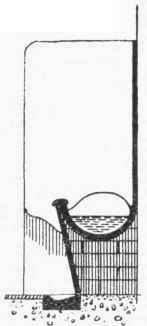
Fig. 142. Trough - urinal of Enamelled Fireclay with Slate Apron, Back, and Divisions, and Glazed Stoneware Channel.
Fig 142 is a section of a trough-urinal of ordinary form with enamelled fireclay trough and capping, slate apron, back, and divisions, and salt-glazed floor-channel. Adams's trough-urinal (fig. 143) is a great improvement. The stalls are 2 ft. 3 in. wide from centre to centre. The trough is of glazed ware, and has a projecting lip in the centre of each stall. The backs are also of glazed ware, semicircular on plan, with projecting divisions of the same material, and the whole range is finished with glazed-ware capping. Water is retained in the trough by means of a weir at one end, and at the other end the flush-pipe A is connected. When the flush-tank is discharged, the water passes down the pipe A, along the trough, over the weir, and down the waste-pipe B into the floor-channel C, and thence to the gully and trap D. The trough and channel are therefore flushed by the same discharge. The fluted floor-slab and channel are formed in one piece of glazed ware. The apron slabs at E are also of glazed ware. The range would be all the better if part of the flush were conveyed to a distributing nozzle in the back of each stall, so that the backs would be automatically cleansed as well as the trough and channel. In some trough-urinals the outlet of the floor-channel is at the same end as the outlet of the trough, and part of the flushing water is conveyed to the upper end of the channel by means of a small pipe connected to the main flush-pipe; this avoids the flooding of the channel with urine-polluted water from the trough.
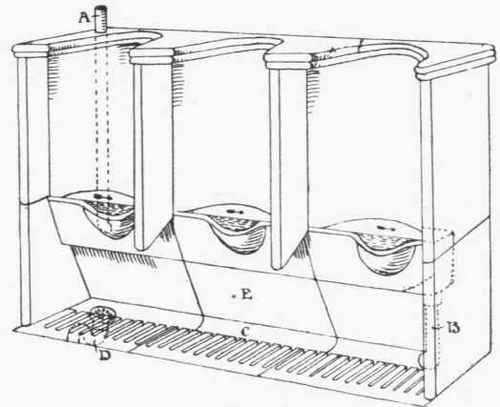
Fig. 143. Adams's Glazed-ware Urinal with Lipped Trough.
3. Stall-urinals. - Urinals of this class are most commonly fixed in ranges. Formerly any kind of stone was considered good enough for the purpose, and many urinals still in existence consist of plain slabs of York stone arranged as backs, ends, and divisions. Stone of this kind soon becomes foul, and is quite unsuitable. Even slate and marble, dense though they are, absorb some portion of the urine. The best material for urinal stalls is undoubtedly enamelled fireclay, but care must be exercised in selection, as these large pieces are often damaged during manufacture. Salt-glazed stoneware is used for cheaper work, and some makers are now able to produce ware of this kind with a very smooth surface. Cast-iron is often used for public urinals in the streets, but the ammonia given off by the urine soon destroys the paint, and causes corrosion of the metal.
Stalls composed of flat slabs of stone (including, of course, slate and marble) are difficult to keep clean, on account of the numerous angles and joints, and are not suitable for use in buildings. Slate urinals are, however, often used in the playgrounds of schools, in the open areas of railway stations, and in the yards of factories and other buildings, where a fairly satisfactory urinal is required at a moderate cost. Slabs should be provided for the back, ends, and divisions. Aprons were formerly fixed to prevent droppings falling on to the floor, but are now seldom used, as they cannot possibly be flushed by the sparge pipe, and as they interfere with the washing of the floor. The stalls vary in width from about 18 in. for children to 24 in. or 27 in. for adults, and in height from about 3 ft. 6 in. for children to 5 ft. or 5 ft. 6 in. for adults. The division slabs project as a rule about 18 in. from the wall, and the end slabs from 18 in. to 24 in. Unless the stalls are at least 24 in. wide (for adults), a projection of 12 in. or 15 in. is better, as it enables users to stand closer to the back, and reduces the floor area soiled by droppings. The slabs are generally about 1 1/2 in. thick, all edges being rounded and all joints made tight with red lead. Holdfasts ought to be of copper, as iron is very soon corroded. It is not a good plan to carry the divisions down to the floor, as the angles thus formed are difficult to keep clean. Greater cleanliness is obtained by fixing the divisions about 15 in. or 18 in. above the floor, as shown at D in fig. 146; they can be secured by building them about 4 1/2 in. into the wall, and grouting with neat cement. Another form of division is shown at C in the same figure.
The slate used for urinals ought to be rubbed and either oiled or enamelled. The enamel is not very durable. An objection to slate is that it affords a convenient surface for the obscene and inane scribbling of fools. The objection can be removed by covering the slate periodically with a mixture of coal-tar and naphtha, which has the further advantage of preventing absorption.
Thick sheets of opaque glass have occasionally been used instead of slate, but have not proved satisfactory. Slabs of glazed fireclay have been used with much better results. Many urinal stalls in hotels and clubs are constructed of polished marble slabs, but, whatever the material may be, the numerous joints and angles, which cannot be avoided in slab urinals, are a serious disadvantage. If, as is generally the case, sparge-pipes are only continued along the back, the divisions, which often receive a considerable amount of urine, are not adequately flushed.
The great improvements which have recently been made in the manufacture of enamelled fireclay have rendered it possible to produce massive urinal stalls of excellent design, which have been very largely used in high-class work. As a rule, the backs are semi-circular on plan, made to fit on the top of a dished base or channel, but in the most modern urinals the base and back are in one piece. Fig. 144 gives the plan and section of a range of urinals of the former type. The backs, A, and bases, B, are of white enamelled fireclay; the front pillars, C, covering the joints between the backs, are in this example of slate or marble, but a glazed fireclay pillar in one piece is better; the upper backs and divisions are also of slate or marble. The stalls are flushed by copper sparge-pipes, D, following the curve of the backs, and the urine and water pass into a sunk channel, E, covered with a loose galvanised-iron grating. The floor-slabs between the grating and urinal are of slate cut out in the centre of each stall, so that droppings will fall into the base of the urinal. The numerous joints are objectionable; the sunk channel is also apt to become foul.
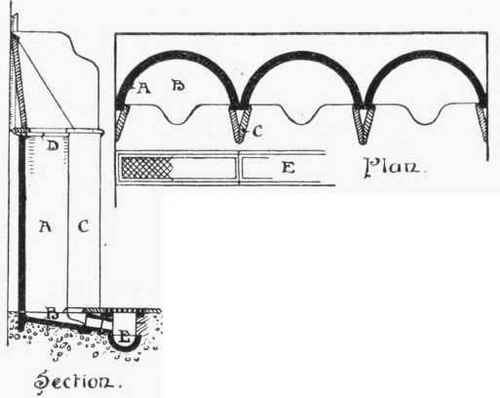
Fig. 144. Stall Urinals with Enamelled Fireclay-Backs and Bases, and Slate or Marble Front Pillars, Divisions, etc.
The urinals shown in fig. 145 are of more modern design, the back and base being in one piece of white enamelled fireclay, measuring about 25 in. by 14 in. by 3 ft. 8 in. Slate or marble divisions are used to give the projection and height necessary for privacy. Lips are formed at AA to retain the flush within the curved back. Instead of a sparge-pipe, a distributing nozzle (B) is used. A single outlet for the entire range is provided in the bottom of the channel.
An objection to this urinal is that the stalls are unduly contracted between the lips AA, and persons who have been enjoying themselves not wisely but too well, will almost inevitably soil the angles outside the lips. It is better to obtain the full projection by adopting a deeper fireclay back with fireclay front pillars. A front outlet is sometimes formed in the base of each stall, and connected by a short bend to a drain under the floor.
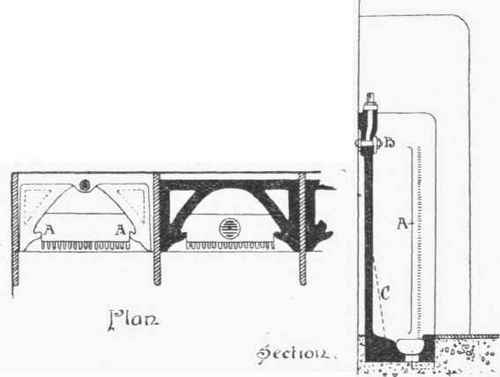
Fig. 145. Stall Urinals with Enamelled Fireclay Back and Base in one piece, and Slate or Marble Divisions.
The new "Adamant" urinal has the base, front pillars and capping in one piece of enamelled fireclay, and is a fine example of the potter's skill. It measures 2 ft. 6 in. by 1 ft. 9 in. by 5 ft. 6 in. The back is semi-circular in plan, and a channel is formed around the upper part to receive a copper sparge-pipe which is fixed by a single nut in the middle. A gun-metal grating is fitted in the base.
Continue to:


My Books

