


Chapter XXIV. Testing Plumber's Work
Description
This section is from the book "Sanitary Fittings And Plumbing", by G. Lister Sutcliffe. Also available from Amazon: Sanitary fittings and plumbing.
Chapter XXIV. Testing Plumber's Work
It is not our purpose to enter into the details of the methods to be adopted in preparing sanitary surveys of existing buildings, but merely to point out in what ways waste-pipes and soil-pipes can be tested before being approved by the architect or engineer. The application of tests to new work which has been executed on the lines already indicated, is not a difficult matter. If all waste-pipes are disconnected at the foot and fixed either outside the buildings or on back-boards inside, and if all the fittings connected with them are without enclosures, defects can be easily discovered. Similarly, exposed soil-pipes and ventilating pipes can be tested without much difficulty. It is only when pipes are concealed and unsystematically connected together that satisfactory testing requires much skill or care.
Four kinds of test are in common use:-1. The Smell Test; 2. The Smoke Test'; 3. The Pneumatic or Compressed Air Test; and 4. The Hydraulic or Water Test. The two last are positive tests, and are the most searching; the smoke test is not always so satisfactory but is often useful; the smell test is in many cases the most easily applied, and furnishes a rough-and-ready means of ascertaining whether there is any serious defect or not, but it does not fix the exact position of any leak which may be revealed by the escaping odour.
1. The Smell Test. - This test can be applied to soil-pipes and drain-ventilating pipes, and also to those waste-pipes which are continued upwards as ventilating pipes, but it cannot be so conveniently applied to un-ventilated waste-pipes. It is carried out by inserting in the pipe to be tested some substance which has a strong and distinctive odour. Oil of peppermint was at one time commonly used. In applying the test to a soil-pipe, from 2 to 4 ounces of the oil should be mixed with a pailful of very hot or boiling water, and the whole poured by an assistant into the open top of the pipe. In the case of a large stack, two or three pailfuls of hot water may with advantage follow the first. The top of the pipe should then be covered, in order to confine the smell as much as possible. The mixing ought to be done outside the house, preferably close to the top of the pipe, and all doors, windows, and air-grates near the pipe ought to be carefully closed, so that no smell can enter the house except through leaks in the plumbing. The various rooms containing fittings connected with the pipe ought then to be carefully examined by the principal, and any trace of the odour noted. During this inspection the assistant must remain outside the building, as otherwise the smell will be carried in by him in consequence of his previous contact with the peppermint. If the odour is observed in any room, search must be made for a leak, but if this cannot be discovered, and if it is reasonably certain that the odour has not entered through the window or air-grate, it will be necessary to apply a more positive test.
Small air-tight boxes filled with chemical preparations are now made for the purpose of testing pipes and drains, and are more convenient in use than peppermint. Kemp's patent drain-tester (fig. 211) is a good example. The cover is kept in position by means of the strip of paper passing over it; when this paper is sufficiently softened by the water in the drain or pipe, the spring tears it and forces the cover off, and the contents of the cylinder are then discharged. To use the tester, a string should be attached to the loop, and the tester placed in (say) the basin of a w.c. and at once flushed into the soil-pipe by means of a pailful of warm water. Inspection can then be made of the various fittings served by the soil-pipe, in order to ascertain if there is any trace of the pungent odour given off by the tester. The open top of the pipe ought to be closed during the test by means of a wet flannel or other stopper, and the air-inlet opening or openings supplying air to the foot of the pipe ought to be similarly closed, or, preferably, the pipe ought to be severed at the foot and there stopped, if the test has not been made before the pipe has been connected with the drain. Kingzett's and Banner's "drain-testers" are on somewhat similar lines.
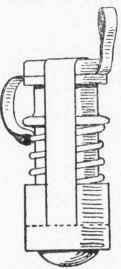
Fig. 211. Kemp's Drain Tester.
2. The Smoke Test. - This test is most thoroughly applied by means of a machine by which smoke can be driven into the pipe with considerable force. The smoke-nozzle passes through a stopper which can be fitted into the foot of the pipe, or into the drain at the nearest inspection-chamber. As soon as smoke issues from the top of the pipe this must be closed, so that a slight pressure of smoke-laden air can be maintained. If there are any serious leaks smoke will be seen issuing therefrom. This test is preferable to the smell test, as the exact place of leakage can in many cases be observed; it is also much more suitable for external pipes, as small escapes of "smell" pass unnoticed in lofty external stacks.
Smoke rockets may also be used for the purpose. Burnett's patent is convenient for soil-pipes, as by means of a removable wire handle it can be pushed (after lighting) through the standing water in the trap of a water-closet. In the case of closets on different floors, a rocket should be inserted in each, so that all branches will be thoroughly tested.
3. The Pneumatic Test. - In applying this test the openings in the pipes must be thoroughly plugged by means of stoppers, the most generally useful for the purpose being those of the bag kind, as these, when inflated, adapt themselves to the shape of the water-closet and other traps in which they are placed. The smallest size made is intended for a 4-in. pipe. Expanding drain-plugs can, however, be used in many cases. When the openings have been thus closed, including the traps of the fittings, the air within the pipes is compressed by means of a small air-pump such as those used for inflating bicycle tyres. Jensen's apparatus for the purpose is shown in fig. 212; A is the pump, which is screwed to the gauge-pipe at B; C is the pressure-gauge, and D the safety-valve, which can be regulated to blow off at any pressure up to 5 lbs.; the end E is threaded for attachment to a pipe passing through the bag-stopper or plug. When the desired pressure has been obtained in the pipes by means of the pump, the cock at B is turned off, and if the hand on the pressure gauge remains constant, it is clear that there are no leaks in the pipes.
Continue to:


My Books

