


Sinks. Part 3
Description
This section is from the book "Sanitary Fittings And Plumbing", by G. Lister Sutcliffe. Also available from Amazon: Sanitary fittings and plumbing.
Sinks. Part 3
A more ordinary form of combined sink is illustrated in fig. 21. This consists of an enamelled fireclay sink (about 22 in. by 18 in. by 13 1/2 in.) with rubbed slate or marble front and skirtings, slate or marble drainer dished to the sink, and teak grating. The sink is fitted with 1 1/2-in. vulcanite plug with brass washer and chain. The number of joints and the square angles formed by the slabs of slate or marble are objectionable features of this kind of sink.

Fig. 22. The "Kallio" Sink.
The "Kallio" sink (fig. 22) represents a new departure. It consists of a sink and draining slab with overflow channel between. The surplus water in the sink passes over the weir A into the channel B, in which the waste-outlet is placed. A small weeping hole C allows the water to drain away from the basin of the sink. The overflow channel is open, and can therefore be easily cleaned.
Combined lavatories and sinks are now made in one piece of enamelled fireclay, and are often a convenience in butlers' pantries and other places.
A common complaint with regard to pottery sinks is that they are so hard and slippery that it is practically impossible to avoid breaking or chipping delicate crockery and glass which are being washed in them. The pottery draining slabs of combined sinks, even when fluted, are a frequent cause of such damage. For this reason the draining slab is now generally covered with a wood grid or fluted drainer, and to prevent damage being done to crockery in the sink itself, the bottom of the sink is fitted with a loose wood grid (fig. 23). These grids are not expensive, and reduce the risk of breakages very considerably; of course they become foul sooner or later, and must then be replaced with new ones. The sink with hinged draining-board (fig. 24) is one of Shanks's new designs; the sink has a standing waste and overflow, and is supported on galvanised iron legs, and the draining-board is made of separate pieces of wood bolted together.

Fig. 23. Wood Grid for Bottom of Sink.
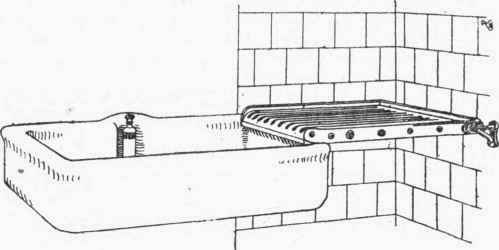
FIG. 24. Shanks's Sink with Hinged Draining Board.
Undoubtedly the hard and slippery surface of pottery sinks has had much to do with the retention of the wooden sink, either naked or lined with lead or copper. An unlined wooden sink (fig. 25) is specially adapted for washing very fragile articles, such as delicate porcelain ornaments and glassware, which are not seriously fouled, but it cannot be recommended for general work. The best woods for the purpose are birch, sycamore, and teak, but soft woods are sometimes used. The wood should be about 2 in. thick, and framed together with tongue and groove joints made water-tight with red and white lead. The whole should be secured with galvanised iron bolts with nuts and washers. A rounded capping may be fixed on the edges of the sink, and a skirting along the back and ends, as shown in part of the illustration. Triangular fillets are sometimes fixed in the angles with brass screws, in order to do away with the sharp corners. They should be thoroughly bedded in red and white lead. The sink may be about 2 ft. 6 in. by 1 ft. 6 in., and from 8 in. to 12 in. or 13 in. deep inside.

Fig. 25. Unlined Wood Sink.
Of the two materials generally used for lining wooden sinks, lead is usually preferred on account of its greater softness. The objections to the material are that the bottom piece is apt to form into ridges in consequence of the expansion due to hot water, or to crack in consequence of the subsequent contraction. These defects can be in a great measure obviated by making the bottom piece very stout; the sides may be of 6 or 8 lb. sheet lead, but the bottom ought to be of 10 or 12 lb. lead. A further precaution is to make the sides slope outwards and to fix a feather-edged fillet in the angle, as this gives the lead more freedom for expansion. Sometimes the bottom, sides, and ends are in one piece, so that only the vertical angles need to be soldered, but this method cannot be recommended. More frequently the bottom and two sides are in one piece, and a separate piece is used for each end. When the bottom is of stouter material than the other parts of the lining, the front and one end will be in one piece, and the back and the other end in another piece. The front edge of the sink should be protected by a hard wood weathered capping to prevent the lead being damaged by pails, and the wood bottom should be dished out around the waste hole, as shown in fig. 26. The vertical angles must be well rounded off with solder, and an overflow grate and pipe must be provided.
Copper is not so much used as lead for lining sinks, although it is more durable. The bottom may weigh 4 lbs. per sq. ft., and the sides about 2 1/2 lbs. The lining is made independently with welted seams, and is then tinned to protect the surface of the copper and at the same time make the seams watertight. It is afterwards fitted into the wooden case. Copper sinks are sometimes hammered out of one piece, but those are of round or oval form, like the bowl of a lavatory; they ought always to be tinned.
Cast-iron sinks, with overflows similar to that shown in fig. 15, are now made in sizes from about 15 in. to 36 in. long, about 14 in. wide, and 7 1/2 in. or 8 in. deep; they are sometimes known as jaw-boxes. Semi-circular and quadrant sinks can also be obtained. The iron is finished by painting, galvanising, or enamelling with glass, porcelain or vitreous enamel. Some idea of the relative cost of these methods of finishing will be gathered from the following list prices of a sink 36 in. by 14 3/4 in. by 7 3/4 in.-painted, 10s.; galvanised 19s.; glass enamelled, 18s.; vitreous enamelled, 25s.; white porcelain enamelled, 32s. 6d.
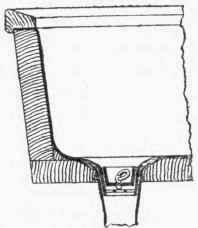
Fig. 26. Wood Sink lined with Lead.
3. Nursemaid's Sinks. - These are best made of white porcelain-enamelled fireclay, fitted with waste and overflow, and need not differ in design from some of the butlers' sinks already illustrated.
4. Vegetable Sinks. - These sinks are often made of wrought-iron riveted and galvanised, or of cast-iron finished in one of the ways already mentioned. They should be about 15 in. or 18 in. deep, so that the dirt can sink below the floating vegetables. The waste may with advantage be placed in a small compartment separated from the body of the sink by a perforated metal strainer, so that grit and garbage will not be carried into the trap. Where soft moorland water is used, the coating of zinc on galvanised iron is soon destroyed, and some other material should be used, such as slate or enamelled fireclay. The deep fireclay "wash-tubs" are very suitable for the purpose. Two compartments are of service, the one for the preliminary washing and the other for rinsing.
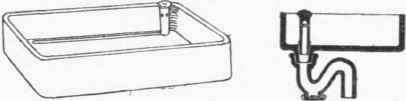
Fig. 27. Laboratory Sink.
5. Sinks for Washing Pans, etc. - Sinks for this purpose are best made of galvanised wrought-iron, or of cast-iron finished black or galvanised. The depth will vary according to the maximum size of the pans in use, and as sand is generally used for scouring the pans, the waste-outlet ought either to be in the side of the sink a little above the bottom, or in a small compartment separated from the body of the sink by a finely perforated metal strainer.
When a special sink is not provided, an iron tray placed in the bottom of a butler's sink may be used to retain the sand and to prevent injury to the enamel.
6. Special Sinks. - As an example 01 a special sink, the laboratory sink illustrated in fig. 27 may be given. It has a porcelain standing waste and overflow, so that no metal whatever is exposed to the action of the acids which may be used in the sink. Porcelain traps and waste-pipes are made for use with these and other sinks. Other special sinks are made for the operating rooms of hospitals and for other purposes, but these need not be specially described. Slate sinks are sometimes used for pickling meat, but enamelled fireclay is a better material.
Sink Supports
Sinks ought not, as a rule, to be enclosed, but the space beneath left open for inspection. Glazed-brick piers or enamelled fireclay pedestals are often used as supports for fireclay sinks, but these form a number of angles with the floor which are difficult to keep clean. It is better to support the sinks on iron or glazed-ware legs or on iron brackets fixed to the wall, so that the floor is not obstructed. Legs and brackets of the kind mentioned are now supplied by all the leading makers of sanitary fittings. If one end of the sink abuts against a wall, this end can conveniently be carried by a brick corbel-course, and only one leg or bracket will therefore be required. Wood sinks can, of course, be supported on iron or wood brackets or legs.
Wash-Tubs
Wash-tubs are now made in enamelled fireclay, ranging in size from about 24 in. by 20 in. by 15 in. upwards, and are more durable than wooden wash-tubs, and less likely to tear or stain the clothes. The fronts generally slope outwards, and should have a roll edge. The backs are often raised. Overflows are not as a rule provided, and the wastes are fitted with plugs (preferably of vulcanite) and discharge into floor-channels. Steeping troughs for laundries can also be obtained in enamelled fireclay up to 7 ft. by 3 ft. 6 in. by 3 ft.
Continue to:


My Books

